Metals producer Mitsubishi Materials purchased a stake in a startup working to build a smelter in Indiana. Meanwhile, the company unveiled plans to substantially increase its e-scrap recycling capacity in Japan.
Tokyo-based Mitsubishi Materials Corporation (MMC) became a “major investor” in Exurban, which is developing its first smelter in Indiana. The dollar amount of the deal was not disclosed.
Two leaders at MMC recently spoke with E-Scrap News about the company’s plans to scale up its e-scrap smelting capacity in the future.
They also discussed concerns about global trade restrictions and a more competitive North American market for printed circuit board (PCB) buyers.
Investment in Exurban
MMC’s investment in Exurban, announced March 29, will give it a presence on the Exurban board, a press release notes.
“We would like to contribute to Exurban with our technical expertise in technology for non-ferrous metals and e-scrap,” Katsuyoshi Isaji, managing executive officer and president of MMC’s Metals Company, stated in the release.
Backed by professionals who have experience with several global smelting giants, Exurban is working to build its first facility in northeast Indiana. The plant, which is anticipated to cost hundreds of millions of dollars, will be capable of taking in e-scrap and other forms of metals-bearing scrap to produce pure metals for sale. (The company recently experienced a setback when it nixed its plans to buy land for the smelter in Fort Wayne, Ind.)
As part of the “strategic alliance,” MMC “will be an important partner to the Exurban Group as it moves towards the financing, construction and operation of its first proposed facility in the United States,” the press release notes.
In the release, Stefan Boel, chairman of Exurban, said the deal represents a vote of confidence in Exurban. “Mitsubishi Materials Corporation is a world leader in recycling,” he stated.
The deal is the latest example of an Asian mining, smelting and refining giant investing in U.S. e-scrap companies.
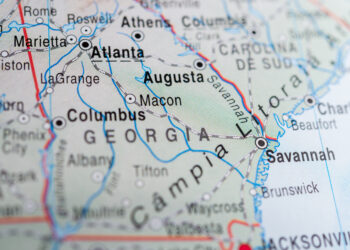
Last year, Seoul-based metals conglomerate Korea Zinc purchased Igneo Technologies in a deal worth a total of $442 million. Igneo is building an $85 million metals recovery facility in Georgia. Igneo also owns evTerra Recycling, which has been opening e-scrap recycling facilities across the U.S.
Also last year, Japanese company JX Nippon Mining and Metals purchased one of Canada’s largest e-scrap companies, eCycle Solutions.
MMC sets sights on significant growth
In bigger-picture news from MMC, the company on Feb. 10 published a management strategy that calls for a reorganization of the company and a 50% increase in its e-scrap recycling capabilities by 2031.
The organizational changes, which took place April 1 and are aimed at strengthening the company’s resource recycling business, involved integrating the metallurgy recycling unit and its scrap appliance, automobile and electronics dismantling unit into a unified Metals Company.
Tatsuya Inoue, general manager of a newly formed Resource Circulation Division in MMC’s Metals Company, told E-Scrap News that having the e-waste processing and metals smelting and refining operations under different units sometimes resulted in inconsistencies.
“To avoid those inconsistencies, these business units shall be merged into the metals business company,” he said. “And with this, we firmly believe that we can expand our resource recycling business.”
According to the plan, called the “Medium-Term Management Strategy 2031,” the company wants to expand the scope, regions and scale of its recycling operations. MMC currently operates two Japanese smelters that recover metals from PCBs, including those imported from North America: the Naoshima Smelter and Refinery and the Onahama Smelter and Refinery.
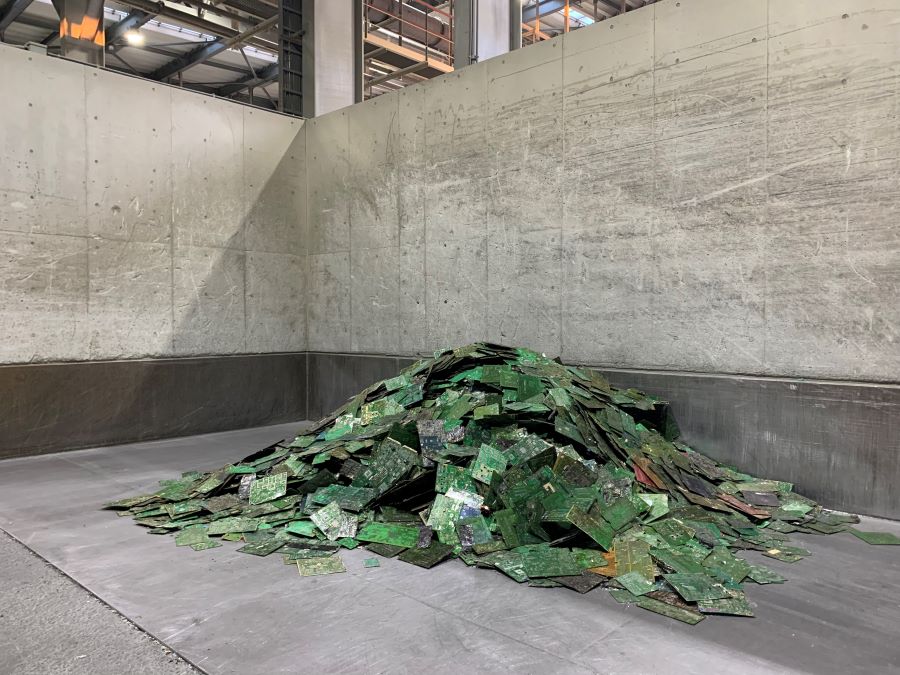
The smelters’ combined receiving capacity for e-scrap is currently about 160,000 metric tons per year, said Mamoru Takatsugu, assistant general manager of the Recycling Business Department in the Metallurgy Division of MMC’s Metals Company. In reality, the company has processed roughly 120,000 or 130,000 metric tons per year in recent years, he said.
MMC plans to boost the smelters’ capacity to 240,000 metric tons by the 2031 fiscal year. That’s a 50% increase in capacity and roughly a doubling of what MMC actually recycles each year.
The latest MMC plan calls for more aggressive growth than earlier goals. During a presentation at the 2021 E-Scrap and E-Reuse Conference in Chicago, Tetsuro Sakai, president of the Metals Company, noted that the company at the time planned to boost its recycling capacity from 160,000 metric tons to 200,000 metric tons by 2030, or a 25% increase.
To start, the company is undergoing a relatively minor expansion of e-scrap recycling capacity at the Onahama smelter. Takatsugu said MMC is making improvements to the e-scrap receiving areas, which are currently undersized and present a bottle neck. The project is expected to be completed by October 2023, he said.
Other expansions have already occurred in the pipeline supplying the smelters. As part of a joint venture with Hanwa, MMC also operates an e-scrap recycling plant in the Netherlands called MM Metal Recycling, which sends PCBs to Japan for metals recovery. That operation underwent its own expansion last year, adding warehouses and boosting its capacity to about 48,000 metric tons per year.
Global trading complications remain
Inoue pointed to society’s growing need for critical metals as a reason for expanding MMC’s secondary materials recycling capacity. The ultimate goal is to have “more metals from secondary material and less from natural resources,” he said.
“We are now aiming to expand to receive more e-scrap and copper scraps at Naoshima to have [a greater] ratio from secondary materials,” he said.
In the interview with E-Scrap News, he and Takatsugu said changes in global trade regulations are presenting uncertainty in terms of sourcing PCBs from overseas.
Takatsugu pointed to an amendment to the Basel Convention on the Control of Transboundary Movements of Hazardous Wastes and their Disposal. The amendment, first proposed by Switzerland and Ghana in 2020 and approved by parties to the convention in 2022, adds requirements and procedures for shipments of PCBs to Japan.
Because of the changes, MMC must keep studying its smelter projects and the company must remain flexible, Inoue said. The PCB trade is becoming more of a regional market – within North America, the Euro zone, etc. – and less of a truly global trade. That reality was acknowledged in the company’s Medium-Term Management Plan 2031.
“We must keep watching carefully what’s going on in this circular economy industry, where the material shall be consumed regionally,” Inoue said. “It’s getting more difficult to trade globally.”
He pointed to particularly difficult market conditions in North America, citing greater competition among PCB buyers looking to purchase PCBs there. That competition is coming from many smelters, as well as from Chinese buyers who are shipping PCBs to Southeast Asia for recycling, he said.
He also cited domestic competition from plants that are under construction in the U.S.
Igneo and Aurubis are both building metals recovery plants in Georgia that will consume scrap circuit boards.
That being said, Inoue noted that MMC sees potential for growth in e-scrap supplies in Japan, south and southeast Asia and in Australia.
As MMC looks to expand its capacity in future years, the company must remain flexible in its sourcing, he emphasized.
“The point is we must be flexible and deal with those market situations more quickly,” he said.