






Is it in the stream? Can we get it out? Will anyone buy it?
Joaquin Mariel, president of Circular Services, uses those three questions to explain why recycling infrastructure is so difficult to scale and so easy to break.
All three conditions have to align before investment in infrastructure or end market development can be justified. The moment one shifts, the economics of the entire system can move with it, he said.
Mariel knows that dynamic firsthand.
Austin-based Circular Services, backed by Closed Loop Partners, is the largest privately held recycling company in the United States, operating more than 35 recycling and organics processing facilities across the country.
Mariel came up through Balcones Resources, the Texas-based MRF operator that merged under the Circular Services umbrella, giving him deep roots in the state’s recycling infrastructure long before the company’s recent $61 million MRF opening in Frisco.
He brought that perspective to the 2026 Texas Recycling Summit in Denton, where he walked attendees through the forces straining PET end markets, the leverage municipalities hold in recycling contracts and why contamination messaging is due for a revision.
Losing stability
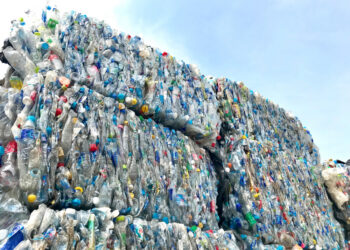
Mariel used PET as a case study in how fast things can unravel. PET bottles have long been the answer to all three questions, he noted, because the material is in the stream in volume. MRFs have invested heavily in the equipment to recover it, and end markets exist to absorb it.
Mariel put the cost of building a modern MRF at roughly $60 million including land, building and equipment. Of that, approximately $20 million goes toward equipment alone, and two-thirds of that equipment cost is dedicated to recovering plastic, which represents less than 10% of the total stream. Half of that plastic is PET.
“You can say a huge, outsized contribution to the capital needed to build the infrastructure is on PET,” Mariel said. “We’ve thrown everything at it.”
That stability, he said, is now cracking. Domestic manufacturers have shifted toward cheaper virgin material including imports, displacing demand for recycled PET content and erasing roughly 30% of end market capacity in a short period.
“We’ve got something that was selling at price A and it’s selling at a tenth of that price today,” Mariel said, adding that the infrastructure built around it hasn’t changed, but the market underneath it has.
And the effects extend beyond MRF operators. Cities across the US that have structured recycling program budgets around PET’s commodity value are now facing a significant financial gap.
A material that once anchored the value of the recyclables basket is generating a fraction of what it did even months ago, he said. At some point, Mariel warned, the numbers force difficult conversations at the municipal level about whether the economics of the program still hold.
“That end market cog has been disrupted,” Mariel said, “and that has nothing to do with the other two.”
Municipal leverage
Mariel pushed back on the notion that municipalities are passive players in the recycling supply chain.
MRFs need feedstock, he argued, and cities that understand that dynamic can use contract language and program design to demand accountability, transparency and volume.
“You’ve got a lot of power, and you’ve got more power today than your community had 10 years ago,” he said. “Put that in your RFP. Say that you require a chain of custody of the material. Communities have a lot of power and influence.”
How cities structure contracts matters as much as what those contracts require, Mariel added. A revenue-share arrangement gives municipalities direct financial stake in program performance but exposes them to market swings.
A fixed-cost model shifts that risk to the operator. Neither is inherently better, he said, but cities need to understand which one they’re signing before commodity prices move.
Under pressure
While Mariel acknowledged that external forces such as trade disruptions, supply chain shifts and market collapses are largely outside the industry’s control, extended producer responsibility (EPR) legislation is one mechanism the sector has turned to help buffer some of that volatility.
However, policies designed to stabilize recycling markets are contending with a nation that resists uniform solutions, he said.
“You could fit seven countries within this country,” Mariel said. “To think that we’re going to create a uniform set of policies across the entire nation that require a lot of infrastructure and a lot more end markets than exist today, it’s not that it won’t ever happen. It’s a big challenge.”
For now, he said, the industry manages that variability the way it always has — through long-term contracts, reliable material streams and relationships built on consistency rather than spot market pricing.
Shifting the conversation
Rather than hammering residents with “no” messaging around contaminants, Mariel stated the sector should concentrate on increasing the volume of high-value recyclables entering the stream, a shift that would simultaneously improve contamination rates through dilution.
“We don’t focus enough on putting the right things in the bin,” he said. “If your stream is 30% contamination, and you introduce 10% more good stuff, your contamination rate also goes down because by adding more good stuff, that rate goes down regardless.”
The shift in messaging, Mariel said, isn’t just about public perception. It’s about keeping the economics of the system intact.
Every aluminum can, cardboard box and milk carton that stays out of the landfill adds volume to a supply chain that depends on consistent, high-quality feedstock. Telling residents what not to recycle, he argued, chips away at participation without addressing the more urgent need: more of the right material moving through the system.
That dynamic becomes even more critical as end markets for materials like PET come under pressure. When commodity values drop, the remaining high-value materials such as aluminum, fiber and clean plastics carry more weight in offsetting program costs, he said.
He added that communities that have built strong participation rates are better positioned to absorb that kind of market shock than those still fighting contamination battles.
“It is absurd to throw away things that we know to be easily recyclable, that fit that supply chain and market dynamic perfectly,” Mariel said. “We damage the system by not supporting it. That seems really simple, but it legitimately is probably one of the most important parts of the puzzle.”