


Resource Recycling
  • The Latest
  • Analysis
    • All
    • Certification Scorecard
    • Industry Announcements
    • Opinion
    NJ’s PCR delay risks making its own excuse permanently true

    NJ’s PCR delay risks making its own excuse permanently true

    E-scrap magnet recycling company scales up

    Why only some rare-earth sources are economically viable

    e-Stewards to develop an ITAD-specific standard

    Certification scorecard — week of Sept. 21

    Who should pay for lithium-ion battery fire damage?

    America’s critical-materials buildout has a feedstock problem

    Certification scorecard – week of Sept. 14

  • Conferences
    • Resource Recycling Conference
    • Plastics Recycling Conference
    • E-Scrap: The Longevity Conference
    • Textiles Recovery Summit
  • Publications
    • E-Scrap News
    • Plastics Recycling Update
    • Policy Now
    • Resource Recycling
    • Other Topics
      • All Topics
      • Brand Owners
      • Critical Minerals
      • Glass
      • Grant Watch / RFPs
      • Markets
      • Organics
      • Packaging
      • Research
      • Technology
      • Textiles
Subscribe
No Result
View All Result
Resource Recycling
  • The Latest
  • Analysis
    • All
    • Certification Scorecard
    • Industry Announcements
    • Opinion
    NJ’s PCR delay risks making its own excuse permanently true

    NJ’s PCR delay risks making its own excuse permanently true

    E-scrap magnet recycling company scales up

    Why only some rare-earth sources are economically viable

    e-Stewards to develop an ITAD-specific standard

    Certification scorecard — week of Sept. 21

    Who should pay for lithium-ion battery fire damage?

    America’s critical-materials buildout has a feedstock problem

    Certification scorecard – week of Sept. 14

  • Conferences
    • Resource Recycling Conference
    • Plastics Recycling Conference
    • E-Scrap: The Longevity Conference
    • Textiles Recovery Summit
  • Publications
    • E-Scrap News
    • Plastics Recycling Update
    • Policy Now
    • Resource Recycling
    • Other Topics
      • All Topics
      • Brand Owners
      • Critical Minerals
      • Glass
      • Grant Watch / RFPs
      • Markets
      • Organics
      • Packaging
      • Research
      • Technology
      • Textiles
Subscribe
No Result
View All Result
Resource Recycling
No Result
View All Result
Home E-Scrap

Washington state report reflects evolving stream

byJared Paben
April 19, 2018
in E-Scrap
Washington state report reflects evolving stream

Note: Chart excludes several relatively low-weight categories, including reused devices, residue sent to landfill, intact units not yet processed, unleaded glass (not separately recorded after 2013), batteries and mercury lamps.

A recently released state program report provides insights into the changing composition of end-of-life electronics. It also shows which processors gained and lost weight allocations last year.

The Washington Department of Ecology recently released the 2017 report for the E-Cycle Washington program, the state’s extended producer responsibility (EPR) program for electronics. The report was compiled by the Washington Materials Management and Financing Authority (WMMFA), an OEM-funded EPR group.

The total weight collected through the program continues to drop, from 45.2 million pounds five years ago to 30.9 million pounds last year. The 2017 number was the lowest in the history of the nine-year-old program, which accepts TVs, computers and monitors.

Last year, manufacturers spent an average of 29 cents a pound on the program, including collection, transportation, processing, program administration and other expenses. That was up slightly from 28 cents in 2016.

The following are a couple of takeaways from the document compared with reports from earlier years:

Stream composition

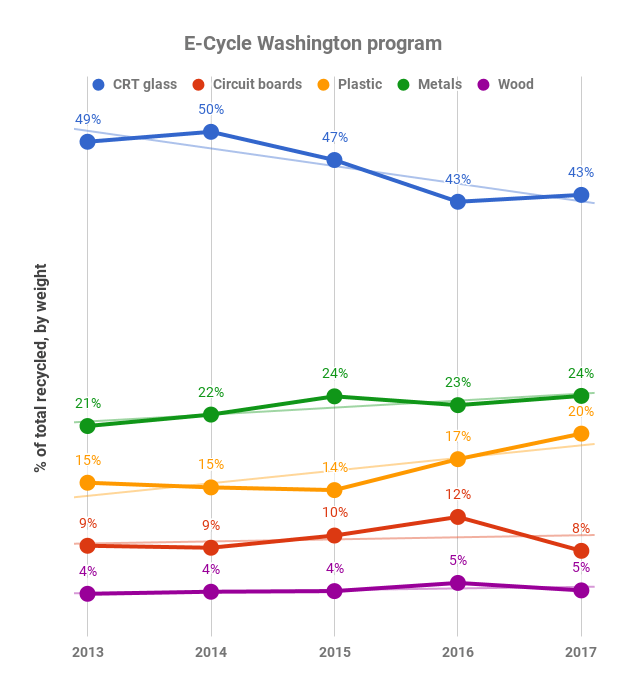
An E-Scrap News analysis of program annual reports over the past five years shows how the makeup of the end-of-life stream is changing.

For example, five years ago, CRT glass made up 49 percent of all weight destined for recycling. Last year, it was 43 percent. Five years ago, plastics were 15 percent of the weight, and last year they were 20 percent.

The chart below shows composition of materials that were recycled through the program:

Note: Chart excludes several relatively low-weight categories, including reused devices, residue sent to landfill, intact units not yet processed, unleaded glass (not separately recorded after 2013), batteries and mercury lamps.

The trends mirror those identified in a study conducted by the Rochester Institute of Technology, Consumer Technology Association (CTA) and Staples Sustainable Innovation Lab.

Shifting allocations

Some processors have been allocated more pounds by WMMFA and some less. In 2016, more than one-third of the programs weight was sent to Seattle-based processor Total Reclaim. In that year, the weight allocations were as follows (excluding ERI, which was allocated comparatively little weight):

  • Ace Metal: 6 million pounds (16 percent)
  • E-Waste LLC: 3.2 million pounds (9 percent)
  • ECS Refining: 5.7 million pounds (16 percent)
  • EWC Group: 4.6 million pounds (12 percent)
  • Total Reclaim: 13 million pounds (35 percent)
  • IMS Electronics Recycling: 3.7 million pounds (10 percent)
  • Simon Metals (Vancouver and Tacoma locations combined): 436,501 pounds (1 percent)

In late 2016, IMS closed its Vancouver, Wash. facility, which was purchased and re-opened by Simon Metals. Also, in September 2016 and October 2017, state regulators issued fines against Total Reclaim over exports and storage of e-scrap (the company is appealing). WMMFA reduced its pound allocation to Total Reclaim significantly last year. The 2017 allocation were as follows:

  • Ace Metal: 5.4 million pounds (17 percent)
  • E-Waste LLC: 3.3 million pounds (11 percent)
  • ECS Refining: 2.0 million pounds (7 percent)
  • EWC Group: 3.4 million pounds (11 percent)
  • Total Reclaim: 6.9 million pounds (22 percent)
  • Simon Metals (Vancouver and Tacoma locations combined): 9.9 million pounds (32 percent)

Earlier this year, WMMFA decided to discontinue allocating pounds to Total Reclaim, according to the state Department of Ecology.

Photo credit: imging/Shutterstock
Tags: Critical MineralsCRTsE-PlasticsEPRPolicy NowProcessors

TweetShare
Jared Paben

Jared Paben

Related Posts

Cyclic launches commercial test of rare earth recycling tech

ERI investment to help fund Cyclic Materials expansion

byPaul Lane
September 29, 2026

The move gives ERI a financial stake in Cyclic and expands a feedstock arrangement in place between the companies.

USFFI signs first film offtake deals

USFFI signs first film offtake deals

byAntoinette Smith
September 29, 2026

The brand-led group has moved more than 3 million pounds of flexible packaging from two California MRFs to reclaimers and...

Auto Draft

Xscindo set to expand its data destruction tech

byPaul Lane
September 29, 2026

The company specializes in devices containing highly sensitive information, offering destruction combined with mineral recovery.

Diversion Dynamics: Policy needed to reach full charge for vape recycling

Disposable vapes banned in California

byStefanie Valentic
September 28, 2026

California will pull disposable nicotine vapes from store shelves by 2028 under a law signed by Gov. Gavin Newsom, while...

Oregon state capitol building with state flag and blue sky.

NAW appeals Oregon EPR ruling

byStefanie Valentic
September 25, 2026

NAW is challenging an Oregon judge's ruling in favor of the state's extended producer responsibility law.

Bipartisan reps introduce bill on recycling claims

House passes bill to ease lithium-ion battery storage rules

byStefanie Valentic
September 24, 2026

The BRACE Act would let lithium-ion battery recyclers store batteries on site under universal waste rules and give EPA 18...

Load More
Next Post

China will expand ban to post-industrial plastic

2026 Buyers’ Guide

Equipment, services and technology suppliers serving the recycling industry.

Browse the Guide

More Posts

Recyclers reeling from NJ PCR extension

Recyclers reeling from NJ PCR extension

September 23, 2026
Oregon state capitol building with state flag and blue sky.

NAW appeals Oregon EPR ruling

September 25, 2026
Newsom nixes recycled content claims bill

Newsom nixes recycled content claims bill

September 28, 2026
Bin to Better gets students involved in reuse, recycling

Bin to Better gets students involved in reuse, recycling

September 24, 2026
Analysis: Undersupply of PCR is ‘stifling’ brand goals

US lawmakers urge protection of domestic RPET

September 25, 2026
Bipartisan reps introduce bill on recycling claims

House passes bill to ease lithium-ion battery storage rules

September 24, 2026
trash bags

Sorted: Should we use recycled trash bags?

September 28, 2026
Calif. Governor Gavin Newsom at podium.

Newsom signs battery EPR expansion, vetoes SB 54 fund bill

September 24, 2026

Who should pay for lithium-ion battery fire damage?

September 21, 2026
Industry announcements for January 2026

Industry announcements for September 2026

August 31, 2026
Load More

About & Publications

About Us

Staff

Archive

Magazines

Work With Us

Advertise
Jobs
Contact
Terms and Privacy

Newsletters

Get the latest recycling news and analysis delivered to your inbox every week. Stay ahead on industry trends, policy updates, and insights from programs, processors, and innovators.

Subscribe

Welcome Back!

Login to your account below

Forgotten Password?

Retrieve your password

Please enter your username or email address to reset your password.

Log In

Add New Playlist

No Result
View All Result
  • The Latest
  • Analysis
  • Recycling
  • E-Scrap
  • Plastics
  • Policy Now
  • Conferences
    • E-Scrap Conference
    • Plastics Recycling Conference
    • Resource Recycling Conference
    • Textiles Recovery Summit
  • Magazines
  • About Us
  • Advertise
  • Archive
  • Jobs
  • Staff
Subscribe
This website uses cookies. By continuing to use this website you are giving consent to cookies being used. Visit our Privacy and Cookie Policy.