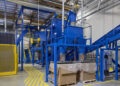





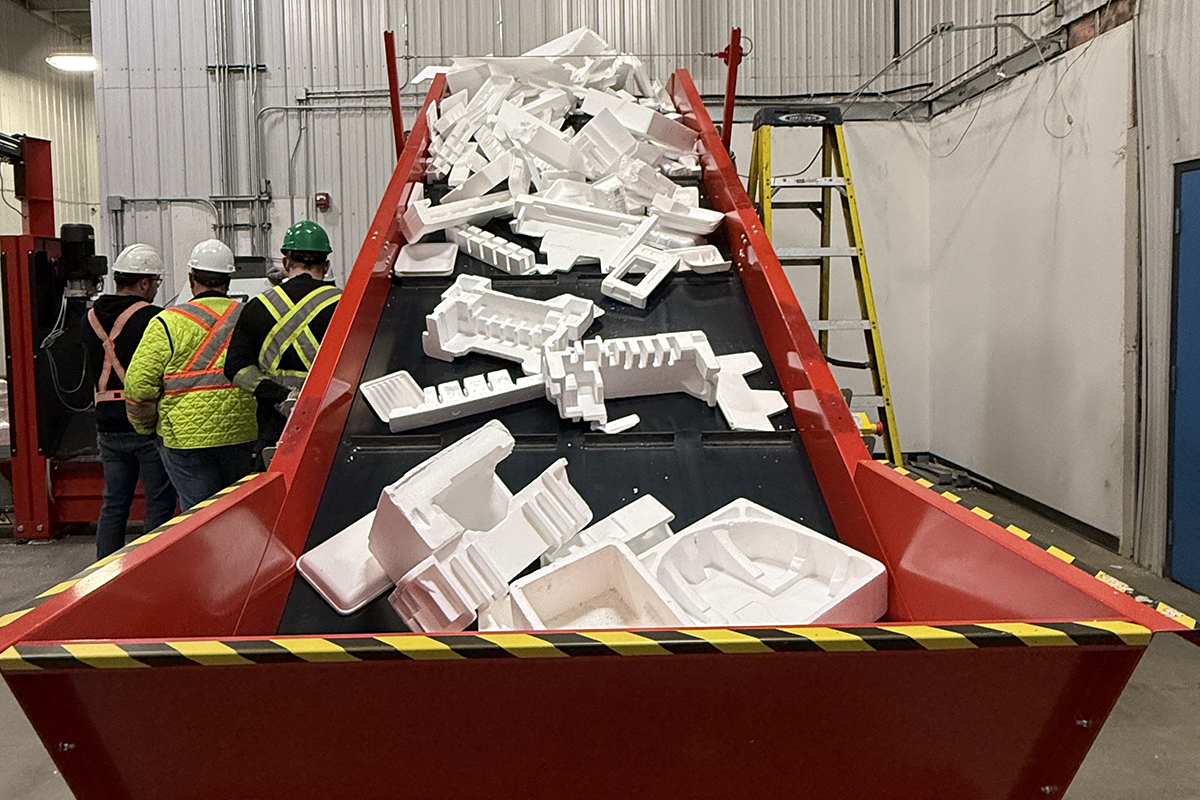
To help increase collection and encourage end markets, producer responsibility organization (PRO) SK Recycles and SARCAN Recycling made a $300,000 joint investment in the province’s first household foam densification technology, housed at the company’s processing facility in Saskatoon.
Sean Collins, director of system operations at SARCAN, said the densifier is “a great example of how investments in recycling infrastructure can support better outcomes for materials collected across the province.” SARCAN provides beverage container, paint, electronics and battery recycling in Saskatchewan.
The province began collecting household foam packaging in December 2024, when its extended producer responsibility (EPR) program for packaging launched. So far residents have recycled more than 50 metric tons of foam.
With packaging producers financially responsible for recycling the materials, EPR makes this kind of program possible, said Colleen McKee, director of marketing and communications at SK Recycles.
“Without full EPR, it was really up to all the communities trying to find a recycling solution for these hard-to-recycle materials themselves,” she said. As the PRO, SK Recycles now can explore solutions and consolidate collected material into one location, and find a viable end market. “We’re really happy to see full EPR in Saskatchewan, and I think it’s going to bring a lot more recycling opportunities to the province and consistency as we transition.”
Rigid foams present unique recycling challenges, due to being lightweight and taking up a lot of space. The new densifier compresses the material at up to a 50:1 ratio. So while a shipment of loose foam weighs about 0.5 metric ton, the first load of densified foam weighed 16 metric tons, and freight cost remained about the same.
Collins said the change could eliminate about 35 semi-truck trips. At current volumes, shipments are expected about twice a year, he said.
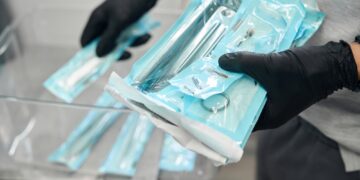
Common items include clean meat and seafood trays and rigid white foam packaging from products such as electronics and furniture. Residents may mistake softer foam packaging for rigid foam, though it actually belongs with flexible plastics, Collins said.
Residents bring their foam packaging to one of SARCAN’s 73 depots for consolidation and transport to the company’s Saskatoon processing facility. There the material is sorted, and SARCAN staff remove adhesives, glue and cardboard. After being compacted into blocks, the material ships via rail to a verified recycling end market in Quebec to be turned into extruded polystyrene insulation boards for residential and commercial applications.
Saskatchewan has no local foam recycler, so Quebec is currently the most viable end market. As volumes grow, SARCAN and SK Recycles would like to secure a Saskatchewan buyer, to keep curbside recycling within the province.
Collins said the densifier in Saskatoon currently serves both the northern and southern parts of the province. A similar machine in the provincial capital city of Regina, about 170 miles from Saskatoon, could be considered as volumes grow.
In 2024, SK Recycles approached SARCAN about expanding depot collection to include household glass, flexible plastics and rigid foam. Hauling loose foam meant transporting mostly air, so densification was the logical solution.
After researching equipment and visiting a similar operation in the US, the team installed a machine shipped from Europe. Densification began in late January 2026, and the first shipment to the end market went out in August.
Despite the harsh weather in Western Canada, collection, processing and shipping continue all year – aside from the occasional blizzard-related depot closures.