



As Apple continues to develop its next-generation electronics recycling system, leaders at the tech giant envision a future in which its system improves reuse and recycling rates for companies industrywide.
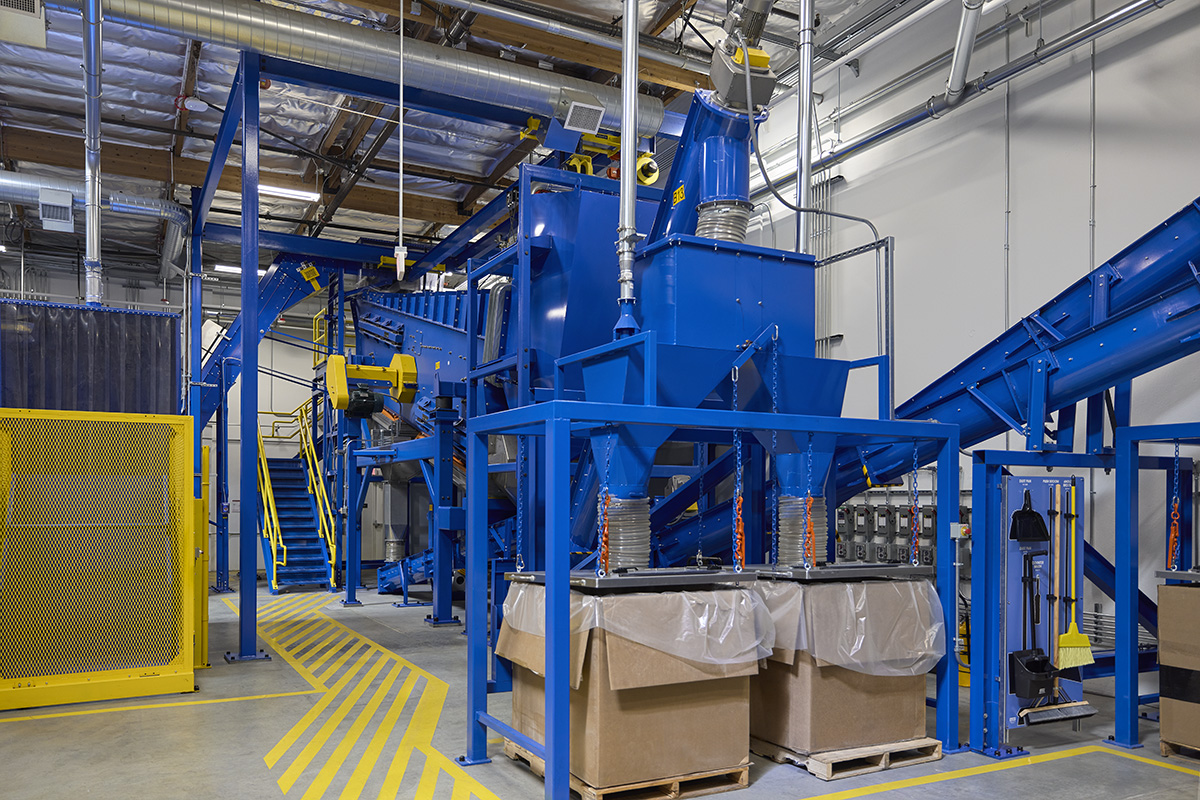
Lorena Tere, Apple’s senior material recovery engineer, gave an update on the company’s Cora system during the E-Scrap Conference in New Orleans. Cora, which debuted last spring, was built at Apple’s Advanced Recovery Center in California to improve e-scrap recycling through precision shredding and advanced sensor technology.
Apple designed Cora to enhance material liberation (detachment) and separation (sorting), Tere said. A single-cutter rotor acts like teeth, breaking down materials more thoroughly and quickly than standard shredders. Multiple speed functions and a perforated screen allow the machine to be used for many material types while keeping more contaminants out of the product stream.
More specifically, high-frequency sorters can detect particles as small as 2 millimeters for multiple material sources. For heavier metals, an X-ray fluorescent sorter can sort metals by atomic number, detecting up to five materials from one batch with particles as small as 5 millimeters. A mid-wave infrared sorter uses hyperspectral sorting to separate plastics by polymer type, while an air knife separates liners and other flexible materials to mitigate contamination and equipment clogging.
Efficiency was designed into Cora at every step, Tere said. An intelligent hydraulic ram, for example, maintains stability for more even processing and enables multiple operation speeds. Cora was even designed to be efficient in the space it occupies — the entire unit only occupies around 8,000 square feet, Tere said, with fewer motors and sensors using less real estate as well as power.
Engineers have developed a series of program “recipes” to allow the system to find and recover various material types; operators input the recipes through an iPad for Cora to act upon. Cora was built to accommodate what Tere called the “sweet spot” of materials, accommodating everything from power accessories to iPhones and iMacs to capitalize on the electronics categories that Apple values.
But it’s not meant solely for Apple products. Cora was designed to accommodate e-scrap from most manufacturers.
“We consider ourselves recyclers,” she said. “If we’re going to make things out of recycled content, we also have to be good stewards of that material.”
Learning for the future
Engineers have gathered some interesting data from Cora’s first six months of operation, Tere said. Where conventional recycling processes resulted in aluminum that was less than 70% pure, aluminum coming from Cora is more than 95% pure, indicating its success in improving the quality of the output. And it’s been able to effectively retrieve a range of materials from power adapters, including ferrous metals, multiple grades of copper and various critical minerals.
Apple will continue to learn what Cora’s capable of and how to improve the device as operations continue. Those findings won’t remain a secret, Tere said. The company intends to make information available on what Cora can do, how to maximize recipes and even how to replicate the system.
The company is still working out how to best share that information, but Tere said input from industry players is welcome as Apple perfects that.
“If there are gaps recyclers have … we want to be a resource for that,” she said.
Cora’s development is part of Apple’s overall mission to make its practices more sustainable, Tere said. Advances have allowed for 30% of the material (by weight) in all Apple products to come from recycled sources. The numbers are better in certain subcategories; all Apple-designed batteries, for example, include 100% recycled cobalt.
The goal, from design through decommissioning, is to keep devices and their components in use as long as possible. That includes improving durability, issuing updates to keep older devices usable and making products more repairable; the company directed more than 15 million devices and accessories for reuse last year alone, she said.
Even Cora was designed more sustainably. Apple used commercially available materials that were fine-tuned for Apple’s specifications, as opposed to custom-ordering more labor- and resource-intensive components.
“Apple has this industry-leading ambition to one day make all of our products out of recycled and renewable resources, eliminating the need for carbon-intensive processes like mining and fully contributing to the circular supply chain,” she said.