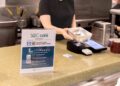





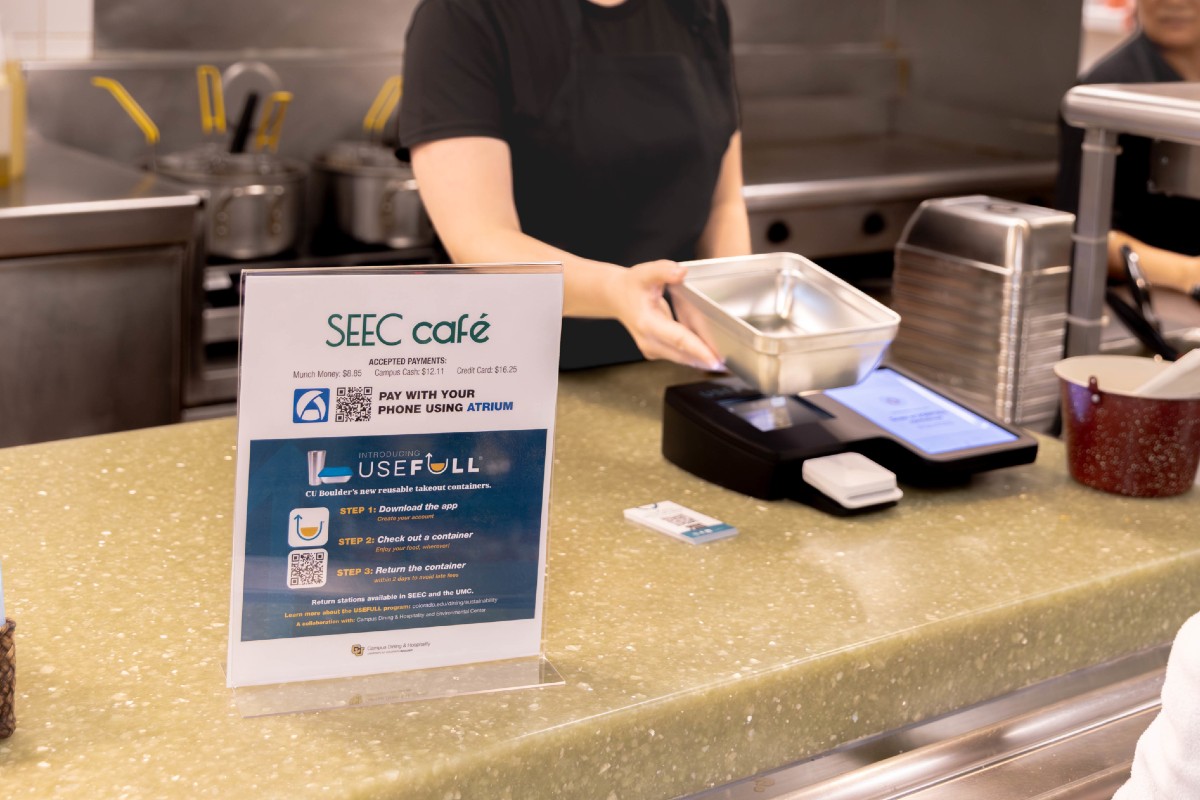
The University of Colorado Boulder has launched a plastic-free, reusable dishware program with Usefull in two locations on campus. Students and guests of the Alferd Packer Grill in the University Memorial Center and SEEC Café in the Sustainability, Energy and Environment Community building can now get fresh meals in reusable stainless-steel containers.
It’s the first campus in the state to offer the program.
Student-led effort
When Clementine Clyker was a student at CU Boulder in 2024, she noticed all the single-use plastics and paper products going in the trash on campus, at a time when the school had suspended composting due to high contamination.
“I noticed that every time someone wanted to get a coffee, it was another disposable cup that was ending up in landfill,” she told Resource Recycling.
Clyker, an environmental studies and geography major, had been working with the school’s Environmental Center, and she brought the issue up with the group. She was referred to the Post-Landfill Action Network (PLAN), a nonprofit founded in 2013 by a group of college students at the University of New Hampshire. PLAN helps college campuses set up zero waste and reusable programs. Working with PLAN, Clyker developed a proposal for her campus to switch to reusable dishware, which she presented in December 2024. Campus stakeholders were immediately supportive, she said.
“A lot of the housing and dining folks were really, really crucial to making this project happen,” said Clyker.
Clyker and her university partners worked on developing the idea for roughly a year and a half, eventually settling on a pilot project for Alferd Packer Grill and the SEEC Café. Those two locations account for more than 2,000 meals a day between them, which is roughly 10% of all campus meals.
How it works
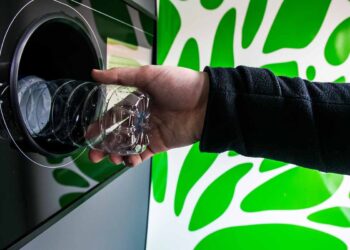
Students, staff and visitors pick up their food or drinks at the two participating locations in Usefull’s stainless steel packaging. They sign up for the app and scan the container in. Containers are free to use, though they must be returned within two days. They can be returned to any Usefull station on campus, which are ADA-accessible, where they are scanned back in. After two days, users are charged $1 a day up to the cost of the unit ($17-25).
CU Boulder’s dining services also provide metal utensils, which are placed in the normal tray return.
Usefull containers are washed and sanitized by Campus Dining and returned to circulation. Usefull’s technology tracks individual containers through the system.
Alison Cove, founder and CEO of Usefull, said, “Students don’t need to choose between convenience and reducing waste. The goal is to make reuse work naturally with the way people already eat on campus.”
Cove said her company offers a range of stainless-steel containers, from insulated options that can keep food hot for hours to several slimmer sizes for grab and go, for everything from soups to salads to sandwiches to sushi. Beverage containers include coffee and smoothie cups. The user experience is better than “soggy” disposable containers, she said. And each campus gets to set its own free usage window, with some commuter schools opting for a week.
Cove said 94% of containers checked out never incur fees. She said Usefull is on more than 20 campuses across the US so far and looking to expand.
“Partnering with the Environmental Center to bring Usefull to campus is an exciting step for Campus Dining & Hospitality,” said Matt Bratton, director of Campus Dining and Hospitality at CU Boulder, in a statement. “This program reinforces our commitment to making collaborative operational decisions that support CU’s sustainability and waste reduction goals. It also provides a unique opportunity to raise awareness and educate the campus community on how sustained behavioral change can make a big collective impact.”
Chris Herr, director of the school’s Environmental Center, said reuse was identified as an attractive option for his campus to reduce the amount of material going to landfills. And the campus decided to lease the reusable containers from Usefull at first rather than buying them outright, a decision that made it easier to start the pilot but would result in higher operating costs long term.
The total cost of the program is about $250,000, said Herr. The school’s student-run environmental board provided $56,000 toward the pilot.
“The other $200,000 came from dining services, basically reallocating funds that would have just gone to purchasing single-use BPI compostable single-use containers,” said Herr. “It’s just a reallocation of funds.”
Clyker added, “In the long term, it ends up being a net benefit or net neutral of purchasing reusable containers versus buying disposables every year.”
Response
Herr said there was some pushback to the reuse program at first, “just because it made the lines longer when everyone was going to the same place at the same time during the first week of school. But ultimately, we’ve been trying to push out marketing about why we’re doing this, not just how to do it. I think that’s been resonating.”
He added, “So it’s really you know kind of this peer-to-peer project where students wanted it. It’s not something that we’re just top-down implementing. So that makes it easier to sell.”
Clyker said one of the biggest challenges the team needed to figure out was space for storing the containers and for dishwashing. Renovations in Alferd Packer Grill also caused delays in implementation. But the obstacles were overcome.
Herr added that if the pilot continues to go well, the next step is to roll out the reusable containers at a residence hall that is getting renovated and will reopen in fall 2028.
One key side benefit of the program is that it has allowed the school to reopen some compost bins in the eating spaces. “We got the single-use packaging out of the stream,” said Herr. “So now, in the first 10 days of the program, we collected 866 pounds of organic material with very little contamination.”
Clyker, who is originally from Superior, Colorado, near Boulder, graduated in May. She now works for the National Park Service in Washington, D.C.
She said seeing people use the reusable containers on campus, after all her work, was “surreal.” “It was really fulfilling to see people not only using them but getting excited about seeing CU taking efforts to improve their sustainability and reduce their waste,” she said.