







Resource Recycling
  • The Latest
  • Podcast
  • Analysis
    • All
    • Certification Scorecard
    • Industry Announcements
    • Opinion
    From claims to custody: PCR procurement grows up

    Certification scorecard — week of Nov. 16

    Adam Gendell

    PET producers ride ‘local for local’ wave

    May pricing bullish for most bales

    HDPE resists seasonal, economic forces

    IT asset disposition and electronics recycling: Now and then

    Data center moratoriums cast development shadow

    Recycling tracking data is already on your truck

    Recycling tracking data is already on your truck

    A five star ranking with one under a microscope

    Certification scorecard — week of Nov. 9

  • Conferences
    • Resource Recycling Conference
    • Plastics Recycling Conference
    • E-Scrap: The Longevity Conference
    • Textiles Recovery Summit
  • Publications
    • E-Scrap News
    • Plastics Recycling Update
    • Policy Now
    • Resource Recycling
    • Other Topics
      • All Topics
      • Brand Owners
      • Critical Minerals
      • Glass
      • Grant Watch / RFPs
      • Markets
      • Organics
      • Packaging
      • Research
      • Technology
      • Textiles
Subscribe
No Result
View All Result
Resource Recycling
No Result
View All Result
Home Analysis

E-scrap transport confronts cost, capacity concerns

byDavid Daoud
October 23, 2026
in Analysis, E-Scrap
shipping and transportation

Rising fuel prices and tighter trucking capacity have impacted how ITAD companies move products around. | Maznev Gennady, Shutterstock

Rising diesel prices and tighter trucking capacity have impacted transportation costs across the electronics recycling and IT asset disposition (ITAD) industries. The effects extend to specialized carriers serving enterprise customers and companies operating their own fleets.

Recent developments in North American freight markets point to higher operating expenses and difficulties securing transportation on certain routes. For electronics logistics and reverse logistics operators, these conditions affect collection costs and the movement of equipment between facilities and processing sites. They also raise questions about the profitability of contracts negotiated before the latest fuel-price increases.

Diesel prices and the Russian supply agreement

US diesel prices reached about $6.27 per gallon in early October, following disruptions to international fuel supplies associated with the conflicts in Iran and Ukraine. On Oct. 9, President Donald Trump announced an agreement with Russian President Vladimir Putin to supply more than 300,000 metric tons of diesel immediately, followed by 500,000 tons in November and an additional 1 million tons thereafter. Washington also temporarily eased restrictions on Russian diesel imports.

The agreement could provide some relief, although the announced quantities are relatively small compared with US consumption. The actual deliveries and their effect on domestic diesel prices remain uncertain.

For ITAD companies operating their own trucks, higher diesel prices directly increase collection expenses. Those relying on contracted carriers may face higher freight rates or fuel surcharges.

The exposure is particularly significant for fixed-price service agreements that include transportation. Where equipment recovery values cannot offset higher collection costs, operating margins narrow.

Likewise, recyclers handling lower-value materials face similar pressures. Long collection distances and relatively small shipment volumes can make transportation disproportionately expensive compared with the value of recovered materials.

Specialized carriers confront tighter capacity

Fuel prices are only part of the problem. The North American cross-border freight market is experiencing driver shortages and regulatory restrictions. An October freight-market index registered 57 for Canada and 54 for Mexico, with readings above 50 indicating tighter conditions.

Higher equipment financing costs are also discouraging fleet expansion. Some transportation corridors have experienced substantial rate increases, although these increases are not representative of the entire trucking market.

For specialized reverse logistics providers, securing capacity involves additional requirements. Enterprise equipment collections often require documented chain of custody and secure handling procedures. Customers may also specify vehicle security measures.

These requirements limit the number of suitable carriers. Even where general freight capacity is available, a shortage of qualified drivers or appropriately equipped vehicles can complicate scheduling. Consequently, specialized transporters face greater pressure to renegotiate contracts when operating expenses exceed the assumptions underlying their original rates.

Fleets face pressure on national contract economics

For ITAD providers operating their own fleets, the combination of higher fuel expenses and uneven collection volumes is placing additional pressure on the economics of national service agreements.

The challenge is particularly pronounced where enterprise contracts require consistent geographic coverage despite substantial differences in equipment volumes between customer locations. Low-volume collections and long-distance routes can become increasingly difficult to justify.

These conditions may encourage providers to revisit collection thresholds, pickup schedules and transportation charges when negotiating or renewing contracts. They also strengthen the economic case for coordinating collections across multiple customer accounts, particularly in markets where individual locations generate insufficient volumes.

Regional consolidation facilities may offer additional opportunities to reduce transportation expenses, although their financial advantages depend on shipment volumes and the costs of intermediate handling.

For providers pursuing national accounts, the issue is increasingly one of contract profitability: how to preserve geographic coverage and service commitments while recovering the actual cost of collection.

Cross-border transportation adds complications

Cross-border movements present further challenges for companies transporting used equipment between the United States, Mexico and Canada.

Driver eligibility restrictions have reduced available capacity. About 25,000 Mexican freight drivers reportedly had US visas withdrawn, while temporary border disruptions have forced some carriers to use alternative crossings.

For ITAD operators shipping equipment for refurbishment or downstream processing, delays can increase costs and extend transit times.

Freight imbalances add another expense when carriers cannot secure profitable return loads and must recover the cost of empty mileage.

Outlook: Transportation costs reshape pricing

Rising transportation costs are impacting the economics of ITAD and recycling contracts. Agreements negotiated under earlier fuel-price and freight-market conditions are coming under pressure, particularly those covering geographically dispersed customer networks.

Providers competing for large enterprise accounts should consider national coverage as an important commercial advantage, but it comes at a growing cost. Low-volume locations are becoming more expensive to serve, increasing the importance of differentiated transportation pricing and collection terms.

Regional ITAD operators with concentrated customer bases are naturally better positioned to manage collection costs within their established territories. This is while national providers face a different challenge: maintaining broad geographic coverage while protecting margins across accounts with widely varying collection volumes.

Transportation costs are becoming more prominent in contract negotiations. Factors such as fuel surcharges, minimum pickup volumes and collection frequency are increasingly seen as important to the economics of service agreements. The ability to recover higher costs depends upon existing contractual commitments and the negotiating position of individual providers.

The ITAD and recycling industries will need to pay closer attention to geopolitical developments as transportation costs become highly exposed to events far beyond their domestic markets. The wars in Ukraine and Iran, shifting international energy relationships and the approaching US midterm elections are introducing further uncertainty into fuel markets and freight economics. Even with efforts to stabilize diesel supplies, transportation costs are unlikely to return quickly to earlier levels, and further volatility should be expected.

For an industry dependent on the movement of equipment across regional and national borders, developments thousands of miles away are translating directly into operating costs and profitability. Geopolitical risk is becoming an increasingly important consideration in transportation planning and contract pricing.

Tags: ITAD
TweetShare
David Daoud

David Daoud

David Daoud is a contributor to Resource Recycling and E-Scrap News, covering IT asset disposition, electronics recycling, and circular IT governance. He is the founder of and current Principal Analyst at Compliance Standards LLC, where he conducts independent research and advisory work on ITAD markets, sustainability and ESG compliance, data security, and lifecycle risk management. Daoud has analyzed enterprise IT trends since the late 1990s and was among the first analysts to examine ITAD as a distinct market segment during his time at IDC. He advises operators, OEMs, and investment teams on regulatory, technology, and market developments affecting the electronics lifecycle.

Related Stories

Solarcycle, Korea Zinc merge in critical mineral venture

Solarcycle, Korea Zinc merge in critical mineral venture

byPaul Lane
November 18, 2026

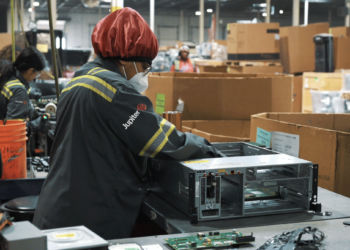
Leadership hopes the new company, Jupiter, will give US firms a central place for e-scrap and ITAD recycling and processing.

Electronics on a desk.

Blancco launches AI ITAD assessment tool

byDavid Daoud
November 18, 2026

Circulate combines diagnostic results with customer-defined grading rules and resale estimates to guide disposition decisions.

IT asset disposition and electronics recycling: Now and then

Data center moratoriums cast development shadow

byDavid Daoud
November 12, 2026

Developers and decommissioning firms face uncertainty amid communities’ concerns over the impact centers create.

MP Materials breaks ground on rare earth magnet campus in North Texas

Inclusivity is key to building mineral supply, insiders say

byPaul Lane
November 10, 2026

E-Scrap Conference panelists say domestic critical mineral demand can be met through collaboration among industry players.

Data centers and AI combine to create ITAD ‘growth engine’

Component shortages drive demand for data center hardware

byDavid Daoud
November 10, 2026

Google, Microsoft and Sims Lifecycle Services report longer equipment lifecycles and growing demand for refurbished components, while rising asset values...

Logitech increases use of recycled plastics

Manufacturers look to meet the call of designing for reuse

byPaul Lane
November 9, 2026

Leaders of companies like Google and Panasonic say advancements continue in incorporating second-life functions into new electronics.

Load More
Next Post
Dow bullish on PE pricing into 2027

Dow bullish on PE pricing into 2027

2026 Buyers’ Guide

Equipment, services and technology suppliers serving the recycling industry.

Browse the Guide

More Posts

Closeup of PP with a chasing arrows recycling symbol.

PureCycle, WM sign rare 3-year bales contract

November 16, 2026
PureCycle sees easing headwinds to R-PP adoption

PureCycle shifts focus, secures feedstock

November 5, 2026

Goodwill eyes EPR revenue, starting with waste audit

November 12, 2026
Artificial intelligence is altering the marketplace for ITAD providers in numerous ways. | Shutterstock

AI alters ITAD economics

November 3, 2026

Alphabet’s Materra wants recyclers to see molecules, not bottles

November 13, 2026
Modern Mining raises $40 million in IPO

Modern Mining raises $40 million in IPO

November 12, 2026
NexPoint Materials to shutter Alabama plastics plant

NexPoint Materials to shutter Alabama plastics plant

November 4, 2026
The missing link in e-plastic recycling

The missing link in e-plastic recycling

October 28, 2026
PET bottles for recycling

PET imports reshape US markets as demand grows

November 11, 2026
IT asset disposition and electronics recycling: Now and then

Data center moratoriums cast development shadow

November 12, 2026
Load More

About & Publications

About Us

Staff
Job Listings

Archive

Magazines

Work With Us

Advertise
Contact
Terms and Privacy

Newsletters

Get the latest recycling news and analysis delivered to your inbox every week. Stay ahead on industry trends, policy updates, and insights from programs, processors, and innovators.

Subscribe

Welcome Back!

Login to your account below

Forgotten Password?

Retrieve your password

Please enter your username or email address to reset your password.

Log In

Add New Playlist

No Result
View All Result
  • The Latest
  • Podcast
  • Analysis
  • Recycling
  • E-Scrap
  • Plastics
  • Policy Now
  • Conferences
    • E-Scrap Conference
    • Plastics Recycling Conference
    • Resource Recycling Conference
    • Textiles Recovery Summit
  • Magazines – Old
  • About Us
  • Advertise
  • Archive
  • Job Listings
  • Staff
Subscribe
This website uses cookies. By continuing to use this website you are giving consent to cookies being used. Visit our Privacy and Cookie Policy.