Resource Recycling
  • The Latest
  • Analysis
    • All
    • Certification Scorecard
    • Industry Announcements
    • Opinion

    ITAD is moving past its adolescent phase: beyond end-of-life

    Rainforest

    Inside the Circle: What the rainforest can teach us about EPR

    Closeup of a printed circuitboard

    Hardware demand puts new focus on parts harvesting

    Rare look inside the world’s largest plastics recycler

    Mass balance matters: Why different rules can lead to different outcomes 

    Certification Scorecard — Week of June 1, 2026

    IT asset disposition and electronics recycling: Now and then

    $60 billion in AI servers will create an ITAD challenge

  • Conferences
    • Resource Recycling Conference
    • Plastics Recycling Conference
    • E-Scrap: The Longevity Conference
    • Textiles Recovery Summit
  • Publications
    • E-Scrap News
    • Plastics Recycling Update
    • Policy Now
    • Resource Recycling
    • Other Topics
      • All Topics
      • Brand Owners
      • Critical Minerals
      • Glass
      • Grant Watch / RFPs
      • Markets
      • Organics
      • Packaging
      • Research
      • Technology
      • Textiles
Subscribe
No Result
View All Result
Resource Recycling
  • The Latest
  • Analysis
    • All
    • Certification Scorecard
    • Industry Announcements
    • Opinion

    ITAD is moving past its adolescent phase: beyond end-of-life

    Rainforest

    Inside the Circle: What the rainforest can teach us about EPR

    Closeup of a printed circuitboard

    Hardware demand puts new focus on parts harvesting

    Rare look inside the world’s largest plastics recycler

    Mass balance matters: Why different rules can lead to different outcomes 

    Certification Scorecard — Week of June 1, 2026

    IT asset disposition and electronics recycling: Now and then

    $60 billion in AI servers will create an ITAD challenge

  • Conferences
    • Resource Recycling Conference
    • Plastics Recycling Conference
    • E-Scrap: The Longevity Conference
    • Textiles Recovery Summit
  • Publications
    • E-Scrap News
    • Plastics Recycling Update
    • Policy Now
    • Resource Recycling
    • Other Topics
      • All Topics
      • Brand Owners
      • Critical Minerals
      • Glass
      • Grant Watch / RFPs
      • Markets
      • Organics
      • Packaging
      • Research
      • Technology
      • Textiles
Subscribe
No Result
View All Result
Resource Recycling
No Result
View All Result
Home E-Scrap

Export market roundup: Vietnam bans e-plastic imports

Colin StaubbyColin Staub
December 6, 2018
in E-Scrap
Shipping containers stacked at a port.

Import policies in China and Southeast Asia continue to tighten, making it more difficult to move certain e-scrap materials to international  markets.

Although the policy changes have dealt a heavy blow to curbside recycling programs across the U.S., the electronics recycling sector has been hit hard on certain commodities, as well. E-plastics and some metals have had their downstream markets disrupted heavily.

E-plastics are officially classified as “other plastics” when shipped internationally. This category also includes mixed-plastic bales and other materials not fitting into more specific classifications. U.S. Census Bureau figures indicate exporters shipped 549 million fewer pounds of these plastics during the first nine months of 2018 compared with that period in 2017, a decrease of 38 percent.

Thailand has already implemented a ban on most e-scrap imports and has announced its intention to stop all imports of scrap plastic within two years. As the year comes to a close, further recent regulatory movement indicates the export market pressures are far from over. The following is a roundup of actions taken by governments in Asia.

Vietnam: The government says it has implemented an outright ban on plastics recovered from e-scrap.

In a press release issued in late October, the Ministry of Natural Resources and Environment noted that “plastic cases of used electronic equipment, such as: television, computers, office equipment” are among the plastics not allowed to be imported under the new regulations.

According to an online translation of the new policy, banned e-plastics include materials that have flame retardants, such as polybrominated biphenyls, or compounds that include phthalate, lead, cadmium, mercury or chromium.

It has been increasingly difficult to move material into Vietnam this year. As was reported by Resource Recycling, sister publication to E-Scrap News, the Vietnamese government previously enacted a temporary ban on recovered plastic imports coming through major Vietnamese ports. That prohibition was initially scheduled to end on Oct. 15. But shipping line Hapag-Lloyd reported to customers that the restriction was instead extended “onwards until further notice.” The company reminded customers that, despite the ban covering specific ports, Hapag-Lloyd “continues to stop the acceptance of plastic scrap and plastic waste to all ports in Vietnam.”

Vietnamese officials sent a letter to customs departments around the country in November, instructing them on the new regulations.

(Story continues below chart. Click chart to view full size in a new browser window.)
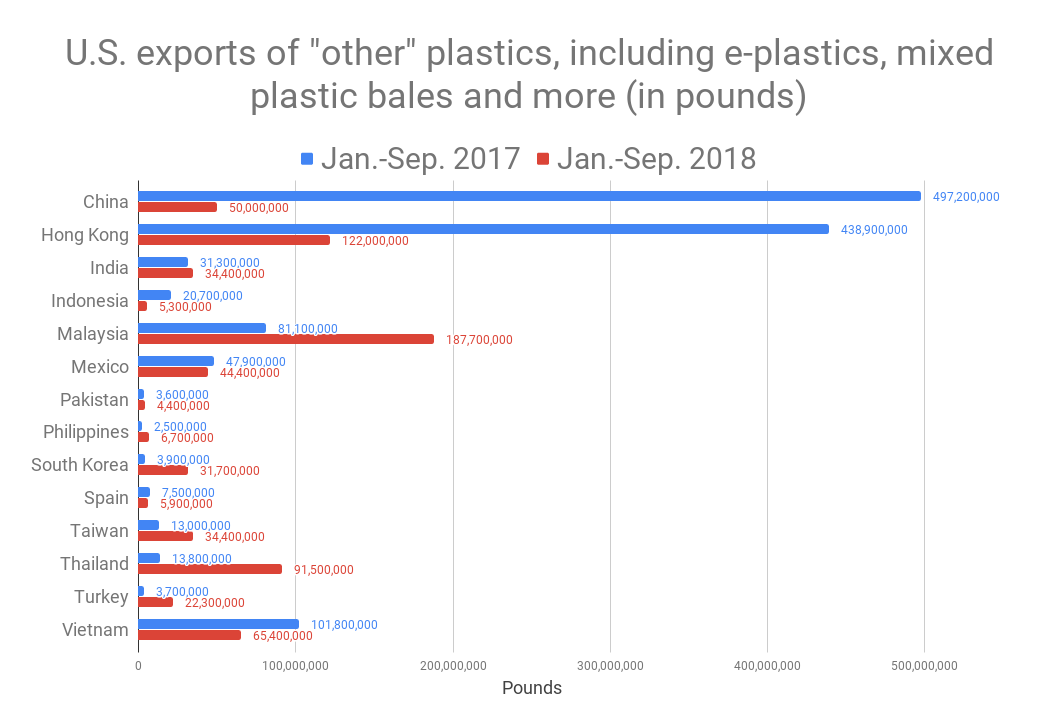
Chart detailing destinations of some U.S. plastics exports.

Taiwan: Scrap material imports have risen sharply this year, and Taiwan’s environmental protection agency in October acted to tamp down the trend.

In early October, regulations took effect reducing the types of material allowed for import. According to the Tai Pei Times, companies can only import post-industrial plastic from their overseas production facilities or loads of a single material type. It’s unclear whether certain polymers are banned altogether.

In response, the CMA-CGM shipping line immediately suspended plastic shipments to Taiwan. Shipping company APL also added Taiwan to the list of countries it will not ship scrap plastic to as of early October.

Hapag-Lloyd told customers that loads in violation of the new restrictions would be returned with penalty charges to the exporter. As a result, Hapag-Lloyd is requiring plastic exporters to submit a letter of indemnity before a shipment can take place.

Malaysia: Plastics Recycling Update, sister publication to E-Scrap News, reported late last month on import requirements the Malaysian government is working on. It’s unclear when those rules will take effect. In the meantime, the government is not issuing import licenses for scrap plastic.

Steve Wong, executive director of the China Scrap Plastics Association, said Malaysia is proposing to only allow scrap plastic from the U.S., Europe and Japan.

Late last month, media outlets widely reported that Malaysia is planning to ban plastic imports in coming years, based on information presented at a meeting of several government ministries in October. But in mid-November, Malaysian Housing and Local Government Minister Zuraida Kamaruddin indicated there are no plans to ban scrap plastic shipments from industrialized countries. The statement was reported in Free Malaysia Today newspaper.

The ban has been described as an effort to reduce imports of non-recyclable plastics, rather than usable scrap materials.

China: The Chinese government has confirmed it will ban additional recovered materials, including post-industrial scrap plastic, at the end of the year. China announced in April that the expanded ban was coming. The confirmation was made public by Chinese state media agency Xinhua last month.

Post-consumer scrap plastic has been banned from import into China since the beginning of this year, but post-industrial scrap plastic has officially been allowed in. Very little plastic of either category has been shipped to China this year; U.S. exports to China are down by nearly 93 percent for the first three quarters of 2018 compared with the same period in 2017.

Even with that heavily diminished tonnage, China remains among the top importers of U.S. scrap plastics.

Additionally, China’s import restrictions continue to be a topic of discussion at World Trade Organization (WTO) meetings. According to a WTO news release, the U.S. and four other delegations questioned Chinese WTO representatives about the scrap material import restrictions during an Oct. 22 meeting of the Committee on Import Licensing.

The U.S. highlighted that Chinese manufacturers are being forced to use virgin material, and it said import restrictions could lead to “a heightened threat of increased marine litter,” according to the release. Canada asked for a specific list of materials that need import licenses and the procedures associated with importing those materials. The Australian delegation noted it appreciates China’s steps to cut down on pollution but the Chinese actions have been “more restrictive than necessary to achieve the desired objectives.”

In response, the Chinese delegation said it would submit more information about its restrictions to the WTO import license committee.

Photo credit: nattanan726/Shutterstock

 

IRT

Tags: AsiaE-PlasticsMarketsTrade & Tariffs
TweetShare
Colin Staub

Colin Staub

Colin Staub was a reporter and associate editor at Resource Recycling until August 2025.

Related Posts

Aluminum can bale close up.

Aluminum scrap exports face scrutiny under HB 9161

byStefanie Valentic
June 9, 2026

A new House bill would direct the US International Trade Commission to investigate whether US aluminum scrap exports to adversarial...

War, not demand driving polymer pricing

War, not demand driving polymer pricing

byAntoinette Smith
June 2, 2026

While prices for recycled commodities are tracking rises in virgin markets, few transactions are occurring, said an ICIS analyst.

Machinex

Longview mill tragedy raises broader questions for fiber, recycling sectors

byKeith Loria
May 29, 2026

A deadly explosion at Nippon Dynawave Packaging’s Longview, Washington plant prompts new questions for the pulp, paper and packaging industries.

EU recyclers make case for solvent-based methods

The electronics recycling industry has a plastics problem

byKen Thomas
May 26, 2026

Pretending otherwise is no longer a viable option, argues the president of Universal Recycling Technologies.

EPR rules take shape in Oregon, as first test

Oregon OKs end-market verification from CAA

byStefanie Valentic
May 20, 2026

The state's Department of Environmental Quality has given the stamp of approval on CAA's Responsible End Markets program plan amendment.

Aurubis smelter pipe system and chimney.

Aurubis sends positive signal for metals recovery markets

byDavid Daoud
May 18, 2026

The company’s performance is often seen as a bellwether for downstream appetite for complex electronic scrap and industrial recycling feedstock.

Load More
Next Post

OCC and mixed paper: A tale of two exports

More Posts

Recycling industry addresses Beyond Plastics report

Recycling industry addresses Beyond Plastics report

May 26, 2026
House resolution aims to make recyclability central to product design

NY EPR bill fails to advance after third try

June 8, 2026
Fire at an EMR recycling facility in Camden, New Jersey May 29, 2026.

EMR faces shutdown calls after numerous fires

June 2, 2026
CalRecycle withdraws proposed regs for SB 54

Oceana, NRDC, CAW sue CalRecycle over SB 54 regs

June 5, 2026
IT asset disposition and electronics recycling: Now and then

$60 billion in AI servers will create an ITAD challenge

June 3, 2026
The independent ITAD at a crossroads

DMD acquires ITAD firm Lifespan, outlines acquisition strategy

June 2, 2026
Our top stories from June 2021

Colorado advances EV battery EPR law

June 3, 2026
Rare look inside the world’s largest plastics recycler

Mass balance matters: Why different rules can lead to different outcomes 

June 5, 2026
In My Opinion: Comparing the nation’s first packaging EPR laws

What Maine’s vape EPR law means for recyclers

June 4, 2026
Circular Materials to supply PlasCred chem recycling plant

Circular Materials to supply PlasCred chem recycling plant

June 4, 2026
Load More

About & Publications

About Us

Staff

Archive

Magazine

Work With Us

Advertise
Jobs
Contact
Terms and Privacy

Newsletter

Get the latest recycling news and analysis delivered to your inbox every week. Stay ahead on industry trends, policy updates, and insights from programs, processors, and innovators.

Subscribe

Welcome Back!

Login to your account below

Forgotten Password?

Retrieve your password

Please enter your username or email address to reset your password.

Log In

Add New Playlist

No Result
View All Result
  • The Latest
  • Analysis
  • Recycling
  • E-Scrap
  • Plastics
  • Policy Now
  • Conferences
    • E-Scrap Conference
    • Plastics Recycling Conference
    • Resource Recycling Conference
    • Textiles Recovery Summit
  • Magazine
  • About Us
  • Advertise
  • Archive
  • Jobs
  • Staff
Subscribe
This website uses cookies. By continuing to use this website you are giving consent to cookies being used. Visit our Privacy and Cookie Policy.