





Editor’s note: Batteries will be featured in sessions at the 2026 E-Scrap: The Longevity Conference Oct. 26-28 in New Orleans.
Research into fluorine-free battery binders could reduce or eliminate the need for harsh chemicals during production and recycling.
The study, done by researchers at the University of California San Diego and the Toyota Research Institute of North America, looked at improving the cost and environmental sustainability of solvent-based processing in lithium-ion battery manufacturing and recycling. The study appeared in Nature Communications earlier this month.
The problem
Binders glue together the battery’s internal parts, including the cathode and anode. The battery industry has generally used binders containing fluorine due to its thermal stability and because it creates strong, uniform electrodes that endure through thousands of charging cycles.
That binder, though, must be dissolved in N-methyl-2-pyrrolidone (NMP) before it can be mixed with the battery’s electrode powders. NMP is toxic and linked to reproductive and developmental health issues. After the electrodes are coated, the batteries go into drying ovens to evaporate the solvent, after which additional steps are taken to recover and purify the solvent for reuse.
“Those extra steps significantly increase the cost and energy use — as well as the environmental impact — of battery manufacturing,” said Jiao Lin, one of the study’s authors.
Fluorine also complicates recycling. Those binders leave residue requiring high heat or chemicals to remove, creating hazardous waste and contaminating the material that’s recovered.
The solution
Researchers created a binder that works like traditional options but contains no fluorine. This binder can also be processed using water. Their process improved upon other water-soluble binders by incorporating polyacrylic acid and carboxymethyl cellulose, which provide flexibility, strength and stickiness.
These polymers were dissolved in water and then combined with citric acid, which links them. Researchers said that combination created a binder with stability and adhesion seen from other products. They noted it also provides better cycle stability than batteries made using fluorine. The binder was compatible with different electrode types, including lithium iron phosphate, nickel-rich and silicon.
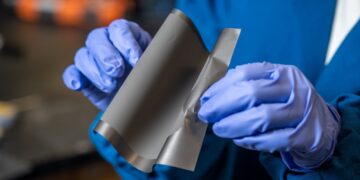
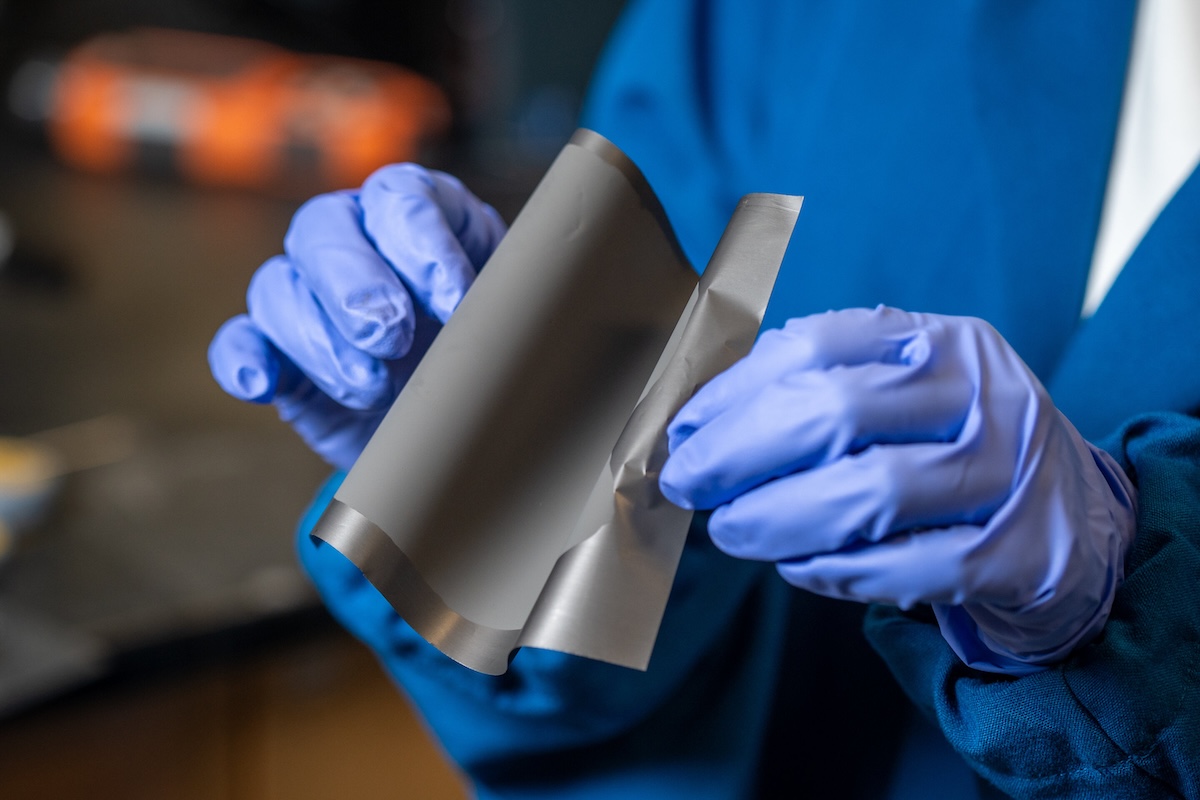
It also enabled easier recyclability, researchers said. The disassembled electrodes were submerged in water, which cleanly separated the electrode coatings from the metal foil sheets while leaving no residue. That allowed the electrode materials to then be regenerated using direct recycling processes for use in new batteries.
“The fluorine-free binder further facilitates sustainable direct recycling, demonstrating full recovery of spent positive and negative electrodes to achieve the same level of performance with pristine materials without generating fluoride residue,” the study’s authors wrote. “Lifecycle analysis shows significant reductions in energy cost and emissions compared with recycling … fluoride-based batteries. This binder strategy endows high performance with circularity, offering a scalable route to sustainable battery manufacturing technologies.”
Researchers said they’ll work to scale up production for commercial manufacturing of their binder and optimize it for different battery chemistries, working with industry partners to eventually bring it to market.
Why it matters
First and foremost, from a manufacturer’s point of view, this binder could save them money. Binders containing fluorine can cost several hundred dollars per 100 grams, while NMP-based solvents can cost $300 per liter.
Researchers have yet to determine what their binder could cost, but they said their product would result in companies spending less on products. The reduction in drying time needed using their binder would save companies additional money, they said, on equipment and energy. And water usage would also go down due to the elimination of the NMP recovery step, which is water-intensive; estimated savings are 6.9%-9.3% on energy, and estimated profits for manufacturers would go up 7.1%.
Then there are the environmental impacts. Across 12 total sustainability indicators, researchers found their binders resulted in lower calculated environmental and resource impacts as compared to the same processes using batteries with fluorine binders.
Recycling batteries using their solvents results in 10% less energy consumption and 3% less water, while greenhouse gas emissions go down 7.2%. That’s on top of removing the harsh chemicals used in the traditional recycling process.
“Moreover, its ambient aqueous processing and fluorine-free chemistry simplify end-of-life treatment and mitigate hazards,” they wrote.
Getting manufacturers to switch may prove more challenging. Changing part of their process would require manufacturers to clear technical, financial and regulatory hurdles, including potentially changing equipment and conducting extensive testing to verify the new binder’s performance. That’s assuming, of course, that researchers can achieve similar results through the scaling-up process.