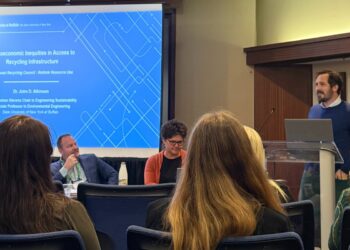





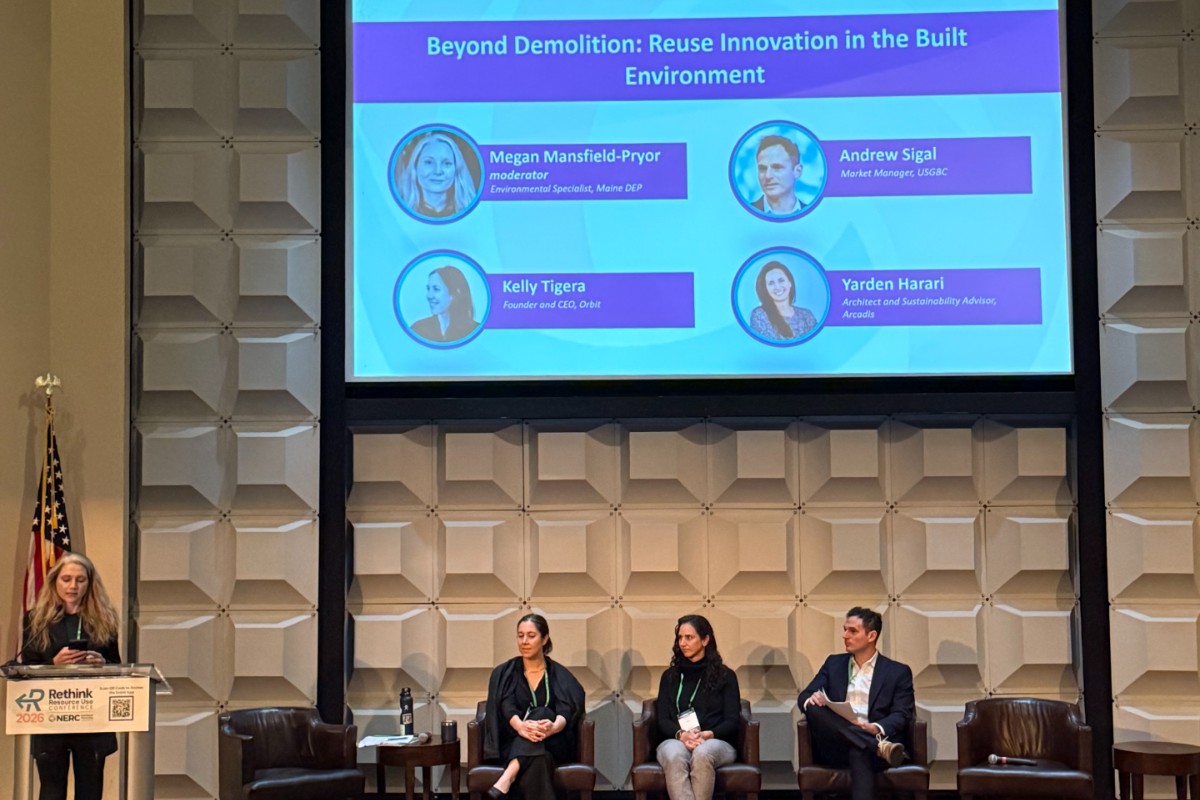
The construction and demolition industries send a massive volume of materials to landfills, but reuse can make a big difference, panelists said at the Northeast Recycling Council’s (NERC) Annual Rethink Resource Use Conference in Plainsboro, New Jersey on Wednesday.
In New York City, 60% of the total waste stream is construction and demolition (C&D) waste, said Kelly Tigera, the founder and CEO of Orbit, an online marketplace for reclaimed construction materials launched in 2005 in the Big Apple. In the US overall, C&D waste has been estimated at 23% of the total waste stream.
According to the EPA, 600 million tons of C&D debris were generated in the United States in 2018, which was more than twice the amount of generated municipal solid waste. Just over 455 million tons of C&D debris were directed to next use (primarily as aggregate); the rest went to landfills.
Construction is “one of the most wasteful industries,” said panelist Andrew Sigal, a market manager at the U.S. Green Building Council (USGBC). “Within that 145 million tons lies a significant opportunity to really decrease waste and direct more material towards its highest and best use.”
At New York construction sites, 10% to 15% of all new materials are thrown away unused, said Tigera. So reuse has the potential to draw from brand new stock as well as used materials. And reuse can help address supply chain and affordability concerns; construction material costs have increased 43% since February 2020, said Tigera.
“In terms of value for users, we can provide access to free and low-cost materials,” said Tigera. “We can provide tax write-offs for donated materials, and we also help sellers save on hauling and dumping costs.”
Orbit is free to use for now, although Tigera said there will soon be fees for sellers on the marketplace.
From panels to seats
Tigera gave a few examples of recent salvage efforts that have leveraged her marketplace. Deconstruction contractor CO Adaptive recovered wood panels from an auditorium at Hunter Brookdale School of Nursing. The panels ended up in four different sites around Brooklyn. Auditorium seats were donated to SoHo Playhouse. In another project, Orbit worked with the city’s Port Authority to salvage historic bricks from retaining walls in Lincoln Tunnel. Orbit is also working with the agency to design a reuse plan for a bus terminal that is scheduled to come down in a few years.
New York City also has a new initiative called the Circular Construction Hub, which is going to be a reuse center for contractors where they can drop off material. Orbit is the online marketplace for that project, said Tigera.
She added that some of the most popular materials on her platform have been doors, shelving, cabinets and acoustic panels. In addition to traditional contractors, buyers include the film industry (for building sets) and the events industry.
A lot of reuse work is already happening around the city and country, “we’re just helping it scale,” said Tigera.
Yarden Jarari, an architect and sustainability adviser at Arcadis, a design and engineering firm, said her recent research suggests the value of pilot projects when it comes to reuse in the C&D space. “You can have pilot projects that are not going to totally overwhelm someone trying something new,” she said. “And also iterate over time with a lot of long-term relationships where you have repeat partners, repeat teams, and have that opportunity to build and bite off more and more rather than trying to do everything at once.”
Jarari added that she would like to see “ways that we can start to measure outbound materials that are coming out of a space the same way that we’re thinking about what’s going into a space.” Having that data could make it easier to drive reuse, she said.
Sigal said certification systems, like those offered from the USGBC, can incentivize reuse. The organization’s True certification for zero waste (with Green Business Certification Inc.) has a particular focus on reuse, he noted.
As a case study, Sigal mentioned 270 Park Ave. in midtown Manhattan. The 60-story headquarters of JPMorganChase opened in October 2025 as a LEED platinum project. The previous building at the site, the former headquarters for Union Carbide, was deconstructed, with 97% of its materials reused or recycled.
Evolving mindset
The panelists agreed that the mindset in the C&D industry is starting to tilt toward reuse, spurred by environmental and cost concerns.
“Our thesis has been if we can provide demand and show that there’s demand for these materials, everything else will wind up behind it,” said Tigera.
She added that government procurement can help drive more reuse in the industry. Tigera also pointed out that salvaged materials are often routed through resellers, who clean and organize them, making purchasing of used goods as easy as buying new.
Sigal added that he would like to see more policy support for C&D reuse. In New York, several bills have been introduced that would bolster reporting and encourage reuse.
“Building reuse saves carbon, but also saves resources from having to be extracted, harvested, manufactured and installed,” said Sigal. “Not to mention the end-of-life considerations there.”