Resource Recycling
  • The Latest
  • Analysis
    • All
    • Certification Scorecard
    • Industry Announcements
    • Opinion

    Certification Scorecard — Week of April 13, 2026

    EV Battery Pack - Sergii Chernov-Shutterstock

    Redwood, Rivian deal fuels US infrastructure plans

    Bloom ESG and e-Stewards roll out critical metals metric

    Colorado regulators suggest mid-range EPR scenario

    Why collaboration on plastic waste still matters

    Battery recycler Ascend Elements files for bankruptcy

    Battery recycler Ascend Elements files for bankruptcy

    EPR fees are a market signal. Here’s what they’re telling you.

    EPR fees are a market signal. Here’s what they’re telling you.

    Wolframite ore, the primary ore of tungsten from Altai, Russia

    Tungsten scrap export controls draw industry attention

    Certification Scorecard — Week of April 6, 2026

    Closed Loop Partners acquires Sutter Metals, connecting electronics disposition to metals recovery

  • Conferences
  • Publications

    Other Topics

    Textiles
    Organics
    Packaging
    Glass
    Brand Owners

    Metals
    Technology
    Research
    Markets
    Grant Watch

    All Topics

Subscribe
No Result
View All Result
Resource Recycling
  • The Latest
  • Analysis
    • All
    • Certification Scorecard
    • Industry Announcements
    • Opinion

    Certification Scorecard — Week of April 13, 2026

    EV Battery Pack - Sergii Chernov-Shutterstock

    Redwood, Rivian deal fuels US infrastructure plans

    Bloom ESG and e-Stewards roll out critical metals metric

    Colorado regulators suggest mid-range EPR scenario

    Why collaboration on plastic waste still matters

    Battery recycler Ascend Elements files for bankruptcy

    Battery recycler Ascend Elements files for bankruptcy

    EPR fees are a market signal. Here’s what they’re telling you.

    EPR fees are a market signal. Here’s what they’re telling you.

    Wolframite ore, the primary ore of tungsten from Altai, Russia

    Tungsten scrap export controls draw industry attention

    Certification Scorecard — Week of April 6, 2026

    Closed Loop Partners acquires Sutter Metals, connecting electronics disposition to metals recovery

  • Conferences
  • Publications

    Other Topics

    Textiles
    Organics
    Packaging
    Glass
    Brand Owners

    Metals
    Technology
    Research
    Markets
    Grant Watch

    All Topics

Subscribe
No Result
View All Result
Resource Recycling
No Result
View All Result
Home E-Scrap

Export market roundup: Vietnam bans e-plastic imports

Colin StaubbyColin Staub
December 6, 2018
in E-Scrap
Shipping containers stacked at a port.

Import policies in China and Southeast Asia continue to tighten, making it more difficult to move certain e-scrap materials to international  markets.

Although the policy changes have dealt a heavy blow to curbside recycling programs across the U.S., the electronics recycling sector has been hit hard on certain commodities, as well. E-plastics and some metals have had their downstream markets disrupted heavily.

E-plastics are officially classified as “other plastics” when shipped internationally. This category also includes mixed-plastic bales and other materials not fitting into more specific classifications. U.S. Census Bureau figures indicate exporters shipped 549 million fewer pounds of these plastics during the first nine months of 2018 compared with that period in 2017, a decrease of 38 percent.

Thailand has already implemented a ban on most e-scrap imports and has announced its intention to stop all imports of scrap plastic within two years. As the year comes to a close, further recent regulatory movement indicates the export market pressures are far from over. The following is a roundup of actions taken by governments in Asia.

Vietnam: The government says it has implemented an outright ban on plastics recovered from e-scrap.

In a press release issued in late October, the Ministry of Natural Resources and Environment noted that “plastic cases of used electronic equipment, such as: television, computers, office equipment” are among the plastics not allowed to be imported under the new regulations.

According to an online translation of the new policy, banned e-plastics include materials that have flame retardants, such as polybrominated biphenyls, or compounds that include phthalate, lead, cadmium, mercury or chromium.

It has been increasingly difficult to move material into Vietnam this year. As was reported by Resource Recycling, sister publication to E-Scrap News, the Vietnamese government previously enacted a temporary ban on recovered plastic imports coming through major Vietnamese ports. That prohibition was initially scheduled to end on Oct. 15. But shipping line Hapag-Lloyd reported to customers that the restriction was instead extended “onwards until further notice.” The company reminded customers that, despite the ban covering specific ports, Hapag-Lloyd “continues to stop the acceptance of plastic scrap and plastic waste to all ports in Vietnam.”

Vietnamese officials sent a letter to customs departments around the country in November, instructing them on the new regulations.

(Story continues below chart. Click chart to view full size in a new browser window.)
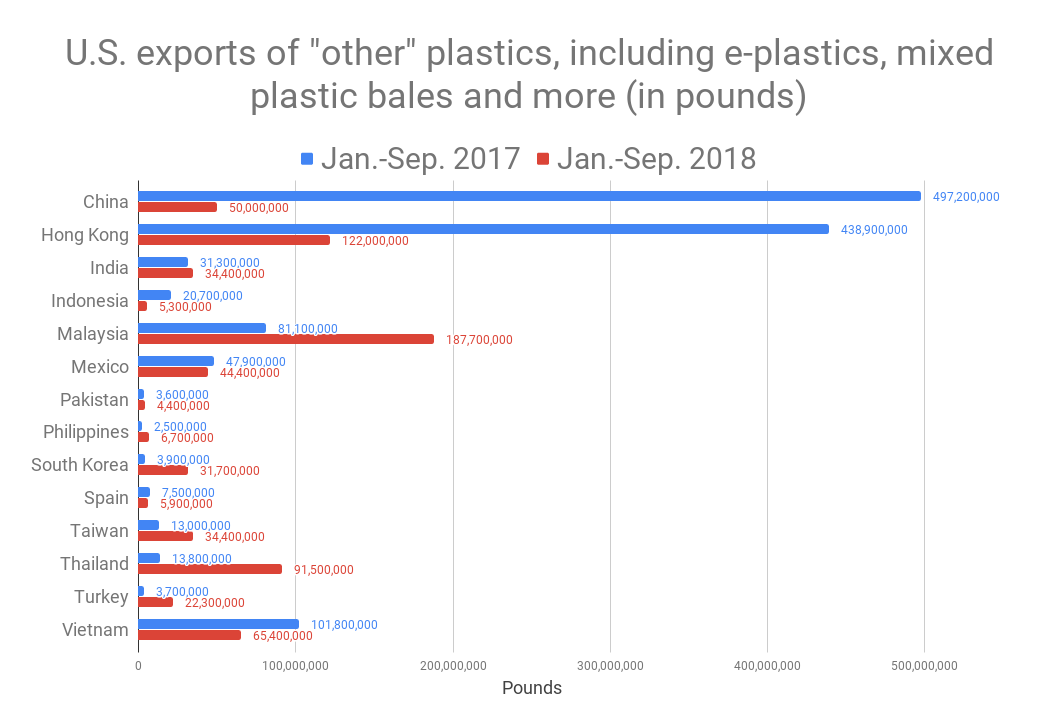
Chart detailing destinations of some U.S. plastics exports.

Taiwan: Scrap material imports have risen sharply this year, and Taiwan’s environmental protection agency in October acted to tamp down the trend.

In early October, regulations took effect reducing the types of material allowed for import. According to the Tai Pei Times, companies can only import post-industrial plastic from their overseas production facilities or loads of a single material type. It’s unclear whether certain polymers are banned altogether.

In response, the CMA-CGM shipping line immediately suspended plastic shipments to Taiwan. Shipping company APL also added Taiwan to the list of countries it will not ship scrap plastic to as of early October.

Hapag-Lloyd told customers that loads in violation of the new restrictions would be returned with penalty charges to the exporter. As a result, Hapag-Lloyd is requiring plastic exporters to submit a letter of indemnity before a shipment can take place.

Malaysia: Plastics Recycling Update, sister publication to E-Scrap News, reported late last month on import requirements the Malaysian government is working on. It’s unclear when those rules will take effect. In the meantime, the government is not issuing import licenses for scrap plastic.

Steve Wong, executive director of the China Scrap Plastics Association, said Malaysia is proposing to only allow scrap plastic from the U.S., Europe and Japan.

Late last month, media outlets widely reported that Malaysia is planning to ban plastic imports in coming years, based on information presented at a meeting of several government ministries in October. But in mid-November, Malaysian Housing and Local Government Minister Zuraida Kamaruddin indicated there are no plans to ban scrap plastic shipments from industrialized countries. The statement was reported in Free Malaysia Today newspaper.

The ban has been described as an effort to reduce imports of non-recyclable plastics, rather than usable scrap materials.

China: The Chinese government has confirmed it will ban additional recovered materials, including post-industrial scrap plastic, at the end of the year. China announced in April that the expanded ban was coming. The confirmation was made public by Chinese state media agency Xinhua last month.

Post-consumer scrap plastic has been banned from import into China since the beginning of this year, but post-industrial scrap plastic has officially been allowed in. Very little plastic of either category has been shipped to China this year; U.S. exports to China are down by nearly 93 percent for the first three quarters of 2018 compared with the same period in 2017.

Even with that heavily diminished tonnage, China remains among the top importers of U.S. scrap plastics.

Additionally, China’s import restrictions continue to be a topic of discussion at World Trade Organization (WTO) meetings. According to a WTO news release, the U.S. and four other delegations questioned Chinese WTO representatives about the scrap material import restrictions during an Oct. 22 meeting of the Committee on Import Licensing.

The U.S. highlighted that Chinese manufacturers are being forced to use virgin material, and it said import restrictions could lead to “a heightened threat of increased marine litter,” according to the release. Canada asked for a specific list of materials that need import licenses and the procedures associated with importing those materials. The Australian delegation noted it appreciates China’s steps to cut down on pollution but the Chinese actions have been “more restrictive than necessary to achieve the desired objectives.”

In response, the Chinese delegation said it would submit more information about its restrictions to the WTO import license committee.

Photo credit: nattanan726/Shutterstock

 

IRT

Tags: AsiaE-PlasticsMarketsTrade & Tariffs
TweetShare
Colin Staub

Colin Staub

Colin Staub was a reporter and associate editor at Resource Recycling until August 2025.

Related Posts

Volatility reshapes outlook for US metals businesses

byScott Snowden
April 15, 2026

Panelists at the ReMA conference in Las Vegas said tariffs, reshoring and geopolitical tension are remaking trade flows, lifting US...

NERC launches hub to promote PCR demand 

byAntoinette Smith
April 15, 2026

The Northeast Recycling Council's PCR Material Demand Hub offers resources for government procurement, material- and product-specific resources, and certification and...

Industry group: Help us find the plastic bale volumes we need

PET bales sink further as other grades firm 

byRecyclingMarkets.net Staff
April 15, 2026

Pricing for HDPE and PP bales rose again, while PET bales remained low, film grades have steadied, and paper and...

Lead battery recycling market set for steady growth

byScott Snowden
April 14, 2026

The global lead battery recycling market is projected to grow steadily through 2034, supported by regulation, automotive replacement cycles and...

Matium raises $8m, adds buyer financing

byAntoinette Smith
April 14, 2026

A trade finance facility from the new Erebor Bank will help bridge the gap between buyer and seller payment terms...

GFL acquires SECURE Waste for $6.4bn

byStefanie Valentic
April 13, 2026

GFL Environmental has agreed to acquire SECURE Waste Infrastructure Corp. in a $6.4 billion deal that expands the waste hauler's...

Load More
Next Post

OCC and mixed paper: A tale of two exports

Leading the Charge in Safe Battery Recycling
Sponsored

Leading the Charge in Safe Battery Recycling

byThe Battery Network
April 13, 2026

We’re connecting people, brands, and communities through one nationwide network built to make battery recycling safer, simpler, and more accessible...

Read moreDetails

More Posts

EPR fees are a market signal. Here’s what they’re telling you.

EPR fees are a market signal. Here’s what they’re telling you.

April 10, 2026

Recycling Partnership CEO stepping down

April 15, 2026
Wolframite ore, the primary ore of tungsten from Altai, Russia

Tungsten scrap export controls draw industry attention

April 9, 2026
Battery recycler Ascend Elements files for bankruptcy

Battery recycler Ascend Elements files for bankruptcy

April 13, 2026

WM opens new $60m MRF in Indy

April 10, 2026

GFL acquires SECURE Waste for $6.4bn

April 13, 2026
Colorado regulators suggest mid-range EPR scenario

Why collaboration on plastic waste still matters

April 13, 2026
Industry group: Help us find the plastic bale volumes we need

PET bales sink further as other grades firm 

April 15, 2026
Solarcycle starts up Georgia recycling plant

S3399 signals a shift in how states are tackling solar panel waste

April 6, 2026
Bill to update New Jersey e-scrap program heads to governor

New Jersey recyclers talk EPR

April 9, 2026
Load More

About & Publications

About Us

Staff

Archive

Magazine

Work With Us

Advertise
Jobs
Contact
Terms and Privacy

Newsletter

Get the latest recycling news and analysis delivered to your inbox every week. Stay ahead on industry trends, policy updates, and insights from programs, processors, and innovators.

Subscribe

Welcome Back!

Login to your account below

Forgotten Password?

Retrieve your password

Please enter your username or email address to reset your password.

Log In

Add New Playlist

No Result
View All Result
  • The Latest
  • Analysis
  • Recycling
  • E-Scrap
  • Plastics
  • Policy Now
  • Conferences
    • E-Scrap Conference
    • Plastics Recycling Conference
    • Resource Recycling Conference
    • Textiles Recovery Summit
  • Magazine
  • About Us
  • Advertise
  • Archive
  • Jobs
  • Staff
Subscribe
This website uses cookies. By continuing to use this website you are giving consent to cookies being used. Visit our Privacy and Cookie Policy.