





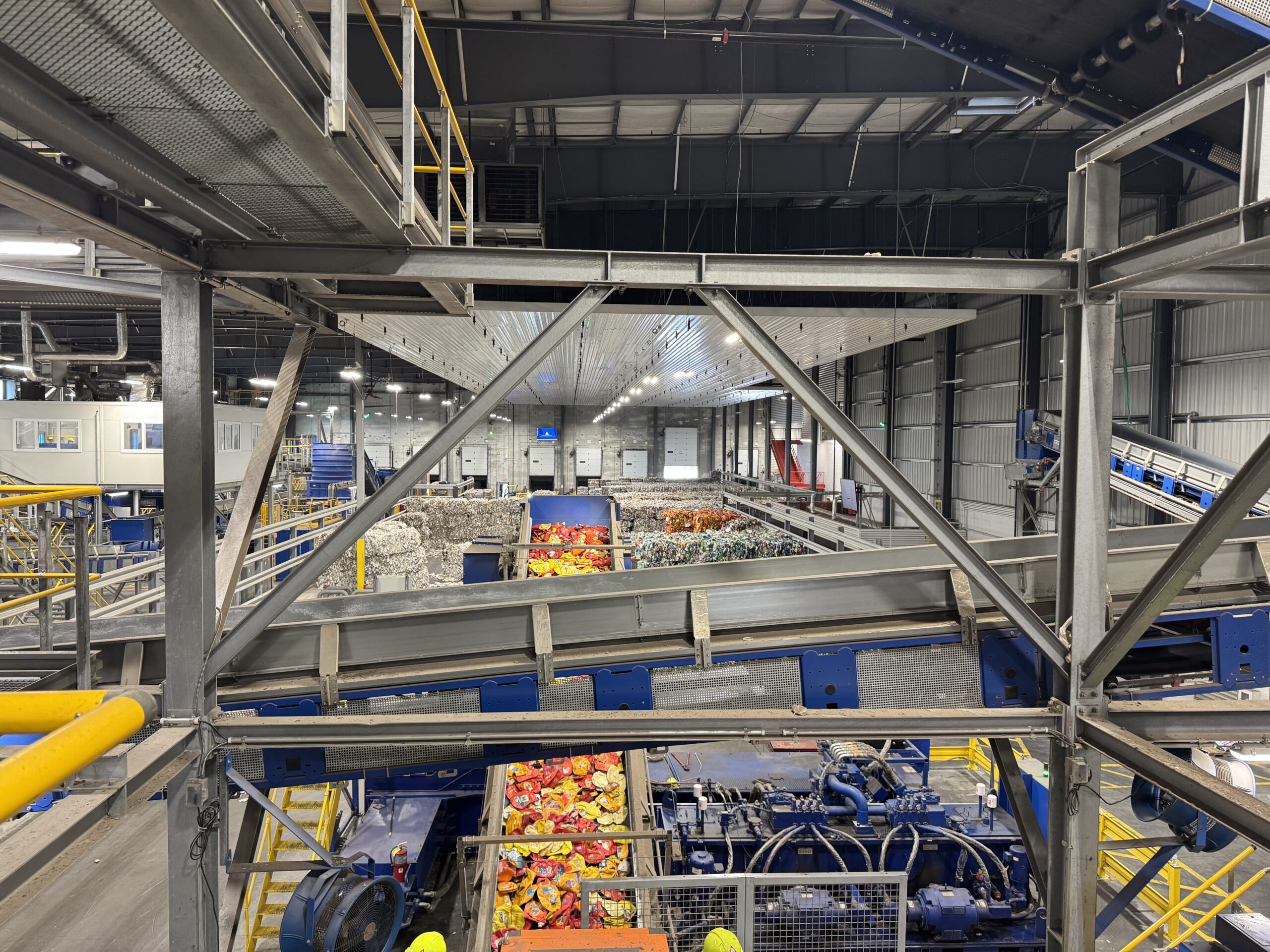
There are some lessons you get only on the plant floor, whether it’s a MRF, a secondary sorting facility or resin plant.
One of the perks of my job is the “inside baseball” exposure to the industry. My role as a journalist at a company owned by the Association of Plastic Recyclers (APR) enables me to attend industry events both external and internal.
A recent expedition took me to Indianapolis for APR’s three-day design training, their first foray outside of the typical one- or two-day offerings. This wasn’t my first training, but it was my favorite so far because of the exposure to the recycling value chain, from start to finish.
Each session has been different, not only because of the subject matter (APR held its first training on film and flexibles in 2025) and facilities featured, but also because of the attendees. And over the years, the training itself has adapted to increasing industry uncertainty.
As company budgets have tightened to reflect an extended downturn, APR aimed to make the programming more cost-effective and comprehensive, Curt Cozart told me. As chief operating officer of APR, he leads the training sessions.
Indianapolis is centrally located, and close to major operations representing the recycling value chain for both rigid polymers and plastic film: three Republic Services sites (a MRF, Polymer Center and joint venture Blue Polymers) and the Borouge International (formerly Nova Chemicals) film recycling plant.
(Past groups have toured a variety of MRFs, along with Indorama’s PET recycling facility near Dallas and WM’s Natura PCR mechanical recycling plant near Houston.)
Who’s in the room
The attendees are packaging designers and industry stakeholders, not marketing or PR people. They come from big, recognizable brands, as well as from companies that are less familiar to the public. They may design anything from the obvious – plastic bottles for your everyday condiments, for example – to the literal “fine print” of recyclability – labels, adhesives or inks.
“As specialists in what they do, they don’t get to see the bigger picture in their everyday work,” Cozart told me.
In addition to younger packaging designers from major brands and representatives from industry associations, the latest session included doctoral and post-doctoral candidates. Enabling them to attend with the help of partial scholarships introduces the training principles earlier in their careers, especially as the industry they enter increasingly makes recyclability a must-have rather than a nice-to-have.
Over the years, I’ve heard many times from engineers that classroom learning didn’t truly prepare them for the reality of working with plastics. So the training helps academics who have learned the theory to then see it in practice, Cozart said, and for current packaging designers to see technological advancements up close.
In my case, after seeing rows upon rows of PET bales at the Republic Services Polymer Center, I learned that the ones consisting entirely of one specific type of bottle can signal a problem. (Spoiler: they’re probably not post-consumer, but rather are rejects from bottle production, and this matters when it comes to certified PCR content.)
Dismantling industry silos
That bigger picture is exactly what’s often missing.
MRF operators and the “boots on the ground” industry veterans know all too well that every single piece of packaging affects its recyclability, from the cap to the ink the expiration date is printed with. So do ever-expanding MRF material acceptance lists.
For example, I recently attended a Wisconsin MRF stakeholder meeting, and it was a surprise to me that most of the locally owned/operated facilities in attendance have accepted paper cups for several years. My professional focus is largely on plastics, but also my main exposure to this substrate has been seeing that WM, the largest US hauler and recycler, added cups to its accepted list just last year.
My own example is just one of the many silos in the recycling industry even today – more than a year after the “OG” recycling targets from consumer brands were meant to take effect.
And that’s the value in the training, Cozart said – helping companies that have made wrong design decisions correct them, or better yet, to avoid them in the first place by providing guidance and breaking down those silos. APR staff are all industry veterans who know the history of packaging design choices because they lived through all the missteps and changing landscapes.
During the training, attendees asked questions industry people recognize well: Leave caps on or take them off? Mono-material? Pizza boxes, yes or no? (Spoiler: on, maybe and it depends.)
But in the past year or so, attendee questions have shifted to focus more on policy, as people throughout the supply chain realize the far-reaching implications of legislative decisions – and how the APR Design Guide is written into key laws, such as California’s SB 54.
What facilities see
Like many in the industry, I have been on numerous MRF tours, and no two have been alike. Each and every facility has something “new,” whether it’s new equipment or a new viewpoint, or even witnessing a process for the nth time, that makes the pieces click into place.
This trip brought the process into sharp focus for me – seeing the entire value chain in action and in sequential order.
The advances in equipment as well as in policy are driving a shift in today’s MRFs, Cozart told attendees. Thanks to ever-more intelligent sorting technology and AI-driven data on recycling streams, they’re producing better quality bales, with lower contamination rates.
The facilities are also much bigger, to provide an economy of scale and the best return on investment. They’re expanding accepted material lists, with more MRFs accepting PP, or paper cups, or PET thermoforms.
APR’s Design Guide is a living document, reflecting compatibility with sortation processes at both MRFs and reclaimers, as well as with washing systems.
The missing piece
Better sorting only matters if someone buys what comes out the other end.
A common theme has emerged in the past year or so. The US has the processing infrastructure to handle large volumes of recycled plastics. Even facilities that have closed amid the prolonged market downturn had nearly new equipment. But what’s missing is the demand.
The industry continues to focus on emerging policy that relates to recycling. But it’s becoming clear that harmonization – both domestically and globally – is crucial, to help streamline packaging design as well as understanding of regulations as they are implemented.
Cozart said, “Companies can’t talk to each other, but they can talk to APR, and APR can talk to other countries’ organizations to harmonize design guides.”
And while harmonizing standards doesn’t come easy, late last year five Canadian PROs announced they were joining forces to provide clear, consistent guidelines to make packaging design recyclable, with plastics guidance anchored in the APR Design Guide.
In the end, most of what I see and hear during design training sessions doesn’t make it into print or even get repeated, but the knowledge I gain as a layperson is invaluable in helping me understand the industry and to figure out where my work fits in. That’s what the training is really about: seeing the pieces connect.