Resource Recycling
  • The Latest
  • Analysis
    • All
    • Certification Scorecard
    • Industry Announcements
    • Opinion

    Certification Scorecard — Week of June 1, 2026

    IT asset disposition and electronics recycling: Now and then

    $60 billion in AI servers will create an ITAD challenge

    The independent ITAD at a crossroads

    DMD acquires ITAD firm Lifespan, outlines acquisition strategy

    Packaging policy is not one-size-fits-all

    Packaging policy is not one-size-fits-all

    Industry announcements for January 2026

    Industry announcements for June 2026

    Europe’s recyclers miss most of the critical materials

    Europe’s recyclers miss most of the critical materials

  • Conferences
    • Resource Recycling Conference
    • Plastics Recycling Conference
    • E-Scrap: The Longevity Conference
    • Textiles Recovery Summit
  • Publications
    • E-Scrap News
    • Plastics Recycling Update
    • Policy Now
    • Resource Recycling
    • Other Topics
      • All Topics
      • Brand Owners
      • Critical Minerals
      • Glass
      • Grant Watch / RFPs
      • Markets
      • Organics
      • Packaging
      • Research
      • Technology
      • Textiles
Subscribe
No Result
View All Result
Resource Recycling
  • The Latest
  • Analysis
    • All
    • Certification Scorecard
    • Industry Announcements
    • Opinion

    Certification Scorecard — Week of June 1, 2026

    IT asset disposition and electronics recycling: Now and then

    $60 billion in AI servers will create an ITAD challenge

    The independent ITAD at a crossroads

    DMD acquires ITAD firm Lifespan, outlines acquisition strategy

    Packaging policy is not one-size-fits-all

    Packaging policy is not one-size-fits-all

    Industry announcements for January 2026

    Industry announcements for June 2026

    Europe’s recyclers miss most of the critical materials

    Europe’s recyclers miss most of the critical materials

  • Conferences
    • Resource Recycling Conference
    • Plastics Recycling Conference
    • E-Scrap: The Longevity Conference
    • Textiles Recovery Summit
  • Publications
    • E-Scrap News
    • Plastics Recycling Update
    • Policy Now
    • Resource Recycling
    • Other Topics
      • All Topics
      • Brand Owners
      • Critical Minerals
      • Glass
      • Grant Watch / RFPs
      • Markets
      • Organics
      • Packaging
      • Research
      • Technology
      • Textiles
Subscribe
No Result
View All Result
Resource Recycling
No Result
View All Result
Home Recycling

Industry group blasts one segment of chemical recycling

byJared Paben
March 22, 2022
in Recycling
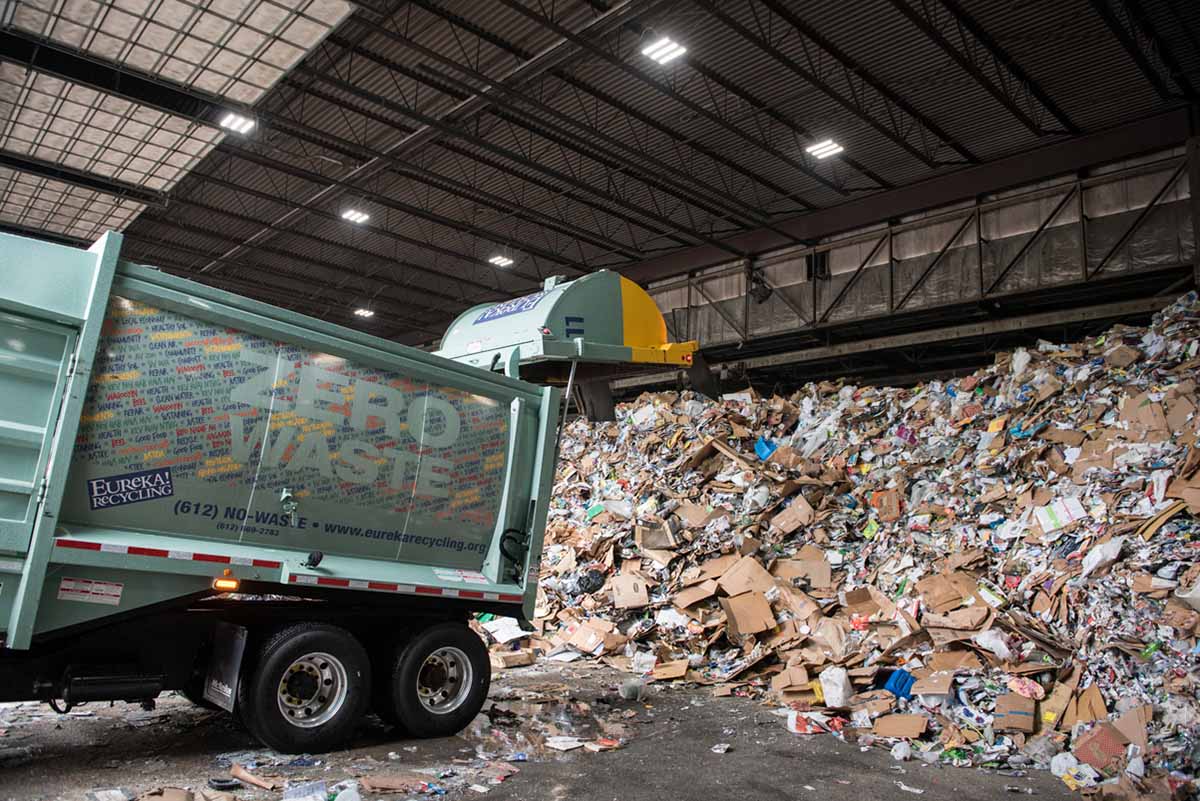
Eureka Recycling, which operates a MRF in Minneapolis, is a member of the Alliance of Mission-Based Recyclers, which criticized plastics-to-fuel processes. | Courtesy of Eureka Recycling

The Alliance of Mission-Based Recyclers called plastics-to-fuel processes “false solutions,” though the group of nonprofit recyclers says it is more open to technologies that are geared toward production of recycled resin.

The Alliance of Mission-Based Recyclers (AMBR) recently issued two reports about chemical recycling (sometimes referred to as “advanced recycling”).

“The end goals of any plastics recycling should be to reduce reliance on virgin fossil fuels and support a circular economy,” Lynn Hoffman, national coordinator for AMBR and co-president of Eureka Recycling, stated in a press release. “Every recycling system should be evaluated based on its ability to meet these goals, and chemical recycling fails the test.”

AMBR is made up of Eureka Recycling in Minneapolis; Eco-Cycle in Boulder, Colo.; Ecology Center in Berkeley, Calif.; and Recycle Ann Arbor of Ann Arbor, Mich. All run MRFs except Ecology Center, which collects curbside recyclables. 

The terms “chemical recycling” and “advanced recycling” generally refer to a wide array of processes that use heat, pressure and solvents to break down the molecular chains of polymers into liquids or gases that can then be processed into fuels, oils, waxes, new plastics, or other chemical products. 

They’re in contrast to the “mechanical recycling” of plastics, which generally refers to steps such as shredding/grinding, washing/drying, melting and extruding scrap plastic. Such processes leave the polymers’ molecular chains intact. 

In two AMBR reports issued March 16, the group argues that plastics-to-fuel technologies perpetuate a reliance on virgin fossil fuels, present risky financial investments, disproportionately impact people of color, and carry other downsides. 

One report is an eight-page overview document. The other is a more detailed 21-page guide for legislators, investors and municipalities. 

As alternatives to combat plastic litter and low recycling rates, AMBR recommends product bans, extended producer responsibility (EPR), bottle deposits, recycled-content laws, and requirements for environmental justice assessments of chemical recycling and solid waste facilities. 

Many of the comments in the report mirror those the AMBR made to the U.S. EPA a year ago, when EPA was seeking comments on what the agency should count in the nation’s recycling rate. 

Group leaves door open for plastics-to-plastics

The AMBR reports don’t completely slam the door on chemical recycling technologies, leaving some space for methods that return recovered resin to the plastics manufacturing pipeline.

“These plastics-to-plastics (PTP) recycling technologies have the potential to complement mechanical recycling programs, but they are also the least developed and most expensive ‘chemical recycling’ processes,” AMBR stated in the eight-page report. “They may play a role in reducing plastic pollution and fossil fuel use, but only when integrated into a larger systemic strategy to reduce, reuse, and then recycle necessary plastic packaging and products.”

A number of companies have announced investment in chemical recycling plants for the production of new plastic. 

For example, Eastman is spending up to $250 million on a facility in Kingsport, Tenn., and the company announced plans for a $1 billion depolymerization plant in France. Public relations consultants working for the company have been consistently issuing press releases about new consumer products made with Eastman’s chemically recycled resins. 

Additionally, plastics producer Saudi Basic Industries Corporation (SABIC) and chemical recycling company Plastic Energy are producing chemically recycled resins for use in Unilever packaging and Tupperware products. Packaging producer Berry Global is also working to use chemically recycled resin. 

Despite the drumbeat of announcements about chemical recycling investments, the sector is still relatively nascent, with the vast majority of plastic used in manufacturing today continuing to be virgin material.

In a statement in response to the AMBR reports, the American Chemistry Council (ACC), which represents plastics producers, noted that plastics companies have invested billions into the technologies to convert more used plastics into new plastic and products. ACC says that since 2017, over 70 projects have been announced, representing $7.7 billion in investments. They have the potential to divert at least 12.1 billion pounds of plastic from landfills, said Joshua Baca, vice president of plastics at ACC.

“Calling advanced recycling a process that ‘burns plastic’ or is focused only on making fuels ignores the facts and is an effort to try to keep plastics out of our economy,” Baca said. “Advanced recycling is a game-changing technology that is critical to accelerating a circular economy. Today it is producing top-quality new plastics that are suitable for the most demanding applications, including food contact, pharmaceutical and medical use.”

In its analysis, AMBR said plastics-to-plastics technologies could be viable if they meet several criteria. 

Those include the following: They rely on transparent reviews of environmental and human health impacts, address gaps that aren’t already being filled by mechanical recycling, recover at least 75% of incoming feedstock, maintain valid agreements with buyers using the outputs in new products or packaging, and pay a price for feedstock that at least covers MRFs’ sorting and sales costs.

 

MAX-AI from BHS

Tags: Industry GroupsPlastics
TweetShare
Jared Paben

Jared Paben

Related Posts

PureCycle maintains price expectations for its R-PP resin

EPR clarity is driving brand demand, says PureCycle CEO

byStefanie Valentic
June 1, 2026

With SB 54 registered and lawsuits already filed, PureCycle CEO Dustin Olsen says the fight over what counts as recycling...

Q1 containerboard exports drop by 19%

What SB 54 looks like from the packaging floor

byStefanie Valentic
June 1, 2026

With compliance deadlines coming on quickly, smaller companies are struggling to absorb changes and stay on the right side of...

Film and flexibles recycling needs collaboration

byBrian Clark Howard
May 29, 2026

Experts from the Film & Flex Recycling Alliance, US Flexible Film Initiative (USFFI), Delterra, The Recycling Partnership and Circular Action...

California extends compostable labeling law

California bills crack down on false recycling, compostable claims

byStefanie Valentic
May 29, 2026

Three bills targeting recycling and compostables labeling have cleared key hurdles as California's session deadline nears.

Chemical recycling roundup: New plant, partnerships

Polystyrene’s circular future is already taking shape

byJustin Riney, Polystyrene Recycling Alliance
May 29, 2026

Justin Riney of the Polystyrene Recycling Alliance explores a study conducted with the Resource Recycling Systems consultancy.

California provides funding to boost thermoform recycling

APR and ANIPAC promote recycling in Mexico

byBrian Clark Howard
May 27, 2026

The two organizations are working to better harmonize the handling of plastics in North America.

Load More
Next Post

News from Corona, RePurpose Global and more

More Posts

Machinex

Longview mill tragedy raises broader questions for fiber, recycling sectors

May 29, 2026
Recycling industry addresses Beyond Plastics report

Recycling industry addresses Beyond Plastics report

May 26, 2026
Fire at an EMR recycling facility in Camden, New Jersey May 29, 2026.

EMR faces shutdown calls after numerous fires

June 2, 2026
The independent ITAD at a crossroads

DMD acquires ITAD firm Lifespan, outlines acquisition strategy

June 2, 2026
What a report on Starbucks cups reveals about recycling

What a report on Starbucks cups reveals about recycling

May 26, 2026
War, not demand driving polymer pricing

War, not demand driving polymer pricing

June 2, 2026
Q1 containerboard exports drop by 19%

What SB 54 looks like from the packaging floor

June 1, 2026
California extends compostable labeling law

California bills crack down on false recycling, compostable claims

May 29, 2026
IT asset disposition and electronics recycling: Now and then

$60 billion in AI servers will create an ITAD challenge

June 3, 2026
BASF, Encina expand circular feedstock partnership

BASF, Encina expand circular feedstock partnership

June 3, 2026
Load More

About & Publications

About Us

Staff

Archive

Magazine

Work With Us

Advertise
Jobs
Contact
Terms and Privacy

Newsletter

Get the latest recycling news and analysis delivered to your inbox every week. Stay ahead on industry trends, policy updates, and insights from programs, processors, and innovators.

Subscribe

Welcome Back!

Login to your account below

Forgotten Password?

Retrieve your password

Please enter your username or email address to reset your password.

Log In

Add New Playlist

No Result
View All Result
  • The Latest
  • Analysis
  • Recycling
  • E-Scrap
  • Plastics
  • Policy Now
  • Conferences
    • E-Scrap Conference
    • Plastics Recycling Conference
    • Resource Recycling Conference
    • Textiles Recovery Summit
  • Magazine
  • About Us
  • Advertise
  • Archive
  • Jobs
  • Staff
Subscribe
This website uses cookies. By continuing to use this website you are giving consent to cookies being used. Visit our Privacy and Cookie Policy.