





Resource Recycling
  • The Latest
  • Analysis
    • All
    • Certification Scorecard
    • Industry Announcements
    • Opinion
    The electronics recycling industry is undergoing a transformation from labor-intensive manual operations to highly automated, AI-driven facilities that use advanced robotics, cleaner chemistry and digital tracking systems to extract critical materials.

    The cyber-physical MRF: AI and robotics reshape e-waste recovery

    Certification scorecard for the week of Feb. 9, 2026

    Meta-Corning deal signals IT hardware retirement wave

    Meta-Corning deal signals IT hardware retirement wave

    Malaysia clamps down on illegal e-waste imports amid probes

    Malaysia clamps down on illegal e-waste imports amid probes

    URT builds alliance to remake electronics plastics at scale

    ICYMI: Top 5 e-scrap stories from January 2026

    The electronics recycling industry is undergoing a transformation from labor-intensive manual operations to highly automated, AI-driven facilities that use advanced robotics, cleaner chemistry and digital tracking systems to extract critical materials.

    Certification scorecard for the week of Feb. 2, 2026

    Auditors warn EU may fall short on critical metals

    Auditors warn EU may fall short on critical metals

    Industry announcements for January 2026

    Industry announcements for February 2026

    ICYMI: Top 5 recycling stories from January 2026

  • Conferences
  • Publications

    Other Topics

    Textiles
    Organics
    Packaging
    Glass
    Brand Owners

    Metals
    Technology
    Research
    Markets
    Grant Watch

    All Topics

Subscribe
No Result
View All Result
Resource Recycling
  • The Latest
  • Analysis
    • All
    • Certification Scorecard
    • Industry Announcements
    • Opinion
    The electronics recycling industry is undergoing a transformation from labor-intensive manual operations to highly automated, AI-driven facilities that use advanced robotics, cleaner chemistry and digital tracking systems to extract critical materials.

    The cyber-physical MRF: AI and robotics reshape e-waste recovery

    Certification scorecard for the week of Feb. 9, 2026

    Meta-Corning deal signals IT hardware retirement wave

    Meta-Corning deal signals IT hardware retirement wave

    Malaysia clamps down on illegal e-waste imports amid probes

    Malaysia clamps down on illegal e-waste imports amid probes

    URT builds alliance to remake electronics plastics at scale

    ICYMI: Top 5 e-scrap stories from January 2026

    The electronics recycling industry is undergoing a transformation from labor-intensive manual operations to highly automated, AI-driven facilities that use advanced robotics, cleaner chemistry and digital tracking systems to extract critical materials.

    Certification scorecard for the week of Feb. 2, 2026

    Auditors warn EU may fall short on critical metals

    Auditors warn EU may fall short on critical metals

    Industry announcements for January 2026

    Industry announcements for February 2026

    ICYMI: Top 5 recycling stories from January 2026

  • Conferences
  • Publications

    Other Topics

    Textiles
    Organics
    Packaging
    Glass
    Brand Owners

    Metals
    Technology
    Research
    Markets
    Grant Watch

    All Topics

Subscribe
No Result
View All Result
Resource Recycling
No Result
View All Result
Home Recycling

July trade analysis: Plastics imports nosedive in Thailand

Colin StaubbyColin Staub
September 11, 2018
in Recycling

A Thai policy restricting the import of scrap plastics has proved effective. U.S. scrap plastic exports to the country dropped by 94 percent after the ban took hold.

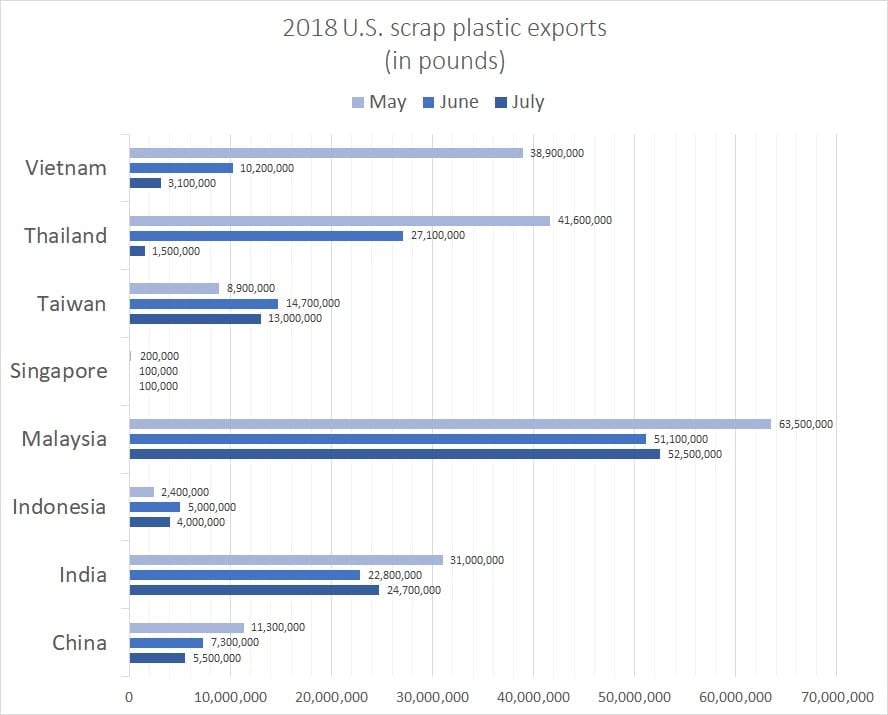
U.S. exporters sent 1.5 million pounds of recovered plastic to Thailand in July, the most recent month for which statistics are available. That’s a substantial decline from the 27.1 million pounds the U.S. shipped to Thailand in June, as well as the 41.6 million pounds sent in May.

The latest export figures were released last week by the U.S. government.

Plastics down but paper rises

Thai authorities in late June announced they would halt scrap plastic imports amid a rising volume of material stuck at ports. In late August, the government described plans to make the ban permanent within two years.

Overall, U.S. exporters sent 203.1 million pounds of scrap plastic to Thailand from January through July, up from 15.5 million pounds during that period in 2017.

The July 2018 figure is by far the lowest volume shipped from the U.S. to Thailand this year.

Meanwhile, U.S. recovered paper exports to Thailand in July increased to their highest monthly volume for the year. The country brought in 54,000 short tons of recovered paper in July, up from 37,000 short tons in June and well above its average of 32,000 tons per month for the January-July 2018 period.

Even with the increase, Thailand still imports just a fraction of the volume of recovered paper consumed by China.

Plastics elsewhere in the region

Vietnam and China both imported their lowest U.S.-sourced plastics volumes of the year in July.

Vietnam brought in 3.1 million pounds, down from 10.2 million pounds in June and significantly down from 38.9 million pounds in May. The drop accompanied growing interest by the Vietnamese government in restricting scrap plastic flowing into the country. Officials in July announced they would stop issuing new scrap import licenses.

China imported 5.5 million pounds of scrap plastic from the U.S. in July. It’s the lowest volume of the year and is down from the 7.3 million pounds shipped to China the previous month. Overall, China imported an average of 10.3 million pounds of scrap plastic from the U.S. per month during the January-July period.

Other Southeast Asian nations stayed fairly consistent in their U.S.-sourced imports in July.

Malaysia imported 52.5 million pounds of U.S. scrap plastic, close to its 2018 monthly average of 56.1 million pounds. Taiwan brought in 13 million pounds from the U.S., near its average of 10.1 million pounds per month. India imported 24.7 million pounds, on par with its monthly average of 25.5 million pounds. Indonesia received 4 million pounds, up slightly from its average of 3.2 million pounds per month this year.

Singapore, which has varied widely in its imports throughout the year, received 117,000 pounds from the U.S. in July, up slightly from its June volume of 99,000 pounds but down from its average of 212,000 pounds per month. Much of the material that moves into Singapore is re-exported to other Southeast Asian countries.
July paper export trends

On the fiber side, China imported its lowest volume of U.S. recovered fiber for the year. The country, which is still by far the largest importer of scrap paper from the U.S. despite its recent restrictions, brought in 486,000 short tons in July, down from 708,000 tons in June.

Like Thailand, a number of Southeast Asian nations brought in their highest monthly volume of scrap paper for the year in July. Vietnam imported 122,000 short tons of U.S. scrap paper, well up from its year-to-date average of 76,000 tons per month. Taiwan brought in 95,000 short tons, above its year-to-date average of 58,000. Malaysia imported its largest volume by far, bringing in 24,000 short tons compared with 10,000 in June and an average of 3,000 per month from January through May.

India stayed on par with its June imports, bringing in 271,000 short tons compared to 276,000 in June. Indonesia imported 122,000 short tons during July, down from its June high of 136,000 tons but still well up from its January through May imports, which averaged 71,000 tons per month.

Similar to its plastics imports, Singapore’s recovered paper import figures have fluctuated throughout the year. In July, the country imported just 275 short tons of scrap paper.
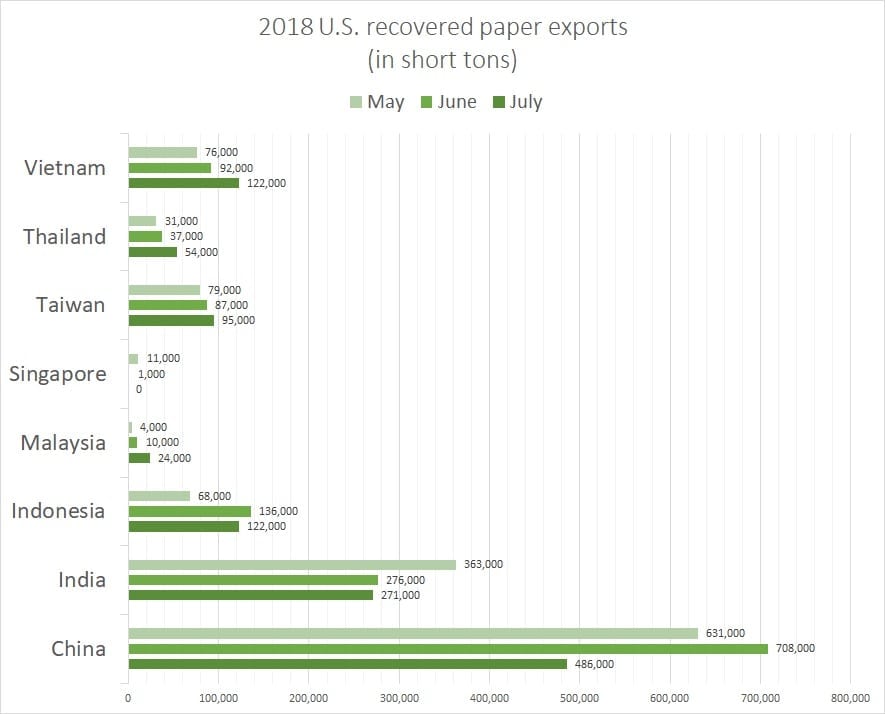
Photo credit: joachim affeldt/Shutterstock

 

Tags: MarketsPaper FiberPlasticsTrade & Tariffs
TweetShare
Colin Staub

Colin Staub

Colin Staub was a reporter and associate editor at Resource Recycling until August 2025.

Related Posts

NERC: Blended average prices fell 40% in third quarter

HDPE, PP bales rise as paper fiber and cans stabilize

byRecyclingMarkets.net Staff
February 12, 2026

National average prices of post-consumer material bales were flat to higher on the month.

Alpek talks PET overcapacity, soft demand

byAntoinette Smith
February 11, 2026

Executives from the Mexico-headquartered polyester giant said the Chinese government has acknowledged issues and convened PET producers, but Alpek is...

Terex beats ESG integration targets as REV group merger closes

byStefanie Valentic
February 11, 2026

Terex exceeded $25 million in ESG integration synergy targets and completed its REV Group merger, expanding its specialty equipment platform...

Packaging Corp. to buy Greif containerboard segment

Export trends offset containerboard production decline

byStefanie Valentic
February 6, 2026

AF&PA reported a 4% decline in containerboard production for 2025, while packaging paper shipments rose 2% in December and boxboard...

Malaysia clamps down on illegal e-waste imports amid probes

Malaysia clamps down on illegal e-waste imports amid probes

byDavid Daoud
February 6, 2026

Malaysia’s growing role as a hub for global e‑scrap is colliding with corruption probes, large container seizures and regional backlash. ...

States push recycling reform forward in new year

byStefanie Valentic
February 2, 2026

New Jersey just passed a bill restricting single-use plastic items, California has opened another round of public comment on SB...

Load More
Next Post

Survey quantifies insulation industry's glass usage

More Posts

Oregon’s Recycling Modernization Act faces injunction

Court partially blocks Oregon EPR law, dismisses bulk of lawsuit

February 10, 2026
Chinese processing group details goals for US visit

AMP lays out vision of next-generation, AI-driven MRFs

July 24, 2024
Malaysia clamps down on illegal e-waste imports amid probes

Malaysia clamps down on illegal e-waste imports amid probes

February 6, 2026

REUSE Act heads to US House for consideration

February 9, 2026

APR, industry create proactive guidance for PET caps

February 12, 2026

ecoATM recycled 7.5M phones in 2025 as payouts hit $1.5B

February 10, 2026
Meta-Corning deal signals IT hardware retirement wave

Meta-Corning deal signals IT hardware retirement wave

February 9, 2026
Texas sues over dumped wind turbine blades

Texas sues over dumped wind turbine blades

February 10, 2026

Alpek talks PET overcapacity, soft demand

February 11, 2026
The electronics recycling industry is undergoing a transformation from labor-intensive manual operations to highly automated, AI-driven facilities that use advanced robotics, cleaner chemistry and digital tracking systems to extract critical materials.

The cyber-physical MRF: AI and robotics reshape e-waste recovery

February 12, 2026
Load More

About & Publications

About Us

Staff

Archive

Magazine

Work With Us

Advertise
Jobs
Contact
Terms and Privacy

Newsletter

Get the latest recycling news and analysis delivered to your inbox every week. Stay ahead on industry trends, policy updates, and insights from programs, processors, and innovators.

Subscribe

Welcome Back!

Login to your account below

Forgotten Password?

Retrieve your password

Please enter your username or email address to reset your password.

Log In

Add New Playlist

No Result
View All Result
  • The Latest
  • Analysis
  • Recycling
  • E-Scrap
  • Plastics
  • Policy Now
  • Conferences
    • E-Scrap Conference
    • Plastics Recycling Conference
    • Resource Recycling Conference
    • Textiles Recovery Summit
  • Magazine
  • About Us
  • Advertise
  • Archive
  • Jobs
  • Staff
Subscribe
This website uses cookies. By continuing to use this website you are giving consent to cookies being used. Visit our Privacy and Cookie Policy.