





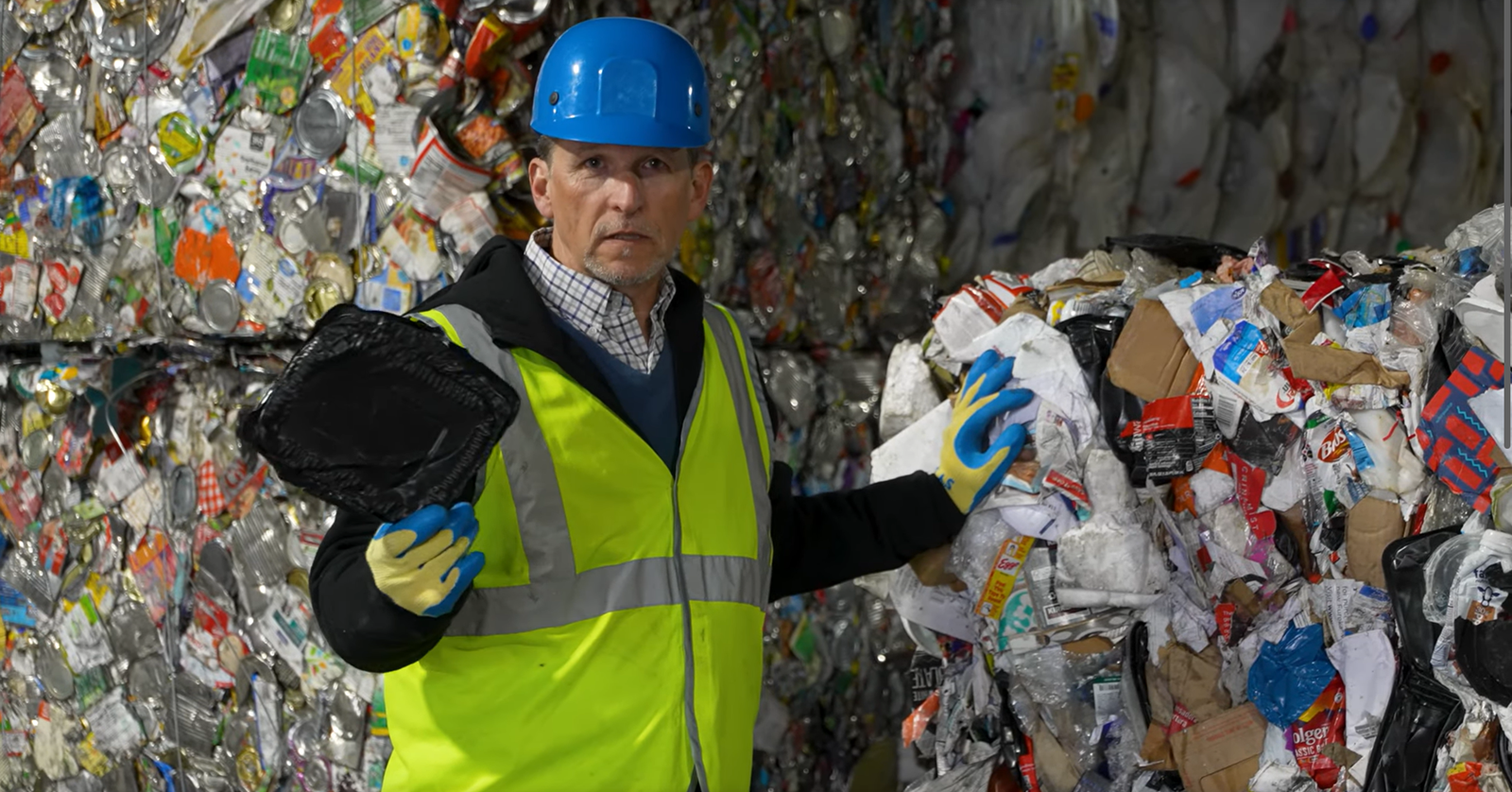
MRF operators linked by an organizational belief that recycling is just one part of materials management recently hosted a film screening and discussion that touched on policy, chemical recycling and the nuances of alternative collection systems like TerraCycle and Ridwell.
The Alliance for Mission Based Recycling, or AMBR, is a small group of MRF operators that came together in 2019. The group counts as members Minnesota-based Eureka Recycling, Colorado-based Eco-Cycle, the California-based Ecology Center and Michigan-based Recycle Ann Arbor.
The organizations are nonprofit recycling firms that share an interest in zero waste, and they differentiate themselves from the major haulers that operate both recycling programs and landfills.
The group recently hosted an online screening of “Chasing Arrows: The Truth About Recycling,” featuring AMBR member organizations, which was produced by Peak Plastic Foundation two years ago. After the screening, leaders of member organizations, as well as a guest from the Ocean Conservancy, held a wide-ranging discussion.
Martin Bourque, executive director of the Ecology Center, said one of his top concerns in the policy space is legislation that treats chemical recycling as production rather than disposal. This is a trend that gained traction over the past few years, with dozens of states passing legislation that regulates chemical recycling processes as manufacturing rather than waste management.
Advocates for these bills, including the American Chemistry Council, say they remove barriers to adoption of the emerging technology. AMBR members are opposed to the bills for that very reason.
“Basically, if they have to get through the same regulatory processes as other waste facilities, it’s pretty hard to build them, anywhere in the country,” Bourque said. He noted that legislation easing chemical recycling development anywhere in the country could affect recycling in other states.
“I don’t want to export California’s unrecyclable plastic waste to some chemical processor in another state that has lower standards,” Bourque said.
EPR and ‘bridge’ strategies
Anja Brandon, associate director of U.S. plastic policy for Ocean Conservancy, said she’s excited about the extended producer responsibility policies that are increasingly being passed in states. Ocean Conservancy has seen EPR policies as upstream tools to further the organization’s mission of reducing marine pollution.
“Specifically, the inclusion of upstream redesign standards and real targets that get at reduction and reuse,” Brandon said. These policies create a framework to require or heavily incentivize that producers design packaging with reduction, reuse and recycling in mind.
“Baking that into the policy, now that we have a regulatory foothold to require producers to do better, to require producers to pay, using that to drive producers in a direction that is best for people and the planet,” Brandon said.
Miriam Holsinger, co-president of Eureka Recycling, described the nuance involved with using what she called “bridge strategies,” temporary measures in pursuit of a longer-term goal. She said temporary measures — for instance, adding more product types into the curbside bin rather than phasing out those products in favor of readily recyclable materials or less packaging altogether — can have a place, but they need to be tightly designed.
“I understand we’re not at zero waste yet, and we have to have a path to get there,” Holsinger said. “But we have to acknowledge when is this a bridge strategy and when is that deadline.”
Holsinger referenced the numerous brand owners that made materials reduction and recycling goals with a 2025 target deadline. As that year approaches, many of those companies have pushed those deadlines out to 2030 or beyond, so “we really have to be firm about, when is the end of that bridge strategy.”
Holsinger offered optimism that, given technological advances in some fields, packaging can be reworked to have less of an environmental impact.
“If we can create cell phones and this technology that allows us all to be on this call at the same time, of course we can create better solutions for how to get us our coffee … potato chips and stuff,” she said.
Ins and outs of on-demand collection
Along the lines of innovation and new thinking in materials management, numerous attendees chimed into the chat to mention emerging collection systems that go beyond traditional curbside or drop-off recycling. Chief among them: Ridwell and TerraCycle, two subscription-based collection systems for hard-to-recycle products that are typically not accepted in curbside programs.
Attendees questioned whether it was environmentally damaging to say certain products aren’t recyclable and should be put in the garbage when they are accepted by these types of services.
Bourque of the Ecology Center said TerraCycle is the most widely known company that has offered this for some years, but he said there are drawbacks.
“It’s pretty expensive and not really financially accessible to most people,” he said. “It’s sort of feel-good in many regards, not really an across-the-board system.”
He also referenced the legal actions TerraCycle has faced for various aspects of its business model. For example, in 2021, TerraCycle and several brand owners were sued in California, with the plaintiff — the nonprofit Last Beach Cleanup — alleging the companies were deceiving consumers over the recyclability of products. That lawsuit was settled several months later with TerraCycle adjusting its recycling labels, facilitating third-party auditing of its recycling programs and other provisions.
Ridwell is a newer player, but unlike TerraCycle, Ridwell provides doorstep collection of hard-to-recycle materials. It has received significant venture capital funding and has rolled out in eight major markets nationwide, including the San Francisco Bay Area where the Ecology Center operates.
“We’ve engaged with them quite a bit about what are their markets,” Bourque said. “They’ve pretty compellingly convinced us they have markets for the things they’re collecting.”
He added the caveat that, since the materials are harder to recycle and there are fewer available end markets, they may fluctuate more, so Ridwell may face downstream instability.
Bourque noted that, like TerraCycle, the cost could be prohibitive for many U.S. households. Depending on the level of service, Ridwell can cost between $14 and $24 per month.
Holsinger touched on the alternative collections as well, saying that while they can be helpful, they risk complicating a recycling system that already leaves many consumers confused.
“We certainly want to allow ways for people to test and create new things and methods and ways to handle things, but we also are really struggling with a recycling system that’s already way too complicated,” Holsinger said. “So I think if we’re actually going back to our goals of keeping it in the ground, reducing the impact on the environment and supporting our communities, having a subscription collection system is not a scalable answer.”
Holsinger tied the alternative collection model back to the concept of a bridge strategy: It can be helpful in the short term, but it doesn’t negate the need for sweeping design changes upstream.
“We need recycling to get more simple,” Holsinger said. “Instead of us (doing) a million different things and (having) a million different bins in our houses — where we have this that goes to dropoff, this that goes to Ridwell, this which we mail back to TerraCycle — can we just get these companies to rein in their creativity and focus it on creating packaging that actually works in the system that we have, that is the most efficient system that we know of at this point?”