




Editor’s note: Textile recycling will be featured at the 2027 Textile Recovery Summit, March 1-3 in National Harbor, Maryland. Register today for the best rates!
NylaNova has partnered with nylon producer Nylene to supply recycled caprolactam, creating a potential outlet for mixed nylon waste as the startup works toward commercial production in 2028.
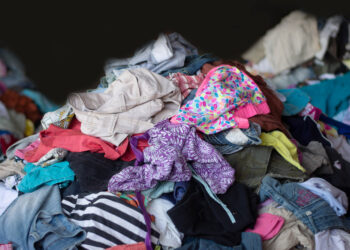
“We will source mixed nylon-6 waste that has little demand in recycling today: post-consumer carpet and apparel, plus post-industrial scrap,” said Richard Rapp, NylaNova’s vice president of engineering. “In our last tonne-scale production run, the feed was only 65% nylon, and it worked very well.”
Based in Evanston, Illinois, NylaNova uses catalysts developed at Northwestern University and exclusively licensed to the company to depolymerize nylon-6 into caprolactam, a building block for new nylon.
According to the company, roughly 2.75 million metric tons of nylon-6 are discarded worldwide annually, and almost none is converted back into nylon. The polymer is used in apparel, carpet and industrial applications.
The process can handle mixed apparel, carpet and industrial scrap without presorting, and NylaNova reports caprolactam yields above 90%. It has not specified a minimum nylon-6 content or contamination limits for incoming feedstock. The company did not identify the other materials in the latest pilot feed or disclose the caprolactam yield from that run.
The company remains in pilot production and has demonstrated continuous operation at tonne scale on off-the-shelf equipment.
“Our first commercial plant is planned for 2028 in the United States, with capacity to produce 20,000 metric tons of green caprolactam per year,” said Ananth Naman, NylaNova’s president.
NylaNova did not disclose a specific plant location and is continuing fundraising. Commercial terms of the Nylene partnership remain undisclosed, including purchase volumes, delivery dates and whether the arrangement is binding.
Nylene produces nylon resins, copolymers and compounds for markets including automotive, packaging, carpet and fiber. It has recycled nylon-6 at its Arnprior, Ontario, facility since 1966, according to the announcement.
“The mixed polymer post-consumer waste stream is not viable within our current operations, while NylaNova’s process is designed from inception for this underserved resource,” Scott Kuehl, Nylene’s business development and product manager, said.
NylaNova’s caprolactam would become an additional supply source for Nylene’s nylon-6 production. NylaNova also received a December 2025 grant from Apparel Impact Institute through its Climate Solutions Portfolio to support commercialization and scaling.
The startup’s emissions and pricing projections are based on commercial-scale modeling.
“The 95% figure comes from a screening life-cycle assessment done by a third-party firm, based on engineering estimates for our process at a commercial scale,” Rapp said.
According to the company, the cradle-to-gate assessment compares emissions per metric ton of caprolactam through the point it leaves the plant. The benchmark is virgin caprolactam produced through the conventional cyclohexane route. The study used the TRACI 2.1 impact assessment method and ecoinvent 3.12 background data, with the virgin and recycled routes modeled within the same framework.
Across the United States, Europe, China and India, projected emissions were 333 to 546 kilograms of carbon dioxide equivalent per metric ton of recycled caprolactam, compared with 8,420 to 8,866 kilograms for virgin material. That represents reductions of 94% to 96%.
Feedstock composition and recovery rates also affected the modeled results. The base case assumed waste containing 97% nylon-6 and conversion of 95% of that nylon into caprolactam, yielding a 95.6% emissions reduction.
A lower-performing scenario assumed feedstock containing 67% nylon-6 and recovery of 65% of the nylon as caprolactam. Emissions in that scenario were still 90.3% below the virgin benchmark, according to the company.
The assessment also projected environmental impact reductions of 62% to 98% across nine categories: global warming, ozone depletion, acidification, particulate matter, smog formation, human toxicity with cancer and non-cancer effects assessed separately, freshwater ecotoxicity and eutrophication. Apart from global warming, the largest reductions were in ozone depletion, acidification, particulate matter and smog, according to the company.
Naman said pricing competitive with virgin caprolactam is projected for commercial production, based on analyses conducted by several third-party firms. The company has not established that pricing through commercial operations.
“Our caprolactam has to meet the same specifications the nylon industry already runs on, with no changes to anyone’s process,” Naman said. “That is what we built the technology to do, and supplying Nylene is how we prove it.”