




Editor’s note: EPR and recycling policy will be featured in the 2027 Plastics Recycling Conference, March 1-3 in National Harbor, Maryland. Register today for the best rates!
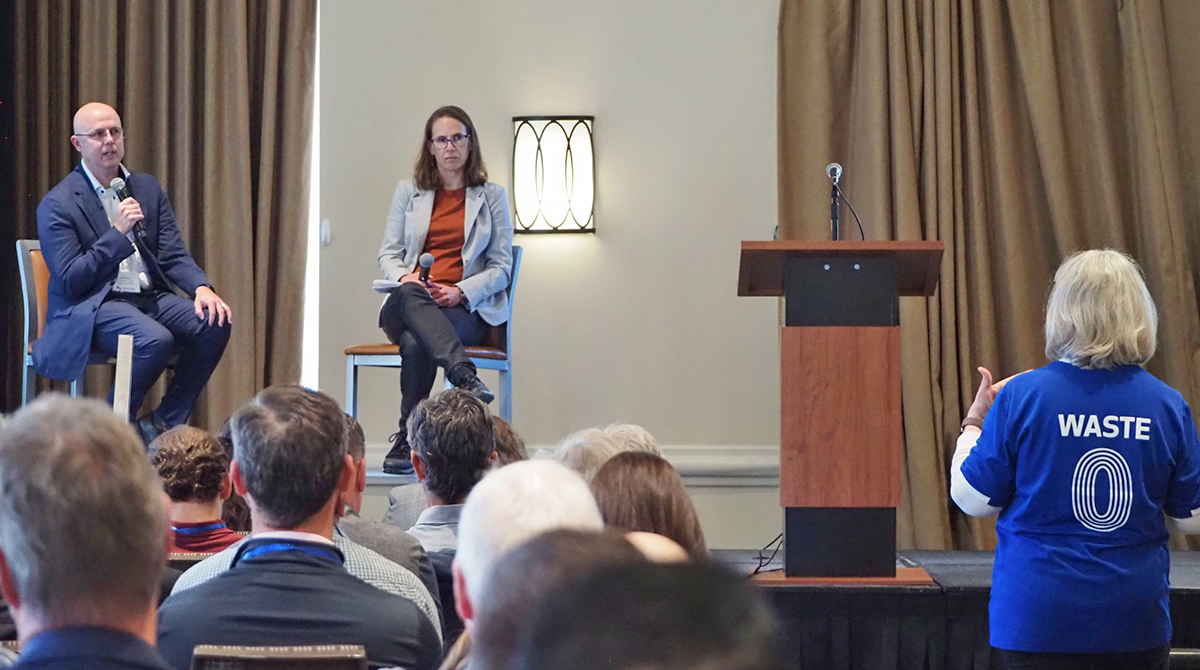
US implementation of extended producer responsibility (EPR) programs for packaging represents a paradigm shift, and this huge transition will require coordination and constructive feedback, the interim CEO of Circular Action Alliance (CAA) said during a panel discussion in New Orleans.
Jeff Meyers, who previously served as chief strategy officer of the producer responsibility organization (PRO), addressed a packed room of stakeholders during the fall member meeting of the Association of Plastic Recyclers (APR) on Oct. 27-29.
Meyers was recently named interim CEO of the PRO during a pivotal era for recycling systems.
APR owns Resource Recycling, Inc., publisher of Plastics Recycling Update.
During the meeting, audience members raised concerns about conflicting regulatory guidance, the need for regional market and education alignment, and support for reclaimers.
Meyers and moderator Kate Bailey, chief policy officer for APR, emphasized the need for real-time feedback on what elements of the program work and what don’t, what obstacles producers are encountering and more.
“We’re still learning, too,” Meyers said. “It’s important to get that feedback from the room. I’ve already cornered at least two of you and asked you what it would take to take more material from California. I’m getting some good, honest answers, which is what we need as we build a partnership together.”
He went on: “This is very different. We have no control. We can’t tell [them] to invest… We don’t own any materials. We literally have very little ability to [control outcomes], but we’re responsible for the targets. And so the only way that we can work is through [incentive] mechanisms… And that’s what keeps me up at night.”
Meyers and Bailey laid out what falls within the PRO’s remit – and what doesn’t.
The PRO’s role
A common misconception is that CAA participates in crafting EPR laws.
What a PRO does and does not do
PRO does
- Implement state law
- Help producers comply with laws
- Collect producer fees
- Provide reimbursement for operating the recycling system
- Provide reimbursement for education and behavior change
PRO does not
- Write state law
- Shape or change state law
- Haul recyclables or own/operate recycling facilities
Meyers said the laws themselves may eventually need changes. “I think time will tell, especially in this influence model we have in California. If we’re not making enough progress, there might have to be some adjustments,” he said.
He added, “We don’t want to control the industry. We don’t want to run reclaimers. But at the same time, we have to have mechanisms to help reach statute targets,” and demand will be among the most critical.
“There are areas that we don’t agree with the states on how they’ve assessed the laws, and we have differences of opinions, and we still work through that with the regulators,” Meyers said. “We’re still in a lot of discussions with CalRecycle on what different terminologies mean. We’re not fully aligned, and that’s part of what CAA does for producers. We’re trying to get clarity, and we don’t always get the clarity we want.”
California: ‘All systems go’
Meyers said that although pending litigation has added uncertainty to the January 2027 implementation of California’s landmark SB 54 legislation, CAA is taking an “all systems go” stance. If something changes, “we will pivot at that point, but we’re planning on launching, and everything is being done to mobilize.”
Addressing one of the most immediate concerns from California reclaimers, Meyers said two program components will help provide support. The first is the producer benefit for using up to 8% PCR content to count toward source reduction targets – which will incentivize PCR demand.
And “maybe even more importantly, we’re working on a second set of incentives for reclaimers to help improve their economics so they can better compete with [virgin resin] producers,” Meyers said.
Getting RPET pricing closer to parity with virgin resin “is going to be one of the most important levers, because without good quality and price equality or somewhere close to that, it’s going to be very hard to get the demand to flow,” he said.
Although the details are yet to be finalized, Meyers said he felt the amount would be “meaningful in the end.” CAA will roll out these reclaimer incentives for certain materials starting by June 2027, he said, with an application process that likely will occur from around March through May 2027.
A ‘design-to-demand’ approach
Much of CAA’s strategy centers on building demand and end markets, which the organization sees as regional. “There’s no plastics recycling without demand,” Meyers said.
He described the PRO’s “design-to-demand” approach: improve packaging design and material quality, invest in recycling capacity and encourage demand for recycled content. He stressed that materials must go to responsible end markets (REMs) to count toward recycling targets, and called for industry partners to “step up to the plate and do the hard work to get through that REM certification process.”
He acknowledged that California’s target of a 65% recycling rate for single-use plastic packaging and food service ware by January 1, 2032, is “really aspirational” and harder for some materials and formats than for others.
But the law allows for CAA to submit unique challenge exemption applications, to request adjusted, material-specific alternative phase-in metrics and annual reporting milestones for hard-to-recycle materials such as film and flexible packaging, PET thermoforms and certain cartons. (CAA is holding a Dec. 3 webinar on these exemptions.)
Learnings from Oregon
Now that Oregon has completed its first year of packaging EPR, the program has provided early examples of producer-funded investment – expanded recycling access and infrastructure, end-market reporting, and funding for MRF upgrades – as well as valuable lessons for the states following closely behind.
For one, finalizing hauler contracts has proven challenging, slowing the initial progress, Meyers said. “That doesn’t mean it’s broken or it’s flawed or it’s not working. It just takes time to get through contracts, especially with local jurisdictions,” which may have to obtain a city council vote to proceed. “So it’s just a lot of barriers to speed, I would say, in rolling it out.”
Bailey added that although “we think of this as seven states with laws,” CAA is negotiating with 270 municipalities in Colorado alone. “So that’s going to take a long time for all of those city lawyers to look at all of those reimbursement contracts.”
But on the positive side, because CAA didn’t spend the entire year-one budget, the PRO used the additional money to reduce producer fees in year two. “I think that’s an act of goodwill and showing building trust,” Meyers said.
Dynamic fee-setting methodology
Meyers said CAA built its first-year operating budget for California using a cost-to-manage model, allocating money to the different material types based on the cost for transport, MRF processing and so on.
He said this approach helps ensure that one material isn’t paying for another material’s cost, and provides fairness.
Bailey said the fees will send signals to the markets as well as determine how recycling will be funded. “So what we see today is not necessarily reflective of where things will go.”
Meyers said CAA will need to partner with APR to develop a fair and equitable eco-modulation framework, which will take time. He added that between eco-modulation and material-specific investments, fees will be increasingly differentiated based on packaging design. And he acknowledged that stakeholders may be disappointed about the lack of certainty, but said the wait was necessary. “I understand that people are looking at investments based on those numbers, but we can’t just make up a budget for something that we’re not actually going to deliver on.”
Harmonization
While CAA is trying to apply its fee-setting methodology as consistently as possible, state regulations differ in what the PRO must fund and in other areas, so “that will ultimately mean comparing state to state won’t make any sense because the scope is different,” Meyers said.
Meyers said as US and Canadian EPR programs develop and mature, CAA wants to see harmonization in several areas: regional end markets, education and outreach tools and resources.
“I have heard from our producers that they would like to see more consistency in education outreach, and I think we can all agree that you can go from city to city and hear two different messages about what’s recyclable and what’s not,” he said.
The ‘pre-operational’ states
CAA refers to the other states that have passed packaging EPR laws – Washington, Minnesota, Maryland and Maine – as “the emerging states.” But Meyers said a more apt term for three of them would be “pre-operational.”
Although implementation is still a year or more away for Washington, Minnesota and Maryland, “we need to be in planning mode now. We’re digesting all the statutes, looking at all the regulations, what it means for material strategies. All of that work has to happen concurrently.”
CAA is planning for those three states at once – an unprecedented task. “We run multiple setups and launches at the same time, but that actually gives us an advantage because the same people will write all three program plans,” providing consistency and a move toward national harmonization, he said. (Maine’s call for EPR program plans failed to attract any bidders.)
Bailey noted that right now, producers should be considering their packaging portfolio against a backdrop of all seven EPR states being fully operational, rather than only those that have already gone into effect.