Resource Recycling
  • The Latest
  • Analysis
    • All
    • Certification Scorecard
    • Industry Announcements
    • Opinion
    CommanderAI launches searchable hauler database

    Blancco brings agentic AI to data erasure, ITAD operations

    APR adds PCR content verification to cert program

    Certification scorecard — week of Oct. 12

    Ingram Micro looks to digital platform and AI

    APR training clicks recycling ‘pieces’ into place

    APR training clicks recycling ‘pieces’ into place

    Southeast grows into US’ critical mineral hub

    Sundry Photography / Shutterstock

    Iron Mountain adds ViaTeK Solutions to ITAD business

  • Conferences
    • Resource Recycling Conference
    • Plastics Recycling Conference
    • E-Scrap: The Longevity Conference
    • Textiles Recovery Summit
  • Publications
    • E-Scrap News
    • Plastics Recycling Update
    • Policy Now
    • Resource Recycling
    • Other Topics
      • All Topics
      • Brand Owners
      • Critical Minerals
      • Glass
      • Grant Watch / RFPs
      • Markets
      • Organics
      • Packaging
      • Research
      • Technology
      • Textiles
Subscribe
No Result
View All Result
Resource Recycling
  • The Latest
  • Analysis
    • All
    • Certification Scorecard
    • Industry Announcements
    • Opinion
    CommanderAI launches searchable hauler database

    Blancco brings agentic AI to data erasure, ITAD operations

    APR adds PCR content verification to cert program

    Certification scorecard — week of Oct. 12

    Ingram Micro looks to digital platform and AI

    APR training clicks recycling ‘pieces’ into place

    APR training clicks recycling ‘pieces’ into place

    Southeast grows into US’ critical mineral hub

    Sundry Photography / Shutterstock

    Iron Mountain adds ViaTeK Solutions to ITAD business

  • Conferences
    • Resource Recycling Conference
    • Plastics Recycling Conference
    • E-Scrap: The Longevity Conference
    • Textiles Recovery Summit
  • Publications
    • E-Scrap News
    • Plastics Recycling Update
    • Policy Now
    • Resource Recycling
    • Other Topics
      • All Topics
      • Brand Owners
      • Critical Minerals
      • Glass
      • Grant Watch / RFPs
      • Markets
      • Organics
      • Packaging
      • Research
      • Technology
      • Textiles
Subscribe
No Result
View All Result
Resource Recycling
No Result
View All Result
Home Plastics

AMP rebrands with a focus on supplying entire facilities

Colin StaubbyColin Staub
February 7, 2024
in Plastics
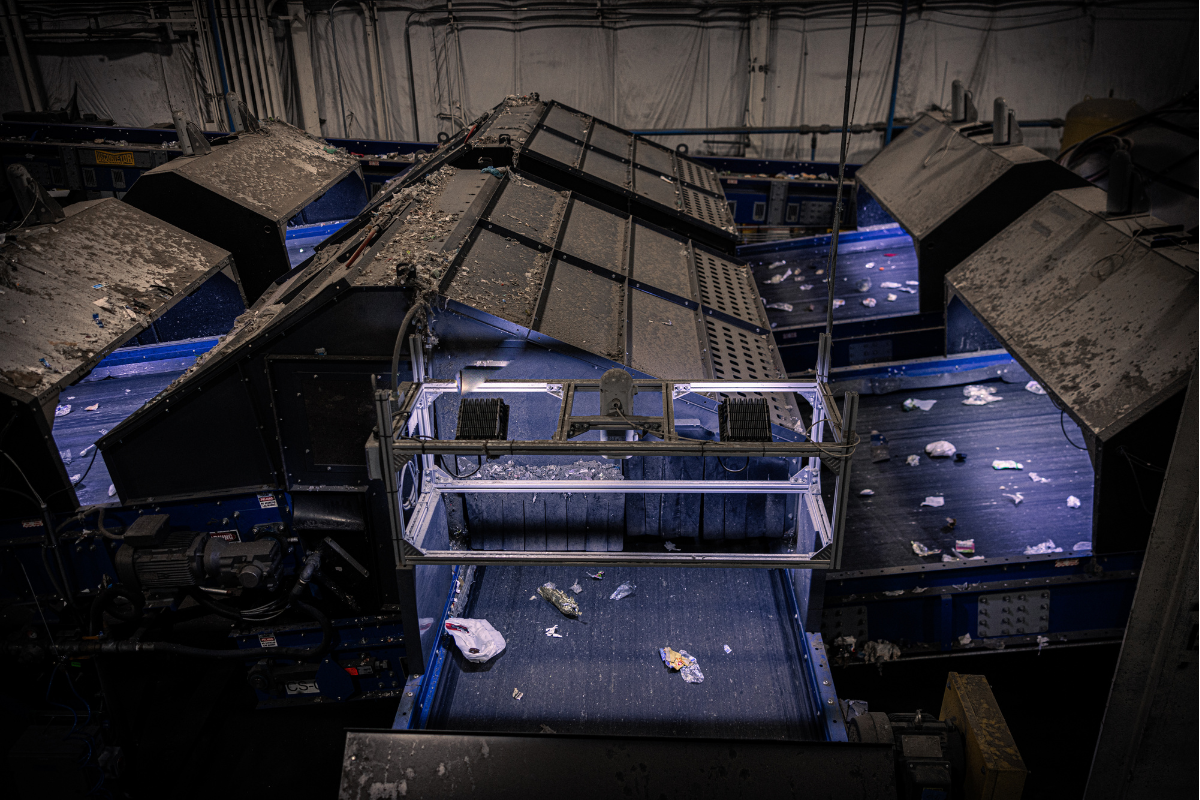
An AMP One fully automated AI sorting system operating at the company’s Cleveland, Ohio secondary sortation facility. | Courtesy of AMP

After 10 years helping materials recovery facilities retrofit with innovative robotics equipment, AMP Robotics has dropped the latter part of its name, reflecting an emerging focus on building recycling centers from scratch with AI-equipped sorting systems.

Based in Louisville, Colorado, AMP has expanded over the past decade from its roots as a fledgling tech startup piloting equipment in a local MRF to a major equipment supplier with units in facilities throughout North America. The company’s artificial intelligence (AI) and robotic sorting equipment is capable of processing all manner of municipal recyclables – including most plastic resins, fiber grades and metals – as well as e-scrap and even municipal solid waste (MSW).

As the company has neared the 10-year mark in the business of developing and supplying recycling industry equipment, it has begun a new focus on supplying facilities with a complete sorting system. It’s an evolution from installing one or two units on a sorting line, and it drove the company to remove “Robotics” from its name. A new website, AMPSortation.com, also reflects the focus on delivering full sortation systems.

“The story of the company has been this continual expansion of scope of AI in the industry and what’s possible,” said Matanya Horowitz, founder and CEO of AMP, in an interview. “But the transition to system levels, we think, is a bit of a seminal moment for the company.” 

The rebrand comes shortly after a round of layoffs at AMP late last year. Horowitz said the job cuts were unfortunate and were a response to broad macroeconomic trends that the company has to plan for, which guide its forecasts on purchasing and fundraising patterns. He noted the layoffs weren’t directly connected to the rebrand.

Entering new industry sectors

AMP began in late 2013 as a small operation, consisting of a workbench in Horowitz’s garage. “It was me buying stuff from Home Depot, smashing it up and putting it beneath the camera,” he recalls.

It steadily expanded from there, aided by multiple rounds of grant funding that enabled a small team of a half-dozen employees and a slightly larger workshop. By 2016, the company launched a pilot project installing one of its early robotic arms at a Denver-area MRF, Alpine Waste & Recycling. The project focused on carton recovery, with the AMP Cortex robotic arm plucking cartons off a sorting line and AMP learning about how to fine-tune the process.

“As I saw it, the first and most obvious opportunity was to help the industry with this problem of manual sorting in MRFs,” Horowitz said. 

In the years that followed, AMP’s units were installed in numerous MRFs across North America, not only improving sortation but also enabling facilities to collect new data and analyze changes in the inbound stream.

By 2021, AMP itself entered the sortation sector, starting up multiple secondary-sortation facilities around the country. These centers began bringing in bales of mixed plastics and residual materials from MRFs and other suppliers, sorting them using the company’s AI and growing suite of sorting equipment, and producing plastics and fiber grades for sale into end markets. 

Integrating AI from the onset

Also in the last few years, the company began to follow two emerging tracks that have led to the rebrand: First, AMP leaders began to explore the possibility of building MRFs from the ground up, with artificial intelligence incorporated from the very beginning at the design phase; and second, AMP continued expanding the types of sorting equipment it produces.

Beyond the company’s robotic arms, it has branched out into its own version of optical sorters (the Jet and MicroJet), which use visioning technology combined with AI to identify, and dozens of air nozzles to direct, recyclables on the sort line. AMP also produces a belt-mounted vacuum sortation system targeted for removing thin plastic film from sort lines.

The interest in supplying entire facilities, mixed with the expanded equipment offering, led to AMP One, which the company bills as “the first zero-manual-sortation MRF.” It’s a modular facility capable of achieving anywhere from 15,000 to 100,000 tons per year of throughput, using entirely automated equipment. The system “autonomously transforms single-stream, municipal solid waste, MRF residue, mixed plastics and other infeeds into valuable bales,” the company states on its website. AMP says its MRFs can be ready in less than nine months from order date.

“Building AI in at the facility level really is a transformative step,” Horowitz said, adding that it opened up new conversations with customers: “We were talking to folks in a really different way than we were talking to them about just one or two robots in a MRF.”

The idea of entirely automated, tailor-scaled, AI-driven MRFs also opens new doors: For example, it might make a rural MRF feasible where it was previously too expensive or logistically challenging, Horowitz said. 

Because the company was having different conversations, and talking with a wider range of customers beyond MRF operators doing retrofits, AMP officially rebranded on Feb. 1. Horowitz expanded on the name change in a post on AMP’s website.

For his part, Horowitz says the shift to supplying sorting systems on a facility level is fulfilling an early vision he had for AMP.

“This is kind of what I really wanted to be doing when I started the company 10 years ago,” he said. “Really move the economics of recycling, so that recycling access can be expanded, so that places where recycling centers didn’t make sense before, now make sense. It’s kind of like, ‘We’ve got all the tools we needed. We’re starting to make the sort of change we were hoping for.'”


Tags: MRFs
TweetShare
Colin Staub

Colin Staub

Colin Staub was a reporter and associate editor at Resource Recycling until August 2025.

Related Posts

Republic breaks ground on St. Louis MRF

byStefanie Valentic
October 15, 2026

Republic Services’ new 45-ton-per-hour Bridgeton MRF is slated to open in 2028, as St. Louis is still deciding how its...

University at Buffalo Professor John Atkinson (right) speaks at the NERC conference in New Jersey.

Improving recycling access for underserved communities

byBrian Clark Howard
October 7, 2026

Panelists at the NERC conference in New Jersey talked about solutions to recycling access, from grants to research to technology...

CleanLane aims to redefine organics recovery in Oregon

CleanLane aims to redefine organics recovery in Oregon

byKeith Loria
September 10, 2026

CleanLane is an ambitious materials recovery facility that will combine advanced recycling, anaerobic digestion and renewable natural gas production under...

Northeast commodity values for Q2 reach 2-year high

Will a MRF shortage limit EPR growth?

byKatherine Doerr
September 10, 2026

Where will all the EPR-collected SSR go? Will there be enough MRFs to handle the material?

Mich. sortation project shows shifting MRF role

Mich. sortation project shows shifting MRF role

byAntoinette Smith
August 26, 2026

Kent County's use of AMP sorting tech is part of a broader expansion of recycling recovery architecture.

Facility fires on pace to match 2025

byPaul Lane
July 29, 2026

The mid-year report from Fire Rover found the number of fire incidents remains elevated compared to historical averages.

Load More
Next Post

TotalEnergies kicks off chemical recycling in Texas

2026 Buyers’ Guide

Equipment, services and technology suppliers serving the recycling industry.

Browse the Guide

More Posts

Lawsuits hover days after SB 54 approval

CAA trims first-year SB 54 budget in final plan

October 13, 2026
Fireside Chat at PRC features CAA chief

Fielkow to step down as CAA CEO

October 14, 2026
Northeast recycled commodity values hit 5-year lows

HDPE, PP prices climb for October

October 14, 2026

Southeast grows into US’ critical mineral hub

October 12, 2026
Removing an eBike battery pack.

EPR’s next fight is over embedded batteries

October 13, 2026

MRF battery fires burn ‘really fast’ and ‘really hot’

March 5, 2024

Ingram Micro looks to digital platform and AI

October 14, 2026
Panelists discuss construction waste reuse at the NERC conference in New Jersey October 7, 2026.

Ramping up reuse of construction materials

October 8, 2026
Sundry Photography / Shutterstock

Iron Mountain adds ViaTeK Solutions to ITAD business

October 9, 2026
plastic bale

Underreported sales may cost bottle bill states up to 40%

October 5, 2026
Load More

About & Publications

About Us

Staff

Archive

Magazines

Work With Us

Advertise
Jobs
Contact
Terms and Privacy

Newsletters

Get the latest recycling news and analysis delivered to your inbox every week. Stay ahead on industry trends, policy updates, and insights from programs, processors, and innovators.

Subscribe

Welcome Back!

Login to your account below

Forgotten Password?

Retrieve your password

Please enter your username or email address to reset your password.

Log In

Add New Playlist

No Result
View All Result
  • The Latest
  • Analysis
  • Recycling
  • E-Scrap
  • Plastics
  • Policy Now
  • Conferences
    • E-Scrap Conference
    • Plastics Recycling Conference
    • Resource Recycling Conference
    • Textiles Recovery Summit
  • Magazines
  • About Us
  • Advertise
  • Archive
  • Jobs
  • Staff
Subscribe
This website uses cookies. By continuing to use this website you are giving consent to cookies being used. Visit our Privacy and Cookie Policy.