

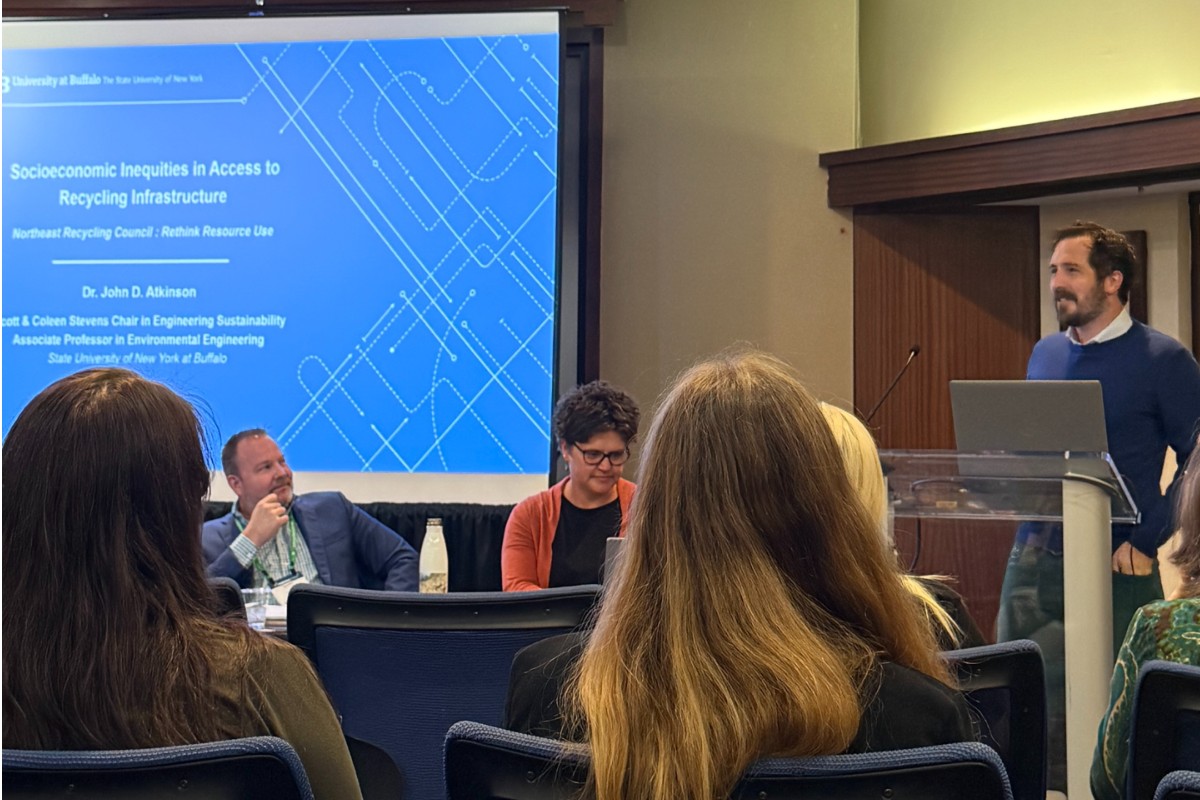
There are some universal lessons for those working to improve recycling access to underserved communities, panelists said at the Northeast Recycling Council’s (NERC) Annual Rethink Resource Use Conference in Plainsboro, New Jersey, outside Princeton on Tuesday.
Angie Lemar, a planner in Wisconsin with Foth Infrastructure and Environment, an engineering firm, said the key is to “understand the communities that you’re reaching out to.”
For instance, providing recycling education in languages that are most spoken in your community is key, said Lemar, as well as understanding the needs of your specific community.
Mark Dancy of WasteZero, a company that works with municipalities to increase recycling participation, added that “convenience is universal. So the more convenient everything is, the more effective it is.”
“For a long time the conversation has been how do we recycle better, and we’re trying to change that and think about well maybe we need to think more about who actually gets to recycle than just how to do it better,” said John Atkinson, professor of environmental engineering at New York’s University at Buffalo. Atkinson and his colleagues have been studying how to quantify that recycling inequality.
After crunching data from 84,000 Census tracts and 130 million buildings across the continental US, Atkinson and team found that plastic packaging waste generation is stable across socioeconomic groups. “Everybody generates the same amount of plastic waste,” he said.
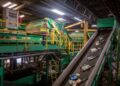
Yet there’s a statistically significant relationship between MRF proximity and recycling rates—the communities closest to MRFs recycle more. And Atkinson and colleagues found that communities near MRFs are 30% to 55% wealthier and 14% to 19% more college educated than communities farther away from MRFs.
“The summary here is that wealthier, more educated states recycle more,” said Atkinson.
He added that the study is a first step toward better understanding recycling access around the country. The data could be used to help site future MRFs, he noted. “Ultimately what we are trying to do is create a more equitable system,” said Atkinson, whose study was published in Nature Communications Sustainability. The first author was Zeinab Mousania.
Balancing grants
Lemar of Foth Infrastructure and Environment talked about her team’s work with Ramsey County, Minnesota. Ramsey includes St. Paul and is the second most populous county in the state. The goal was to “create a more equitable dispersion of their recycling funds,” Lemar said.
So Foth applied the CDC’s EJI Explorer tool for environmental justice to Ramsey County, which ranks Census tracts on 36 environmental, social and health factors. Prior to that, the funding mechanism for recycling grants had been purely based on population. But after the tool was run, the county’s municipalities were divided into three tiers. Those places that the tool identified as most burdened in terms of health and environment were flagged to receive the highest payments per household. Communities are then able to spend the money on a range of recycling enhancement projects.
“We’re seeing communities that previously were not receiving very much money now actually be able to implement some programming because their funding dollars have gone from $1,500 to over $20,000,” said Lemar.
Dancy of WasteZero said roughly 15% of communities in the country are considered recycling deserts, with little to no access. These are especially clustered in the South. Some of those communities formerly had access but lost it due to budget cuts, excess contamination or other issues. Due to the inertia in government “it’s really hard to get them reinstated,” said Dancy.
One of the solutions WasteZero suggests is telling communities that have trash pickup service but not recycling to begin sorting high-value recyclables, such as aluminum cans, in separate bags within the regular waste stream. Then, those bags can be pulled out and sorted at the waste facility for a fraction of the cost of running separate recycling collection services.
Politics?
Atkinson said every reviewer that looked at his team’s paper said they needed to add a variable for politics, specifically red state versus blue state. “I don’t buy into that,” he said. “Recycling is an economics problem.”
He added that new technology can help improve access in rural areas. For instance, apps could alert a hauler not to come out to a specific house that’s remote if the bin is empty on a particular day.
Session moderator Caroline Mitchell, the director of community partnerships development with The Recycling Partnership, said additional funding for recycling provided through extended producer responsibility (EPR) systems in several states often includes earmarks for environmental justice.
“(EPR) does provide an amazing increase in resources and additional focus and clarity to help on a lot of our environmental justice fronts,” said Mitchell.
Atkinson added, “I think one of the things that our work shows is that people want to recycle, independent of where they live and how much money they make and what level of education they have.”