




Resource Recycling
  • The Latest
  • Analysis
    • All
    • Certification Scorecard
    • Industry Announcements
    • Opinion

    America’s critical-materials buildout has a feedstock problem

    Certification scorecard – week of Sept. 14

    Canada Plastics Pact reports 2024 progress

    Trade tensions shift global mineral partnerships 

    Spin-off lets Linca focus on battery mineral recovery

    Critical mineral policy shift creates opportunity

    CommanderAI launches searchable hauler database

    Inside the Circle: Put AI to work for the people who do the work

    Northeast commodity values for Q2 reach 2-year high

    Will a MRF shortage limit EPR growth?

  • Conferences
    • Resource Recycling Conference
    • Plastics Recycling Conference
    • E-Scrap: The Longevity Conference
    • Textiles Recovery Summit
  • Publications
    • E-Scrap News
    • Plastics Recycling Update
    • Policy Now
    • Resource Recycling
    • Other Topics
      • All Topics
      • Brand Owners
      • Critical Minerals
      • Glass
      • Grant Watch / RFPs
      • Markets
      • Organics
      • Packaging
      • Research
      • Technology
      • Textiles
Subscribe
No Result
View All Result
Resource Recycling
  • The Latest
  • Analysis
    • All
    • Certification Scorecard
    • Industry Announcements
    • Opinion

    America’s critical-materials buildout has a feedstock problem

    Certification scorecard – week of Sept. 14

    Canada Plastics Pact reports 2024 progress

    Trade tensions shift global mineral partnerships 

    Spin-off lets Linca focus on battery mineral recovery

    Critical mineral policy shift creates opportunity

    CommanderAI launches searchable hauler database

    Inside the Circle: Put AI to work for the people who do the work

    Northeast commodity values for Q2 reach 2-year high

    Will a MRF shortage limit EPR growth?

  • Conferences
    • Resource Recycling Conference
    • Plastics Recycling Conference
    • E-Scrap: The Longevity Conference
    • Textiles Recovery Summit
  • Publications
    • E-Scrap News
    • Plastics Recycling Update
    • Policy Now
    • Resource Recycling
    • Other Topics
      • All Topics
      • Brand Owners
      • Critical Minerals
      • Glass
      • Grant Watch / RFPs
      • Markets
      • Organics
      • Packaging
      • Research
      • Technology
      • Textiles
Subscribe
No Result
View All Result
Resource Recycling
No Result
View All Result
Home Recycling

Mich. sortation project shows shifting MRF role

Antoinette SmithbyAntoinette Smith
August 26, 2026
in Plastics, Recycling
Mich. sortation project shows shifting MRF role

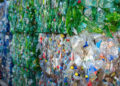
Denis Kvarda / Shutterstock

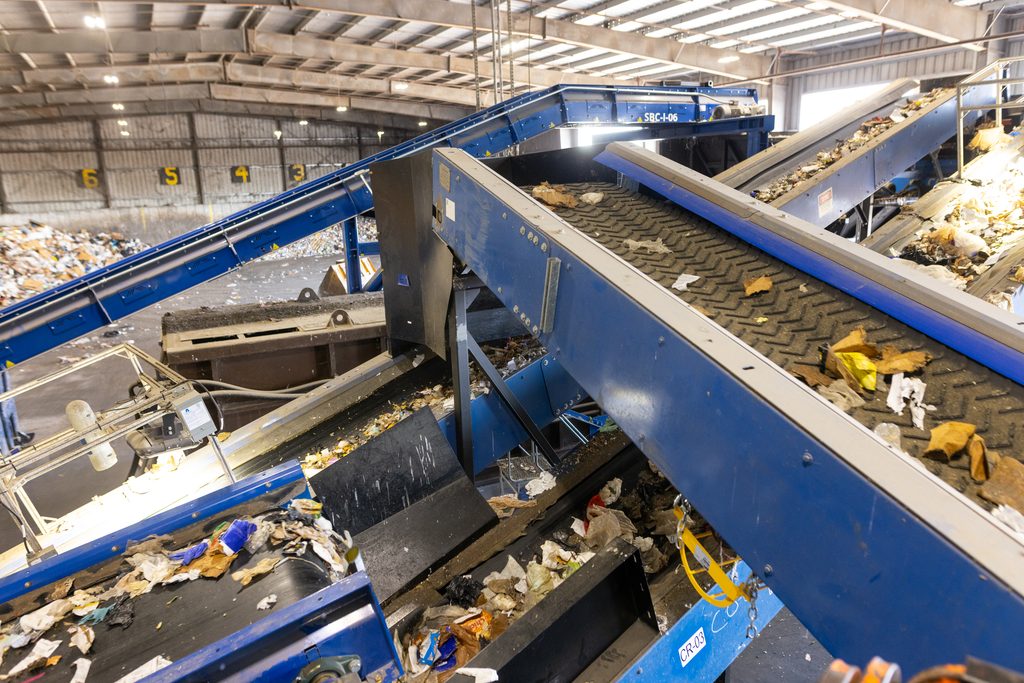
A county in western Michigan is leveraging AMP AI-assisted technology to recover recyclable commodities from households, but with a twist: The sortation system sits upstream of a waste-to-energy facility. 

Although the setup is unique, the problem it will address is a familiar one: Kent County’s recycling rate has plateaued, and an estimated 75% of recyclables still end up in the trash, said Dar Baas, director of the county’s Department of Public Works. 

Kent County is home to the state’s second-largest city, Grand Rapids. The Department of Public Works is installing AMP’s technology at its waste-to-energy facility to recover recyclables from mixed municipal solid waste (MSW) before it hits the combustion chamber, Baas said. 

The system will process about 25 tons per hour, initially targeting plastics and OCC to route directly to the commodities market or to the county MRF for a final sort. Completion is targeted for third-quarter 2027.

Unlike most jurisdictions, a single public operator controls Kent County’s transfer stations, landfill, MRF and WTE facility. That unified ownership enables the county to direct materials strategically — routing loads either to the MRF or to WTE with a pre-sort depending on composition and market conditions, Baas said.

Stuck at 10% 

The county has operated in the recycling space since 1990, and in 2010 opened a merged single-stream facility – state of the art at the time. But despite a long and progressive history and employing three full-time educators, who provide tours and conduct outreach with area schools, the county’s recycling rate is stuck at 10%, Baas said.

The county generates about 1 million tons of trash a year, and about 60% of that is considered municipal and commercial solid waste, most of which is combustible or processable, Baas said. 

The team’s outreach efforts indicated that to increase recovery rates, “we need to go back into the waste stream itself.” So while curbside and drop-off options will remain the primary means to recover materials, the new setup will provide a second line of defense to recover even more, he said. “What they’re telling us is after 30 years, they’re only going to put about 25% of the right stuff in the right container for recycling.”

The ‘best next step’

Due to the cost of building a greenfield MSW facility, the county decided upgrading its existing MRF with robotics and embedding mixed-waste sortation directly into the WTE plant was a “best next step,” Baas said.

The county’s Recycling & Education Center already uses AMP technology to process source-separated curbside recyclables at the MRF level. The new WTE deployment extends that relationship to the same underlying platform, creating what amounts to a shared identification and recovery architecture across the county’s system.

The new bolt-on system also reduces financial and political risk compared to building a new MRF or a mega-processing plant, Baas said. It also provides a real-world test of what additive technology can do within existing infrastructure — and possibly spur investment in similar systems, he added.

Upstream, better source separation yields cleaner, lower-cost feedstock for MRF commodity markets. Downstream, the WTE pre-sort catches materials that would otherwise be lost to combustion. 

AMP CEO Tim Stuart noted a secondary operational benefit at the WTE end: pre-sorting recyclables before combustion also improves combustion efficiency by removing materials that affect burn temperature and throughput. “We don’t see any derogation by material coming through there,” he told Resource Recycling, pointing to results from the company’s recent project in Virginia.

Project uses Virginia roadmap

The Michigan design will draw directly on what AMP is learning from its recent project in Portsmouth, Virginia. 

In June, the company completed a new single-stream recycling facility fed by the adjacent 108,000 ton/year MSW sorting site AMP runs under a 20-year contract with the Southeastern Public Service Authority (SPSA). 

Stuart said lessons from the ramp are already being carried into Kent County planning. “The Virginia facility process is going great, exceeding our expectations from an efficiency and recovery perspective,” he said. “And we’re going to take those lessons learned and continue to learn as we put new AMP One facilities out there.”

The company is also working on a second facility there to recover recyclables and organics from MSW, expected to come online in late 2027. The project will increase processing capacity to up to 540,000 tons/year. 

The MSW facility was commissioned in early February and is running at about 20% of its ultimate processing capacity, said Andrew Trump, AMP general manager, in an interview with Resource Recycling. 

Under the AMP contract with SPSA, the company must divert at least 50% of the waste stream — capturing essentially all organics (about 40% of incoming material) and all traditional recyclables (about 10%), with additional recovery potential depending on end markets.
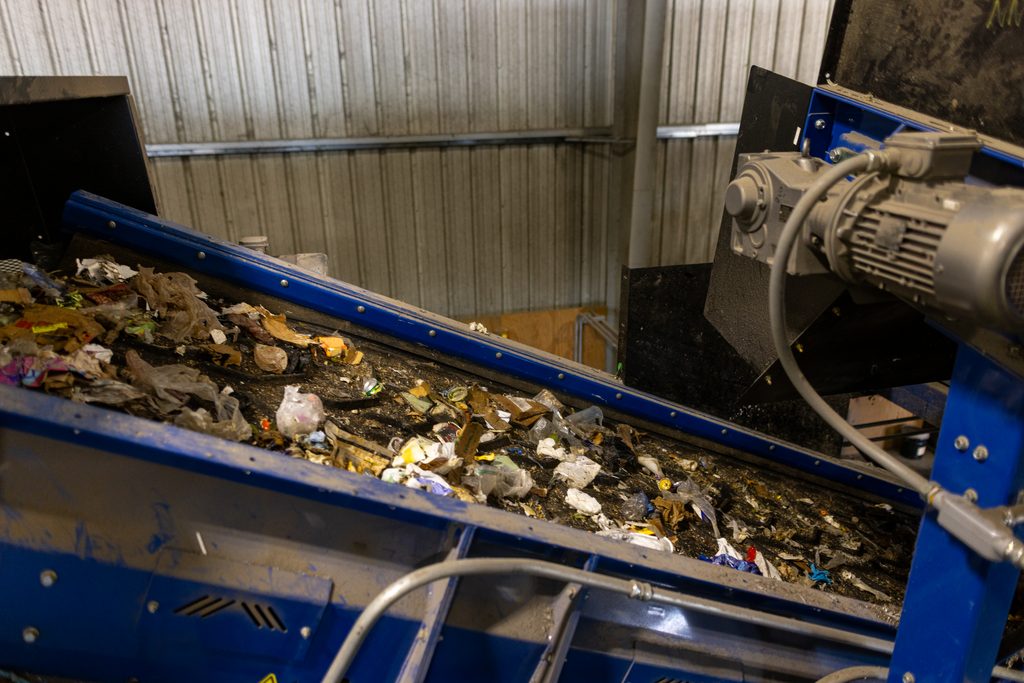
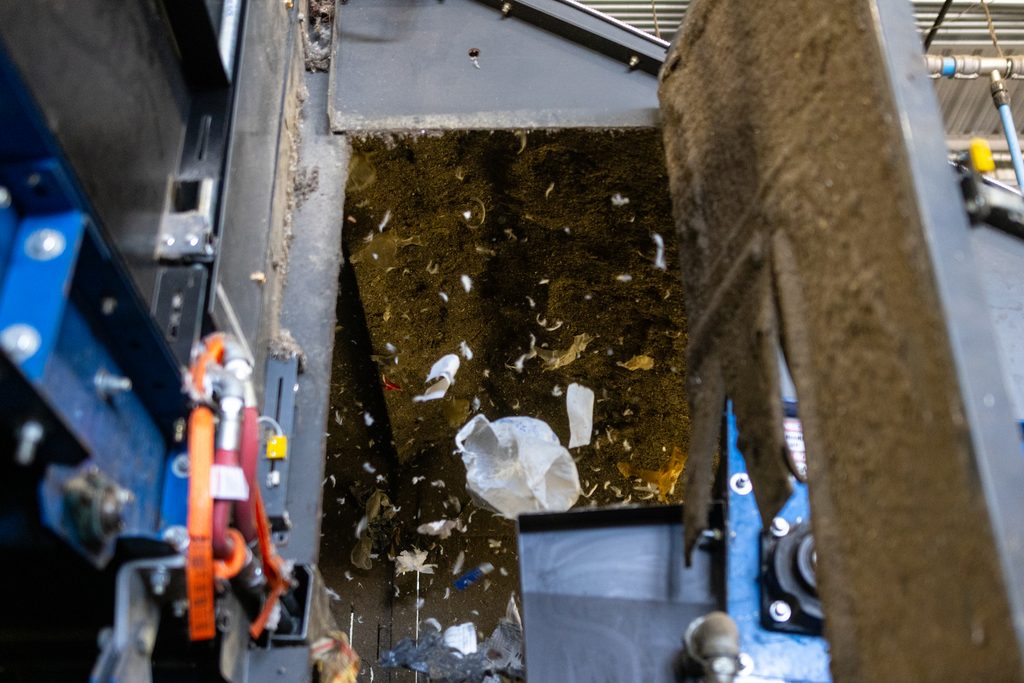
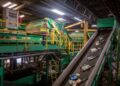
The AMP system in Portsmouth, Virginia | Courtesy AMP

The operation also includes pyrolysis of the organics fraction, producing biochar used as landfill daily cover. In March, Google signed a carbon credit purchase agreement for the first several years of biochar production. 

By focusing first on plastics and OCC, the Kent County system can establish a baseline for commodity recovery and generate data on what is actually moving through the MSW stream. Stuart said the county and AMP will refine recovery targets as they better understand material composition.

“Unfortunately, there’s still a lot of valuable recycling material that makes its way into the MSW,” Stuart said. “We’ll be working with Kent County to understand the material coming through there, and what makes sense for us to continue to build on those initial recovery sources.”

In the meantime, the project provides an example of the evolving role of the modern MRF, from  the recycling plant to part of an integrated, multi-facility recovery platform.

Tags: MRFsTechnology
TweetShare
Antoinette Smith

Antoinette Smith

Antoinette Smith has covered commodity plastics and supply chains for more than a decade, with a special focus on economic impacts and consumer behavior. She brings a balanced, thoughtful view to recycling stories, and isn't afraid to ask "why?" Contact Antoinette at antoinette@resource-recycling.com.

Related Posts

Study assesses environmental cost of excess data storage

BAN paper says AI e-scrap estimates are low

byPaul Lane
September 17, 2026

The advocacy group said current estimates on the scrap resulting from data centers don’t account for the full picture of...

Google Pixel 6 phone

Google makes repairability part of design ethos

byBrian Clark Howard
September 16, 2026

The tech titan supports the right-to-repair movement in several key ways.

CommanderAI launches searchable hauler database

Inside the Circle: Put AI to work for the people who do the work

byBill Shireman
September 14, 2026

There is more than one way to use AI, and some ways are more valuable than others.

CleanLane aims to redefine organics recovery in Oregon

CleanLane aims to redefine organics recovery in Oregon

byKeith Loria
September 10, 2026

CleanLane is an ambitious materials recovery facility that will combine advanced recycling, anaerobic digestion and renewable natural gas production under...

Northeast commodity values for Q2 reach 2-year high

Will a MRF shortage limit EPR growth?

byKatherine Doerr
September 10, 2026

Where will all the EPR-collected SSR go? Will there be enough MRFs to handle the material?

iFixit launches 2-week circuit board training course

Printed circuit board (PCB) recycling explained

byJavier Castilloand2 others
September 9, 2026

Recycling PCBs presents significant technical challenges because these waste streams combine metallic, non-metallic and electronic fractions with different characteristics and...

Load More
Next Post
Top stories from July 2024

ITAD global regulation and compliance this summer

2026 Buyers’ Guide

Equipment, services and technology suppliers serving the recycling industry.

Browse the Guide

More Posts

New Jersey pushes back PCR mandate to 2030

New Jersey pushes back PCR mandate to 2030

September 10, 2026
California Governor Gavin Newsom speaking at podium.

What’s on Newsom’s desk after the CA session end

September 14, 2026
Spin-off lets Linca focus on battery mineral recovery

Critical mineral policy shift creates opportunity

September 14, 2026
Canada tariffs latest in new normal for RPET

Canada tariffs latest in new normal for RPET

September 11, 2026
CommanderAI launches searchable hauler database

Inside the Circle: Put AI to work for the people who do the work

September 14, 2026

SB 54 plan for cartons, film draws warning

September 15, 2026
Lawsuits hover days after SB 54 approval

Preparing for SB 54 design compliance

September 8, 2026
Bale pricing mostly flat for September

Bale pricing mostly flat for September

September 9, 2026
Alpek closing Pennsylvania RPET plant

Alpek seizing on war-related opportunity 

July 27, 2026
Additive cuts acetaldehyde migration in RPET bottles

PET roadmap pairs demand, CO2 footprint

September 15, 2026
Load More

About & Publications

About Us

Staff

Archive

Magazines

Work With Us

Advertise
Jobs
Contact
Terms and Privacy

Newsletters

Get the latest recycling news and analysis delivered to your inbox every week. Stay ahead on industry trends, policy updates, and insights from programs, processors, and innovators.

Subscribe

Welcome Back!

Login to your account below

Forgotten Password?

Retrieve your password

Please enter your username or email address to reset your password.

Log In

Add New Playlist

No Result
View All Result
  • The Latest
  • Analysis
  • Recycling
  • E-Scrap
  • Plastics
  • Policy Now
  • Conferences
    • E-Scrap Conference
    • Plastics Recycling Conference
    • Resource Recycling Conference
    • Textiles Recovery Summit
  • Magazines
  • About Us
  • Advertise
  • Archive
  • Jobs
  • Staff
Subscribe
This website uses cookies. By continuing to use this website you are giving consent to cookies being used. Visit our Privacy and Cookie Policy.