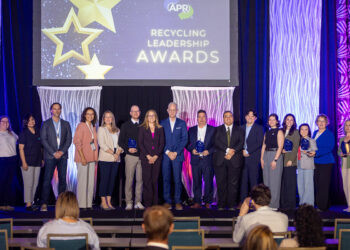














Four pioneers who shaped electronics recycling policy gathered for a special session at E-Scrap Conference 2025 moderated by Resource Recycling Inc. founder Jerry Powell.
Former Panasonic environmental chief David Thompson described how a Minnesota law in the early 1990s that required manufacturers to take back and recycle nickel cadmium batteries jolted Panasonic. “All of a sudden, the great state of Minnesota passed a law that required manufacturers to take back and recycle nickel cadmium batteries if you wanted to continue to sell them,” he said, a precursor to today’s lithium-ion battery handling rules.
Thompson said the manufacturers responded by creating both a trade group and a coordinated collection effort, forming a new trade association called the Portable Rechargeable Battery Association, as well as a take-back program for nickel cadmium batteries.
He noted that the unified approach allowed companies to bring a single proposal to other states that were considering similar laws.
Former Sony environmental director Douglas Smith recalled a similar pattern around CRTs, as regulators moved to treat discarded televisions as hazardous waste once household exemptions disappeared. He noted that “in 1990, we got permission from the EPA to recycle glass back into the new glass, and also use lead, primary lead smelters.”
Thompson said Panasonic helped build a closed loop for CRT glass, working with Techneglas and Envirocycle.
In that system the company made new CRTs using about 15% post-consumer glass, he said, until flat panels replaced tubes and new battery chemistries arrived.
For Wayne Rifer, EPEAT founder and standards developer, those early years showed that end-of-life mandates alone would not deliver the broad design changes many advocates hoped for.
Extended producer responsibility rules “may affect design for recycling a little bit, maybe some toxins, but really not an awful lot,” he said. That conclusion helped drive the creation of EPEAT, which uses American National Standards to rate products against environmental criteria and publishes detailed model information on a public registry. EPEAT also has been the subject of compliance audits tracking how OEMs meet those criteria.
Rifer said those data could play a larger role on the plant floor as AI tools mature. He pointed out that product-specific information is already available from manufacturer sites, eco label programs and other sources, and he urged attendees to use AI to harvest that information so “that can then appear on your lines and make all of your workers a lot smarter.”
Walter Alcorn, who joined the Consumer Technology Association in 2010 and previously served as vice president for environmental affairs, said his main task there was “keeping the industry together” on complex questions such as state electronics EPR laws and right-to-repair mandates in a sector he described as driven by “cowboy” independence and aggressive innovation.
Looking across his tenure, Alcorn told the crowd that “it used to be that material based things were more valuable,” but today the value is in the data, in the software and the service.
He also warned that surging AI demand is running into infrastructure limits, predicting that “we are going to start seeing brownouts next year” on the East Coast because power grids struggle to keep up with new data center load.
Smith and Thompson told the audience that recyclers should see themselves as competing with mines and primary material suppliers rather than with landfills. Smith said OEMs will continue to insist on very pure recovered streams because “you need a dependable connection, and gold is still the right thing to use” as chips shrink and processing speeds increase.
When asked what advice they would offer younger professionals, Thompson urged attendees to “have some vision” about technologies and systems they want to improve. Smith stressed that operators should keep trying to “invent a better mousetrap,” while Rifer told younger attendees to “get out ahead of it” by applying their comfort with computers and AI to disassembly, data capture and sorting.
Thompson closed by encouraging continued investment in technology that can return complex material streams to manufacturing. “If these products were easy to recycle, we probably would not be having so much conversation about, you know, who is going to do what, where, all along the street,” he said.