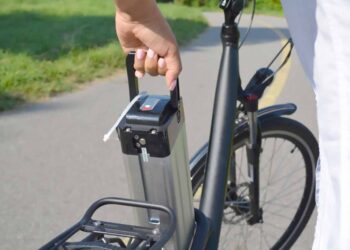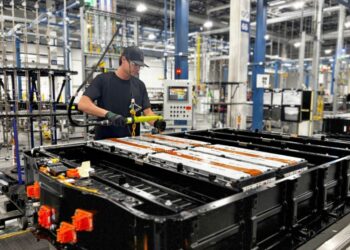


Battery fires have moved from an occasional operational hazard to a defining insurance issue for recycling and waste facilities. As lithium-ion batteries proliferate in everything from disposable vapes to electric vehicles and grid-scale storage systems, insurers are recalibrating how they view fire exposure and what they’re willing to cover.
“From 2016–2021 to 2022–2025, we’ve seen an increase of approximately 26% in reported fire incidents,” said Ryan J. Fogelman, fire protection consultant with Fire Rover. Based in Farmington Hills, Michigan, the company provides remote fire detection and suppression systems for high-risk industrial facilities, particularly waste and recycling plants. The company recently partnered with SWANA to develop a fire reporting tool for the waste and recycling industry.
Fogelman attributes much of that rise to what he calls the “Vape Effect.”
“These devices – which contain small lithium-ion batteries – are marketed as daily disposables,” he said. “With essentially zero convenient, safe and legal drop-off points, consumers default to the trash or recycling bin, creating a relentless influx of ignition sources.”
For MRFs, transfer stations and scrap yards, that influx has established what Fogelman calls a “new baseline” of fire risk. In 2025 alone, there were 448 publicly reported fires in waste and recycling facilities. MRFs account for roughly half of those incidents annually, he noted.
The mechanics are straightforward but unforgiving.
“Batteries are inherently safe until they are subjected to abuse factors,” Fogelman said. “In a waste facility, those abuse factors are unavoidable.”
Compaction in collection trucks, crushing under loaders or shredding operations can damage internal separators, which keep the positive and negative electrodes apart while allowing ions to pass between them. If the electrodes touch, it creates an internal short circuit, which can trigger rapid heat release, fire or sometimes explosion.
“In vape pens, the battery is small, but the chemistry is the same as larger lithium-ion batteries,” Fogelman said. “When damaged, even a small cell can ignite surrounding paper, plastic or fluff in a recycling facility.”
‘No longer writing policies based on hope‘
Citing industry data from the National Waste & Recycling Association, Fogelman noted commercial insurance rates for waste and recycling operations have climbed steadily for nearly a decade.
“The conversation has shifted from insurance being a ‘cost of doing business’ to a massive budgetary line item that dictates operational viability,” he said. “Insurers now demand proof of engineered controls, not just fire extinguishers and written policies. They require proof of risk mitigation and they’re no longer writing policies based on hope.”
That recalibration is not limited to recycling. Across the broader insurance market, lithium-ion fire losses have reshaped how underwriters think about battery-related exposure. This thinking applies to MRF and e-scrap recycling operations in terms of best practices to reduce risk from an insurer’s vantage point.
At kWh Analytics, a managing general agent specializing in renewable energy property insurance, senior data science manager Nicole Thompson said large battery fires – particularly in grid-scale energy storage – have forced insurers and reinsurers to reassess severity risk. “Insurance is a finite resource. When large, severe loss events occur, even if they’re few in number, they become underwriting reference points.”
She pointed to incidents such as the Moss Landing fire in January 2025 and a 2024 energy storage fire as examples that drew intense scrutiny from reinsurers. Even in an asset class where normalized failure rates have declined, highly visible, prolonged losses can tighten insurance capacity and pricing. Thompson said that while installed battery storage capacity has grown dramatically, failure rates per gigawatt-hour have dropped sharply.
“Between 2018 and 2024, we’ve seen roughly a 98% reduction in normalized failure rates,” she said. “The broader trend is that the industry is getting better at managing the risk.” That progress has led to more differentiated underwriting. Rather than viewing battery exposure as a single category of risk, insurers are examining how well a facility is designed and managed.
Aggressive suppression can avoid total facility loss
“The key underwriting question is not just will an event occur, but will it stay contained,” Thompson said. “Separation, firewalls, containerization and third-party monitoring analytics are major differentiators.”
Underwriters increasingly evaluate system design, chemistry type, propagation risk and operational monitoring when determining coverage terms. Facilities that demonstrate strong containment strategies and early warning systems are more likely to receive favorable consideration than those relying on basic fire protection measures alone.
Ronald Butler is CEO of Detroit-based Energy Storage Safety Products International (ESSPI), a fire protection and lithium-ion safety technology firm that works with industrial operators and insurance underwriters. He noted that lithium-ion batteries rarely fail instantaneously; they often release volatile gases and heat well before ignition, so early detection is critical.
“Batteries are very safe, until they’re not and when they fail, they fail miserably,” he said. “The greatest detection systems identify early off-gassing species. That allows facilities to notify personnel, communicate with stakeholders and isolate the problem before it escalates.”
Butler noted his company collaborates with insurers and risk engineers to design detection, containment and monitoring systems that can reduce the severity of a loss event, particularly in facilities where batteries are stored, transported or processed.
Butler also stresses separation. “The first thing you want to do is separate commodities,” he said. “Keeping batteries away from Class A combustibles such as wood and packaging can significantly limit severity.”
And while training is important, he cautioned against relying on employees as primary responders in a lithium-ion fire scenario. “Instead, facilities should train employees for awareness while relying on automatic detection, containment and suppression systems, coupled with coordination with local fire departments,” Butler said.
Fogelman noted many operators overestimate the role of municipal fire departments. “Most departments adopt a containment strategy rather than aggressive suppression, which can lead to total loss of the facility,” he said. “Traditional overhead sprinklers are often designed for containment, not extinguishment.”
Looking ahead, Fogelman expects EPR programs and more convenient battery drop-off infrastructure to help “turn off the tap” of batteries entering the waste stream. He also predicts broader adoption of AI-driven sorting and smart suppression systems.
Thompson foresees underwriting standards for battery-intensive operations, particularly energy storage installations, continuing to tighten around best practices, especially as new editions of safety standards such as NFPA 855 require large-scale fire testing.
While NFPA 855 specifically governs stationary energy storage systems, the underlying underwriting focus on containment, propagation control and engineered safeguards is influencing how insurers evaluate lithium-ion exposure more broadly.
“Underwriting is increasingly focused on identifying which projects reflect improved best practices,” she said.
The “wait and see” approach, as Fogelman put it, is over. In 2026, insurability may depend on how convincingly facilities can demonstrate they are both preventing ignition and limiting catastrophic loss when prevention fails.