Resource Recycling
  • The Latest
  • Analysis
    • All
    • Certification Scorecard
    • Industry Announcements
    • Opinion
    Apple Watch on product box.

    Wearables are coming and ITAD isn’t ready

    Certification Scorecard — Week of April 13, 2026

    EV Battery Pack - Sergii Chernov-Shutterstock

    Redwood, Rivian deal fuels US infrastructure plans

    Bloom ESG and e-Stewards roll out critical metals metric

    Colorado regulators suggest mid-range EPR scenario

    Why collaboration on plastic waste still matters

    Battery recycler Ascend Elements files for bankruptcy

    Battery recycler Ascend Elements files for bankruptcy

    EPR fees are a market signal. Here’s what they’re telling you.

    EPR fees are a market signal. Here’s what they’re telling you.

    Wolframite ore, the primary ore of tungsten from Altai, Russia

    Tungsten scrap export controls draw industry attention

    Certification Scorecard — Week of April 6, 2026

  • Conferences
  • Publications

    Other Topics

    Textiles
    Organics
    Packaging
    Glass
    Brand Owners

    Metals
    Technology
    Research
    Markets
    Grant Watch

    All Topics

Subscribe
No Result
View All Result
Resource Recycling
  • The Latest
  • Analysis
    • All
    • Certification Scorecard
    • Industry Announcements
    • Opinion
    Apple Watch on product box.

    Wearables are coming and ITAD isn’t ready

    Certification Scorecard — Week of April 13, 2026

    EV Battery Pack - Sergii Chernov-Shutterstock

    Redwood, Rivian deal fuels US infrastructure plans

    Bloom ESG and e-Stewards roll out critical metals metric

    Colorado regulators suggest mid-range EPR scenario

    Why collaboration on plastic waste still matters

    Battery recycler Ascend Elements files for bankruptcy

    Battery recycler Ascend Elements files for bankruptcy

    EPR fees are a market signal. Here’s what they’re telling you.

    EPR fees are a market signal. Here’s what they’re telling you.

    Wolframite ore, the primary ore of tungsten from Altai, Russia

    Tungsten scrap export controls draw industry attention

    Certification Scorecard — Week of April 6, 2026

  • Conferences
  • Publications

    Other Topics

    Textiles
    Organics
    Packaging
    Glass
    Brand Owners

    Metals
    Technology
    Research
    Markets
    Grant Watch

    All Topics

Subscribe
No Result
View All Result
Resource Recycling
No Result
View All Result
Home E-Scrap

Old office and home tech to drive new e-scrap volumes

byDavid Daoud
December 9, 2025
in E-Scrap
stack of printers

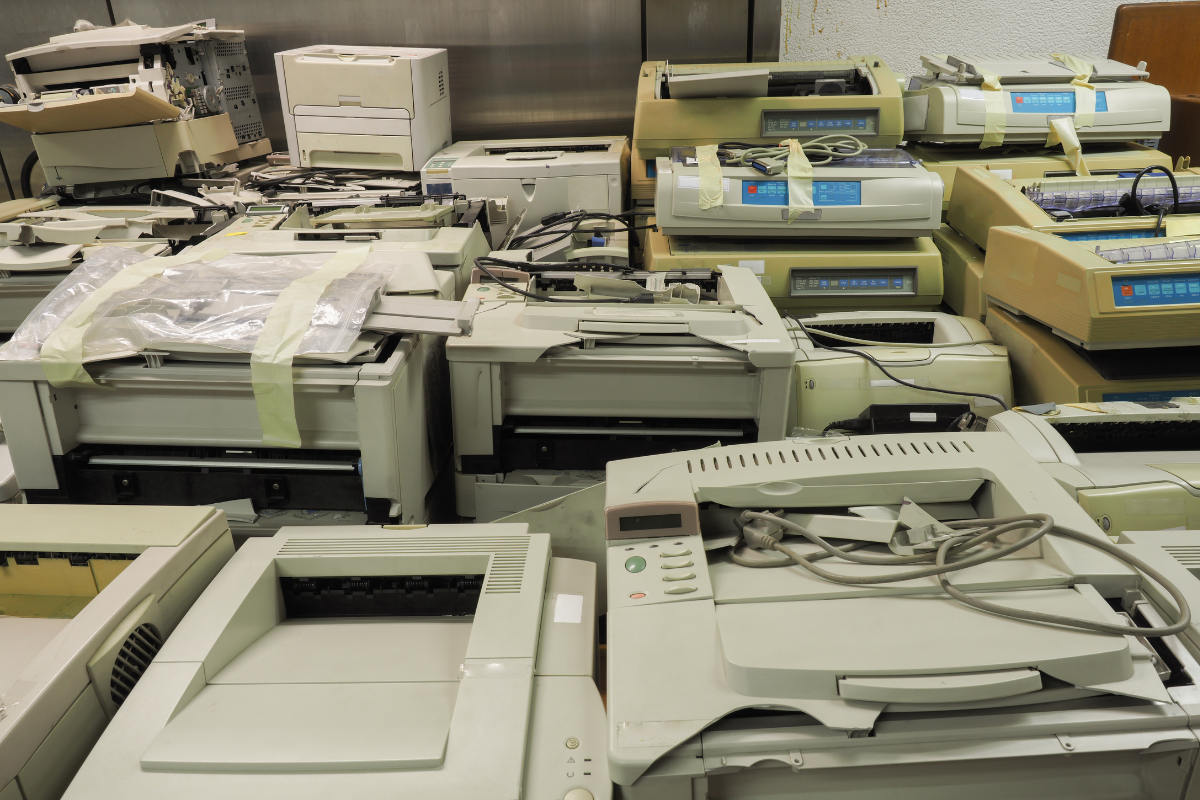
A broad retirement cycle will push more legacy devices into municipal programs and commercial disposition channels. | KG Designs/Shutterstock

Shipments of both inkjet and laser units have declined steadily for years and every percentage point of contraction feeds directly into higher volumes of small office equipment entering the recycling stream. 

While some people may think this is an isolated trend, a broad retirement cycle is accelerating across multiple categories and the next 18 to 24 months will push a significant wave of legacy devices into both municipal programs and commercial disposition channels.

A shift in enterprise environments

Looking at the enterprise sector, IT teams are rapidly moving away from on-site voice, storage and networking systems. The migration to cloud communications is eliminating entire rooms of PBX hardware, early Voice over IP phones, voicemail servers and analog switching gear that hold little or no resale value. This material is now showing up consistently in enterprise cleanouts linked to UCaaS migrations and post-pandemic office consolidations.

Infrastructure modernization is driving similar turnover elsewhere. Hardware load balancers, WAN-optimization appliances and mid-generation Fibre Channel arrays are being retired as organizations adopt SD-WAN and modern flash-based storage. Tape libraries and older LTO drives continue to exit service as companies transition to current-generation tape or cloud-backup environments. These categories represent high-volume, low-value streams with complex remediation and dismantling requirements, but modest reuse potential.

Office imaging equipment follows the same trend. IDC data shows a sustained multi-year decline in US printer and copier shipments. As fleets shrink and offices digitize workflows, scanners, fax units, desktop laser printers, MFPs and associated peripherals are entering recycling channels in increasing numbers.

A parallel consumer cycle

Consumer turnover is equally concentrated as CRT televisions continue to trickle into municipal collection events as the last remaining units are removed from garages and basements. DVD and Blu-ray player shipments have fallen by more than 80% from peak levels and many households are disposing of both devices and media. Legacy cable and satellite set-top boxes are being returned or discarded as pay-TV subscriptions decline nationally. This material shares the same characteristics: low reuse potential, limited resale and high plastic content.

Mobile devices also add volume with the retirement of 3G networks and the sunset of early LTE hardware that no longer receives security support, as millions of older smartphones fall below reuse thresholds each year. These devices contribute to an increasingly battery-heavy consumer stream, with all the handling requirements and downstream constraints that implies.

According to the EPA‘s most recent data set, the US generated roughly 2.7 million tons of consumer electronics waste and about 1.04 million tons were collected – a recovery rate near 38%. As device categories become obsolete and replacement cycles continue, the volume of small electronics entering municipal and retail take-back programs is expected to remain elevated.

Economic and processing implications

The material profile emerging from this retirement cycle is about high volume, low device-level value, high plastic concentration and variable remediation needs. For most categories in this wave – printers, analog phones, tape libraries, DVD players, set-top boxes, early networking gear – resale contribution is negligible. Margins depend on throughput efficiency, downstream reliability and the ability to separate mixed materials at scale.

This favors organizations with industrial shredding capability, automated separation systems and established outlets for plastics, low-grade circuit boards and metals. Facilities positioned to process large batches while maintaining compliance with CRT, battery, mercury-lamp and mixed-material regulations will capture most of the economic advantage.

Enterprise-focused ITAD firms also stand to benefit, not through remarketing, but through bundled service contracts. As companies replace voice systems, storage infrastructure and office equipment in the same project window, ITAD providers that offer combined site-clear services, on-site data sanitization and serialized reporting will see increased project volume. The value in these engagements is tied to logistics, labor, chain-of-custody compliance and integrated service delivery rather than resale outcomes.

Municipal recyclers and OEM-linked collection partners remain in a favorable position during this phase. Statewide or multiyear take-back programs provide predictable inflow of legacy categories – CRTs, set-top boxes, printers, small electronics – with compensation structures that reflect cost-plus or per-pound economics. These operators are shielded from the resale collapse affecting many of the retired device classes.

Specialty resale niches

Although most material in this cycle has limited value, a few narrow resale pockets remain. MiniDV and Hi8 camcorders continue to support niche demand tied to digitization services. Certain late-generation enterprise components maintain reuse value in industries with long hardware support lifecycles. Retro gaming and AV equipment also sustain a small but active collector market. These niches do not materially change overall stream economics, but do offer targeted opportunities for refurbishers working with specific partners.

Outlook and analysis

The next two years will bring a heavier mix of low-value office and consumer electronics into both municipal and commercial processing networks. This is the tail end of the pre-cloud, pre-mobile hardware era; printers still powered by mechanical drive trains, desk phones tethered to legacy PBXs and consumer devices designed for physical media rather than digital delivery. As these categories reach their natural end, recyclers and ITAD providers will see higher overall volume but limited resale contribution.

Operators with optimized throughput, reliable downstream markets and multi-category processing capability will be best positioned to navigate this phase. For the sector, the opportunity is not in recovering value from individual devices, but in managing the final wave of legacy electronics efficiently, safely and at scale


Tags: Electronics
TweetShare
David Daoud

David Daoud

David Daoud is a contributor to Resource Recycling and E-Scrap News, covering IT asset disposition, electronics recycling, and circular IT governance. He is the founder of and current Principal Analyst at Compliance Standards LLC, where he conducts independent research and advisory work on ITAD markets, sustainability and ESG compliance, data security, and lifecycle risk management. Daoud has analyzed enterprise IT trends since the late 1990s and was among the first analysts to examine ITAD as a distinct market segment during his time at IDC. He advises operators, OEMs, and investment teams on regulatory, technology, and market developments affecting the electronics lifecycle.

Related Posts

Apple Watch on product box.

Wearables are coming and ITAD isn’t ready

byDavid Daoud
April 16, 2026

Wearable devices provide unique challenges at end of life.

Bloom ESG and e-Stewards roll out critical metals metric

byDavid Daoud
April 15, 2026

The two groups announced the upgrade to their jointly developed Environmental Benefits Calculator.

TOMRA rolls out updated FINDER with AI tools

byScott Snowden
April 14, 2026

TOMRA introduced an updated FINDER metal sorting system with modular sensors and AI tools, aiming to improve separation of complex...

Battery recycler Ascend Elements files for bankruptcy

Battery recycler Ascend Elements files for bankruptcy

byDavid Daoud
April 13, 2026

The move is emblematic of near-term struggles in the sector.

Closed Loop Partners acquires Sutter Metals, connecting electronics disposition to metals recovery

byDavid Daoud
April 2, 2026

The acquisition completes a deliberate chain from enterprise device collection through disposition to raw material recovery, positioning PE capital to...

Policy update: EPR, right to repair and more

TERRA expands certified e-scrap network to Ecuador

byScott Snowden
April 1, 2026

TERRA has added Vertmonde in Quito to its certified electronics recycling network, giving the organization a first member in Ecuador...

Load More
Next Post
electronic vapes

Vape fires cost waste, recycling sector $2.5B yearly

Leading the Charge in Safe Battery Recycling
Sponsored

Leading the Charge in Safe Battery Recycling

byThe Battery Network
April 13, 2026

We’re connecting people, brands, and communities through one nationwide network built to make battery recycling safer, simpler, and more accessible...

Read moreDetails

More Posts

EPR fees are a market signal. Here’s what they’re telling you.

EPR fees are a market signal. Here’s what they’re telling you.

April 10, 2026

Recycling Partnership CEO stepping down

April 15, 2026
Battery recycler Ascend Elements files for bankruptcy

Battery recycler Ascend Elements files for bankruptcy

April 13, 2026
Wolframite ore, the primary ore of tungsten from Altai, Russia

Tungsten scrap export controls draw industry attention

April 9, 2026

WM opens new $60m MRF in Indy

April 10, 2026
Industry group: Help us find the plastic bale volumes we need

PET bales sink further as other grades firm 

April 15, 2026

GFL acquires SECURE Waste for $6.4bn

April 13, 2026
Colorado regulators suggest mid-range EPR scenario

Why collaboration on plastic waste still matters

April 13, 2026
Solarcycle starts up Georgia recycling plant

S3399 signals a shift in how states are tackling solar panel waste

April 6, 2026

Amazon, DOE partner on critical materials recovery

April 13, 2026
Load More

About & Publications

About Us

Staff

Archive

Magazine

Work With Us

Advertise
Jobs
Contact
Terms and Privacy

Newsletter

Get the latest recycling news and analysis delivered to your inbox every week. Stay ahead on industry trends, policy updates, and insights from programs, processors, and innovators.

Subscribe

Welcome Back!

Login to your account below

Forgotten Password?

Retrieve your password

Please enter your username or email address to reset your password.

Log In

Add New Playlist

No Result
View All Result
  • The Latest
  • Analysis
  • Recycling
  • E-Scrap
  • Plastics
  • Policy Now
  • Conferences
    • E-Scrap Conference
    • Plastics Recycling Conference
    • Resource Recycling Conference
    • Textiles Recovery Summit
  • Magazine
  • About Us
  • Advertise
  • Archive
  • Jobs
  • Staff
Subscribe
This website uses cookies. By continuing to use this website you are giving consent to cookies being used. Visit our Privacy and Cookie Policy.