





Resource Recycling
  • The Latest
  • Analysis
    • All
    • Certification Scorecard
    • Industry Announcements
    • Opinion

    Certification Scorecard — Week of June 8, 2026

    ITAD is moving past its adolescent phase: beyond end-of-life

    Rainforest

    Inside the Circle: What the rainforest can teach us about EPR

    Closeup of a printed circuitboard

    Hardware demand puts new focus on parts harvesting

    Rare look inside the world’s largest plastics recycler

    Mass balance matters: Why different rules can lead to different outcomes 

    Certification Scorecard — Week of June 1, 2026

  • Conferences
    • Resource Recycling Conference
    • Plastics Recycling Conference
    • E-Scrap: The Longevity Conference
    • Textiles Recovery Summit
  • Publications
    • E-Scrap News
    • Plastics Recycling Update
    • Policy Now
    • Resource Recycling
    • Other Topics
      • All Topics
      • Brand Owners
      • Critical Minerals
      • Glass
      • Grant Watch / RFPs
      • Markets
      • Organics
      • Packaging
      • Research
      • Technology
      • Textiles
Subscribe
No Result
View All Result
Resource Recycling
  • The Latest
  • Analysis
    • All
    • Certification Scorecard
    • Industry Announcements
    • Opinion

    Certification Scorecard — Week of June 8, 2026

    ITAD is moving past its adolescent phase: beyond end-of-life

    Rainforest

    Inside the Circle: What the rainforest can teach us about EPR

    Closeup of a printed circuitboard

    Hardware demand puts new focus on parts harvesting

    Rare look inside the world’s largest plastics recycler

    Mass balance matters: Why different rules can lead to different outcomes 

    Certification Scorecard — Week of June 1, 2026

  • Conferences
    • Resource Recycling Conference
    • Plastics Recycling Conference
    • E-Scrap: The Longevity Conference
    • Textiles Recovery Summit
  • Publications
    • E-Scrap News
    • Plastics Recycling Update
    • Policy Now
    • Resource Recycling
    • Other Topics
      • All Topics
      • Brand Owners
      • Critical Minerals
      • Glass
      • Grant Watch / RFPs
      • Markets
      • Organics
      • Packaging
      • Research
      • Technology
      • Textiles
Subscribe
No Result
View All Result
Resource Recycling
No Result
View All Result
Home Resource Recycling Magazine

Community Spotlight: A city where recycling economics are ‘what’s keeping us alive’

Colin StaubbyColin Staub
June 5, 2018
in Resource Recycling Magazine

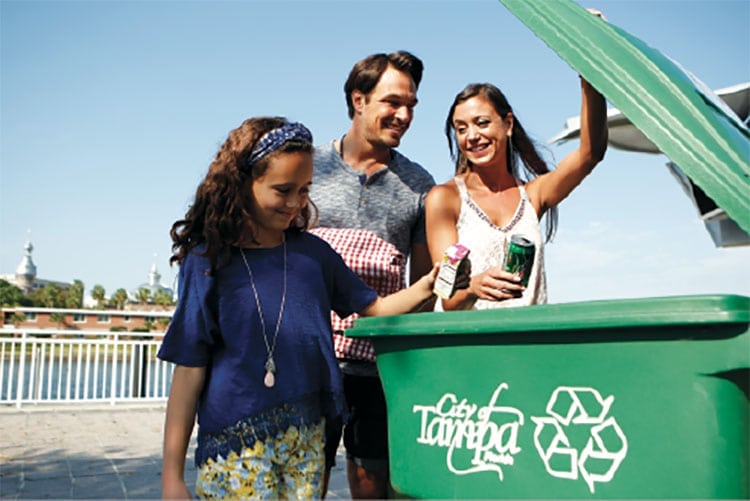
Sometimes a municipal recycling program’s biggest impact is abundantly clear.

Just look at Tampa, Fla. The city has a revenue-sharing agreement with materials recovery facility (MRF) operator Waste Management. But right now, the value for the city is not the money that comes back from marketed material – it’s what gets saved by not having to send more to disposal.

About 20,000 tons of recyclables are collected by city crews through the residential curbside program each year. At the same time, Tampa collects 310,000 tons of waste that’s sent to a waste-to-energy incinerator.

A local official pointed out that if the recycling program was absent, the waste-to-energy facility would be pushed beyond capacity, and the city would likely need to explore additional disposal avenues sooner rather than later.

Tampa’s population is also booming, which adds to the economic pressure.

“I always like to say we’re past the point of no return,” said Mark Wilfalk, director of the city’s Department of Solid Waste and Environmental Program Management. “We’re to the point where, although we don’t get a high dollar return, the value of having that diversion program in place is what’s keeping us alive.”

System evolves to single-stream

Tampa’s recycling program has its roots in a subscription-based program that operated during the 1990s – residents could receive a curbside cart on request. Residents were asked to source-separate a number of material types, and the program was geared toward specific neighborhoods.

Around 2000, the city rolled out curbside recycling to the entire city. And about a year after that citywide implementation, Tampa switched to a dual-stream system in which fiber was kept separate but everything else was commingled.

Half a decade later, Tampa began retrofitting vehicles for automated recycling collection to boost efficiency. The switch also meant adoption of full-fledged single-stream collection.

Today, the city handles collection of recycling, yard waste and garbage for residential customers inside city limits. Collected recyclable material is sent to the Waste Management MRF.

Determining a diversion rate for the city is not straightforward. Using the figures noted earlier – 20,000 tons sent to recycling and 310,000 tons sent to the waste-to-energy site – would mean a recovery rate of around 6 percent.

But Wilfalk said those numbers don’t account for all the city’s waste and recycling tonnages.

And the issue is compounded by the fact that Florida regulations allow waste-to-energy weights to be counted toward diversion.

Wilfalk reiterated that the true mark of success for the Tampa program is whether it can keep the city’s waste output at a level that does not require additional disposal options.

“It’s an expensive program,” he acknowledged. “But it would be a lot more expensive if we didn’t have it in place.”

Paths to improvement

Currently, the program accepts standard single-stream commingled recyclables, including glass, although that material presents challenges for the program. There are few local markets for glass, and it often ends up requiring a cost to dispose, rather than bringing in any commodity value.

“It’s a little difficult for us, but we’ll weather the storm until hopefully the markets change,” Wilfalk said.

Another issue is contamination. Tampa’s contamination rate currently runs between 12 and 15 percent. That figure is relatively low, but Wilfalk noted it’s higher than the previous year, when the contamination rate was calculated at about 10 percent.

Program leaders have learned to account for Florida’s weather patterns when determining material quality. One year, for example, the contamination study was completed after a stretch of 21 days of solid rain, Wilfalk recalled, and the rate was abnormally high.

To try to continue to move the ball forward on program efficiency and material quality, Tampa gets help through an agreement with Waste Management. Under the contract between processor and city, Tampa receives a $60,000 per year endowment fund, money that’s dedicated to educating the public.

“It works for both sides because it educates our customers and they end up getting a cleaner product at the facilities,” Wilfalk said.

Each month, Tampa receives a $5,000 check from Waste Management, which the city uses to promote recycling in a variety of ways, including creating advertisements, putting up billboards and more.

Tampa is also looking to increase its recycling efforts in two areas that pose challenges to communities nationwide: commercial and multi-family recycling.

Although the city handles all residential collection, commercial “is more of an open market,” Wilfalk explained, which means it’s a harder stream to tackle in a unified manner. The city also doesn’t have a requirement for recycling receptacle space to be provided with new buildings, and most developments have included only garbage enclosures.

But Wilfalk said planners are making progress by laying out the economic equation to property owners, a strategy that makes sense in a city where recycling is valued for its cost-cutting characteristics.

“The reluctancy is there, but that’s until you get [building owners] to realize the benefits of it,” he said. “So if they’re paying $200 for two eight-yard dumpsters to be serviced each month, and we can put a recycling program in there for $75 a month, that’s their savings.”

This article originally appeared in the May 2018 issue of Resource Recycling. Subscribe today for access to all print content.

Think your local program should be featured in this space? Send a note to [email protected].

Tags: Local Programs
TweetShare
Colin Staub

Colin Staub

Colin Staub was a reporter and associate editor at Resource Recycling until August 2025.

Related Posts

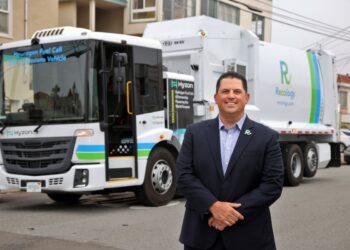
NYC, Mack Trucks unveil winning artwork

NYC, Mack Trucks unveil winning artwork

byAntoinette Smith
June 4, 2026

The five new hand-painted waste collection trucks feature themes of honor, resilience and care, and will operate in the city's...

Extruder pushes out natural HDPE pellets at KW Plastics in Troy, Alabama.

Rare look inside the world’s largest plastics recycler

byBrian Clark Howard
May 13, 2026

KW Plastics in Troy, Alabama is a leading recycler of PP and HDPE—here’s a glimpse behind the gates.

Bill to update New Jersey e-scrap program heads to governor

New Jersey recyclers talk EPR

byBrian Clark Howard
April 9, 2026

At the Association of New Jersey Recyclers’ spring meeting industry representatives discussed the state and future of the sector.

Wineries help create model for film recycling

Wineries help create model for film recycling

byAntoinette Smith
April 7, 2026

A collaboration between California wineries and the recycling value chain has provided a closed-loop model the partners aim to see...

Waste Connection recycling cart in The Dalles, Oregon

First Oregon community expands curbside recycling with EPR funding

byBrian Clark Howard
April 1, 2026

The City of The Dalles in northern Oregon is now rolling out nearly 5,000 new 90-gallon recycling carts to customers...

Rural effort targets vapes as battery fire risk grows

byScott Snowden
March 24, 2026

A Wisconsin firefighter is building a rural vape collection service as discarded devices with lithium-ion batteries continue to raise fire...

Load More
Next Post

The Recycling Partnership to launch coastal cart program

More Posts

Recycling industry addresses Beyond Plastics report

Recycling industry addresses Beyond Plastics report

May 26, 2026
House resolution aims to make recyclability central to product design

NY EPR bill fails to advance after third try

June 8, 2026
CalRecycle withdraws proposed regs for SB 54

Oceana, NRDC, CAW sue CalRecycle over SB 54 regs

June 5, 2026
Various PET thermoform containers.

Thermoform recovery soars, PCR content falls

June 10, 2026
Rare look inside the world’s largest plastics recycler

Mass balance matters: Why different rules can lead to different outcomes 

June 5, 2026

Three-bill package aims to revamp Michigan’s bottle return system

June 9, 2026
Circular Materials to supply PlasCred chem recycling plant

Circular Materials to supply PlasCred chem recycling plant

June 4, 2026

Battery fires still a major risk to recyclers: report

June 9, 2026
Rainforest

Inside the Circle: What the rainforest can teach us about EPR

June 8, 2026
How electronics legislation fared this legislative season

NY sends repairability labeling bill to governor

June 8, 2026
Load More

About & Publications

About Us

Staff

Archive

Magazine

Work With Us

Advertise
Jobs
Contact
Terms and Privacy

Newsletter

Get the latest recycling news and analysis delivered to your inbox every week. Stay ahead on industry trends, policy updates, and insights from programs, processors, and innovators.

Subscribe

Welcome Back!

Login to your account below

Forgotten Password?

Retrieve your password

Please enter your username or email address to reset your password.

Log In

Add New Playlist

No Result
View All Result
  • The Latest
  • Analysis
  • Recycling
  • E-Scrap
  • Plastics
  • Policy Now
  • Conferences
    • E-Scrap Conference
    • Plastics Recycling Conference
    • Resource Recycling Conference
    • Textiles Recovery Summit
  • Magazine
  • About Us
  • Advertise
  • Archive
  • Jobs
  • Staff
Subscribe
This website uses cookies. By continuing to use this website you are giving consent to cookies being used. Visit our Privacy and Cookie Policy.