
Advertisement Header Ad
Resource Recycling
  • The Latest
  • Analysis
    • All
    • Certification Scorecard
    • Industry Announcements
    • Opinion

    Certification Scorecard for December 3, 2025

    Industry Announcements for Week of December 1

    News from Dynamic Lifecycle Innovations, Precision E-Cycle

    News from Northeast Recycling Council, Plastipak and more

    News from Northeast Recycling Council, Sortera Technologies and more

    News from MKV Polymers, Metallium Ltd. and more

    Certification Scorecard for November 19, 2025

    News from American Beverage, Inteplast Group and more

    News from Action Carting Environmental Services, International Paper and more

  • Conferences
  • Publications

    Other Topics

    Textiles
    Organics
    Packaging
    Glass
    Brand Owners

    Metals
    Technology
    Research
    Markets
    Grant Watch

    All Topics

Subscribe
No Result
View All Result
Resource Recycling
  • The Latest
  • Analysis
    • All
    • Certification Scorecard
    • Industry Announcements
    • Opinion

    Certification Scorecard for December 3, 2025

    Industry Announcements for Week of December 1

    News from Dynamic Lifecycle Innovations, Precision E-Cycle

    News from Northeast Recycling Council, Plastipak and more

    News from Northeast Recycling Council, Sortera Technologies and more

    News from MKV Polymers, Metallium Ltd. and more

    Certification Scorecard for November 19, 2025

    News from American Beverage, Inteplast Group and more

    News from Action Carting Environmental Services, International Paper and more

  • Conferences
  • Publications

    Other Topics

    Textiles
    Organics
    Packaging
    Glass
    Brand Owners

    Metals
    Technology
    Research
    Markets
    Grant Watch

    All Topics

Subscribe
No Result
View All Result
Resource Recycling
No Result
View All Result
Home Resource Recycling Magazine

Community Spotlight: A city where recycling economics are ‘what’s keeping us alive’

Colin StaubbyColin Staub
June 5, 2018
in Resource Recycling Magazine
Share on XLinkedin

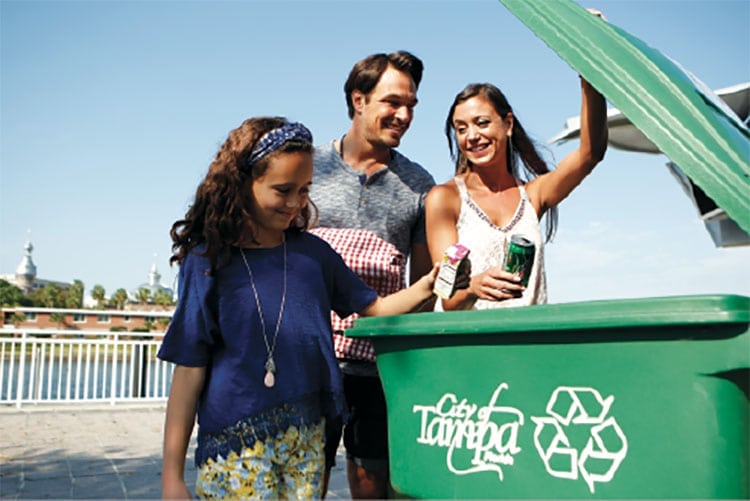
Sometimes a municipal recycling program’s biggest impact is abundantly clear.

Just look at Tampa, Fla. The city has a revenue-sharing agreement with materials recovery facility (MRF) operator Waste Management. But right now, the value for the city is not the money that comes back from marketed material – it’s what gets saved by not having to send more to disposal.

About 20,000 tons of recyclables are collected by city crews through the residential curbside program each year. At the same time, Tampa collects 310,000 tons of waste that’s sent to a waste-to-energy incinerator.

A local official pointed out that if the recycling program was absent, the waste-to-energy facility would be pushed beyond capacity, and the city would likely need to explore additional disposal avenues sooner rather than later.

Tampa’s population is also booming, which adds to the economic pressure.

“I always like to say we’re past the point of no return,” said Mark Wilfalk, director of the city’s Department of Solid Waste and Environmental Program Management. “We’re to the point where, although we don’t get a high dollar return, the value of having that diversion program in place is what’s keeping us alive.”

System evolves to single-stream

Tampa’s recycling program has its roots in a subscription-based program that operated during the 1990s – residents could receive a curbside cart on request. Residents were asked to source-separate a number of material types, and the program was geared toward specific neighborhoods.

Around 2000, the city rolled out curbside recycling to the entire city. And about a year after that citywide implementation, Tampa switched to a dual-stream system in which fiber was kept separate but everything else was commingled.

Half a decade later, Tampa began retrofitting vehicles for automated recycling collection to boost efficiency. The switch also meant adoption of full-fledged single-stream collection.

Today, the city handles collection of recycling, yard waste and garbage for residential customers inside city limits. Collected recyclable material is sent to the Waste Management MRF.

Determining a diversion rate for the city is not straightforward. Using the figures noted earlier – 20,000 tons sent to recycling and 310,000 tons sent to the waste-to-energy site – would mean a recovery rate of around 6 percent.

But Wilfalk said those numbers don’t account for all the city’s waste and recycling tonnages.

And the issue is compounded by the fact that Florida regulations allow waste-to-energy weights to be counted toward diversion.

Wilfalk reiterated that the true mark of success for the Tampa program is whether it can keep the city’s waste output at a level that does not require additional disposal options.

“It’s an expensive program,” he acknowledged. “But it would be a lot more expensive if we didn’t have it in place.”

Paths to improvement

Currently, the program accepts standard single-stream commingled recyclables, including glass, although that material presents challenges for the program. There are few local markets for glass, and it often ends up requiring a cost to dispose, rather than bringing in any commodity value.

“It’s a little difficult for us, but we’ll weather the storm until hopefully the markets change,” Wilfalk said.

Another issue is contamination. Tampa’s contamination rate currently runs between 12 and 15 percent. That figure is relatively low, but Wilfalk noted it’s higher than the previous year, when the contamination rate was calculated at about 10 percent.

Program leaders have learned to account for Florida’s weather patterns when determining material quality. One year, for example, the contamination study was completed after a stretch of 21 days of solid rain, Wilfalk recalled, and the rate was abnormally high.

To try to continue to move the ball forward on program efficiency and material quality, Tampa gets help through an agreement with Waste Management. Under the contract between processor and city, Tampa receives a $60,000 per year endowment fund, money that’s dedicated to educating the public.

“It works for both sides because it educates our customers and they end up getting a cleaner product at the facilities,” Wilfalk said.

Each month, Tampa receives a $5,000 check from Waste Management, which the city uses to promote recycling in a variety of ways, including creating advertisements, putting up billboards and more.

Tampa is also looking to increase its recycling efforts in two areas that pose challenges to communities nationwide: commercial and multi-family recycling.

Although the city handles all residential collection, commercial “is more of an open market,” Wilfalk explained, which means it’s a harder stream to tackle in a unified manner. The city also doesn’t have a requirement for recycling receptacle space to be provided with new buildings, and most developments have included only garbage enclosures.

But Wilfalk said planners are making progress by laying out the economic equation to property owners, a strategy that makes sense in a city where recycling is valued for its cost-cutting characteristics.

“The reluctancy is there, but that’s until you get [building owners] to realize the benefits of it,” he said. “So if they’re paying $200 for two eight-yard dumpsters to be serviced each month, and we can put a recycling program in there for $75 a month, that’s their savings.”

This article originally appeared in the May 2018 issue of Resource Recycling. Subscribe today for access to all print content.

Think your local program should be featured in this space? Send a note to [email protected].

Tags: Local Programs
Colin Staub

Colin Staub

Colin Staub was a reporter and associate editor at Resource Recycling until August 2025.

Related Posts

Industry insiders reject dual-stream switch

byColin Staub
September 11, 2018

Debates pitting single-stream versus dual-stream recycling have gained steam in recent months. But in a recent gathering of key stakeholders,...

Glass on the chopping block in Pennsylvania county

byJared Paben
September 18, 2018

Citing market upheavals this year, Erie County, Pa. officials are asking people to stop putting glass in their curbside receptacles....

Florence causes ‘enormous mess’ in Carolinas

byColin Staub
September 18, 2018

Hurricane Florence has forced programs to suspend collection and led haulers to remind residential customers about proper storm debris management....

Recycling stakeholders vie for public office

byJared Paben
October 2, 2018

While much of the nation's political focus has been on national races and control of Congress, recycling professionals are seeking...

A stack of laptop computers.

E-scrap grant money still available in Empire State

byJared Paben
October 10, 2018

In 2016, New York began providing grants to offset municipalities' e-scrap collection and recycling costs. Two years later, nearly one-third...

Here are the recycling numbers for one major hauler

byJared Paben
October 23, 2018

Waste Connections has provided a high-level look at its materials recovery division, detailing total tonnages over the past two years...

Load More
Next Post

The Recycling Partnership to launch coastal cart program

More Posts

Redwood secures $350 million to expand recycling, storage

Redwood secures $350 million to expand recycling, storage

November 6, 2025
CMR, Paladin form REcapture to expand rare earth recovery

CMR, Paladin form REcapture to expand rare earth recovery

November 6, 2025
Earnings results point to active IT hardware lifecycles

Earnings results point to active IT hardware lifecycles

November 6, 2025
Texas students turn old tech and e-scrap into art 

Texas students turn old tech and e-scrap into art 

November 6, 2025
Analysis: Q3 earnings confirm new industry priorities

Analysis: Q3 earnings confirm new industry priorities

November 13, 2025
Iron Mountain raises ITAD guidance on strong growth

Iron Mountain raises ITAD guidance on strong growth

November 13, 2025
ERCC outlines shift toward convenience benchmarks

ERCC outlines shift toward convenience benchmarks

November 13, 2025
Analysis: EU softens ESG rules as compliance pressure builds for US

Analysis: EU softens ESG rules as compliance pressure builds for US

November 20, 2025
Sector holds wide gaps in environmental standards

Sector holds wide gaps in environmental standards

November 20, 2025
From crawl to run: a clear roadmap for ITAD ESG

From crawl to run: a clear roadmap for ITAD ESG

November 20, 2025
Load More

About & Publications

About Us

Staff

Archive

Magazine

Work With Us

Advertise
Jobs
Contact
Terms and Privacy

Newsletter

Get the latest recycling news and analysis delivered to your inbox every week. Stay ahead on industry trends, policy updates, and insights from programs, processors, and innovators.

Subscribe

Welcome Back!

Login to your account below

Forgotten Password?

Retrieve your password

Please enter your username or email address to reset your password.

Log In

Add New Playlist

No Result
View All Result
  • The Latest
  • Analysis
  • Recycling
  • E-Scrap
  • Plastics
  • Conferences
    • E-Scrap Conference
    • Plastics Recycling Conference
    • Resource Recycling Conference
    • Textiles Recovery Summit
  • Magazine
  • About Us
  • Advertise
  • Archive
  • Jobs
  • Staff
Subscribe
This website uses cookies. By continuing to use this website you are giving consent to cookies being used. Visit our Privacy and Cookie Policy.