





Resource Recycling
  • The Latest
  • Analysis
    • All
    • Certification Scorecard
    • Industry Announcements
    • Opinion

    Certification Scorecard — Week of April 13, 2026

    EV Battery Pack - Sergii Chernov-Shutterstock

    Redwood, Rivian deal fuels US infrastructure plans

    Bloom ESG and e-Stewards roll out critical metals metric

    Colorado regulators suggest mid-range EPR scenario

    Why collaboration on plastic waste still matters

    Battery recycler Ascend Elements files for bankruptcy

    Battery recycler Ascend Elements files for bankruptcy

    EPR fees are a market signal. Here’s what they’re telling you.

    EPR fees are a market signal. Here’s what they’re telling you.

    Wolframite ore, the primary ore of tungsten from Altai, Russia

    Tungsten scrap export controls draw industry attention

    Certification Scorecard — Week of April 6, 2026

    Closed Loop Partners acquires Sutter Metals, connecting electronics disposition to metals recovery

  • Conferences
  • Publications

    Other Topics

    Textiles
    Organics
    Packaging
    Glass
    Brand Owners

    Metals
    Technology
    Research
    Markets
    Grant Watch

    All Topics

Subscribe
No Result
View All Result
Resource Recycling
  • The Latest
  • Analysis
    • All
    • Certification Scorecard
    • Industry Announcements
    • Opinion

    Certification Scorecard — Week of April 13, 2026

    EV Battery Pack - Sergii Chernov-Shutterstock

    Redwood, Rivian deal fuels US infrastructure plans

    Bloom ESG and e-Stewards roll out critical metals metric

    Colorado regulators suggest mid-range EPR scenario

    Why collaboration on plastic waste still matters

    Battery recycler Ascend Elements files for bankruptcy

    Battery recycler Ascend Elements files for bankruptcy

    EPR fees are a market signal. Here’s what they’re telling you.

    EPR fees are a market signal. Here’s what they’re telling you.

    Wolframite ore, the primary ore of tungsten from Altai, Russia

    Tungsten scrap export controls draw industry attention

    Certification Scorecard — Week of April 6, 2026

    Closed Loop Partners acquires Sutter Metals, connecting electronics disposition to metals recovery

  • Conferences
  • Publications

    Other Topics

    Textiles
    Organics
    Packaging
    Glass
    Brand Owners

    Metals
    Technology
    Research
    Markets
    Grant Watch

    All Topics

Subscribe
No Result
View All Result
Resource Recycling
No Result
View All Result
Home Resource Recycling Magazine

Community Spotlight: L.A. planners juggle goals, markets and huge volumes of material

Colin StaubbyColin Staub
July 15, 2019
in Resource Recycling Magazine
Every year municipal crews in Los Angeles collect 1.5 million tons of material.

The second-largest city in the country also has a very ambitious waste diversion goal: 90% by 2025. That means Los Angeles must stay creative to continue managing the massive volume of recyclables its residents generate.

“We have a vast amount of bins all throughout the city,” said Robert Potter, city of Los Angeles division manager for the Bureau of Sanitation. “There are roughly 3 million containers that are out there on any given week.”

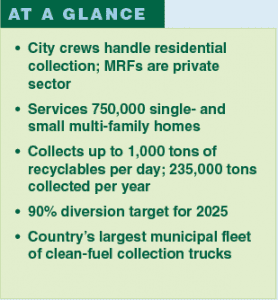
The city’s residential recycling program relies on city crews to service 750,000 single- and multi-family homes.

Every day, the city collects 3,600 tons of garbage, 1,600 tons of organics and about 1,000 tons of recyclables. That equals out to 1.5 million tons of overall material per year, Potter said, and about 235,000 tons of recyclables in a year.

And like most municipalities, particularly those in California, Los Angeles has faced challenges stemming from the wider recycling market slump that has occured in the wake of China’s National Sword policy.

“Our recycling program has seen a shift … in being a revenue stream to a little bit of a cost center,” Potter explained.

Shifts in MRF contracts

California has aggressive diversion goals that municipalities must meet. And as a major metropolis, Los Angeles (population: 4 million) can’t exactly discontinue service or temporarily scale back collection of certain materials as nimbly as a smaller municipality.

To respond to the challenges and ensure the recycling program is sustainable amid the new market realities, the city and its private-sector MRF contractors that receive residential recyclables have changed some of their contractual terms.

“When we had conversations with our MRFs, we said, ‘You know what, this minimum floor price, this set dollar amount for a five-year period, it just can’t work anymore,’” Potter said. In short, the city understood it could no longer reasonably expect to receive at least $10 per ton for the duration of a contract.
During the recent contract negotiations, the city and MRFs came to an agreement on a shifting floor system. Under the new contract, the markets for three key commodities are evaluated every three months, with a pricing formula determining whether the municipality pays or receives revenue for that time period.

The underlying idea is that when markets are strong and commodities are way up, both parties benefit, but when the market tanks, both parties absorb the hit.

“It’s not perfect,” Potter acknowledged, noting that the markets became even more volatile as the city’s contract negotiations were underway and that there is room for further improvement. But in the bigger picture, the arrangement means MRFs can stay in business without getting hit with huge revenue declines.

During the negotiation process, the city addressed several key questions: What are the values for commodities, which are the primary commodities, and is it possible to set a minimum floor value based on the markets?

“That’s a true reflection of what’s going to happen to the MRF and what’s going to affect us financially,” Potter said.

Exploring alternatives

Potter acknowledged that reaching the city’s 90% diversion goal within six years will be “challenging in the current environment.”

In April, the Los Angeles City Council voted to direct the Sanitation Bureau to develop a report exploring the wider impact China’s import restrictions have had on recycling efforts in the city.

“The city’s … program was designed to effectively manage solid resources collection and allow the city to achieve zero waste goals,” the Council directive stated. “The program’s recycling objectives were tied to the purchase of recyclable materials by Chinese firms.”

The recycling crisis, the City Council document continued, presents an opportunity for Los Angeles to rethink its waste system. First and foremost, the city could shift toward a waste reduction approach by considering bans of not-currently-recycled products.

The Council referenced a recent product ban proposal in Berkeley, Calif., which would prohibit all single-use disposable foodware inside restaurants and charge a 25-cent fee per beverage or meal that is served in packaging. The Berkeley ordinance would also require that the “disposable” packaging be recyclable or compostable.

The report the Sanitation Bureau has been asked to prepare will explore alternative approaches the city can take to push toward its waste management goals. This includes “setting ambitious and achievable source reduction goals for single-use food and beverage packaging” and other “highly-littered and non-essential” plastic products. The report will also look into local and regional market development as well as tactics to support reuse projects.

Other areas of focus

Los Angeles has also been active in optimizing its truck fleet and finding ways to move the needle outside the residential sphere.

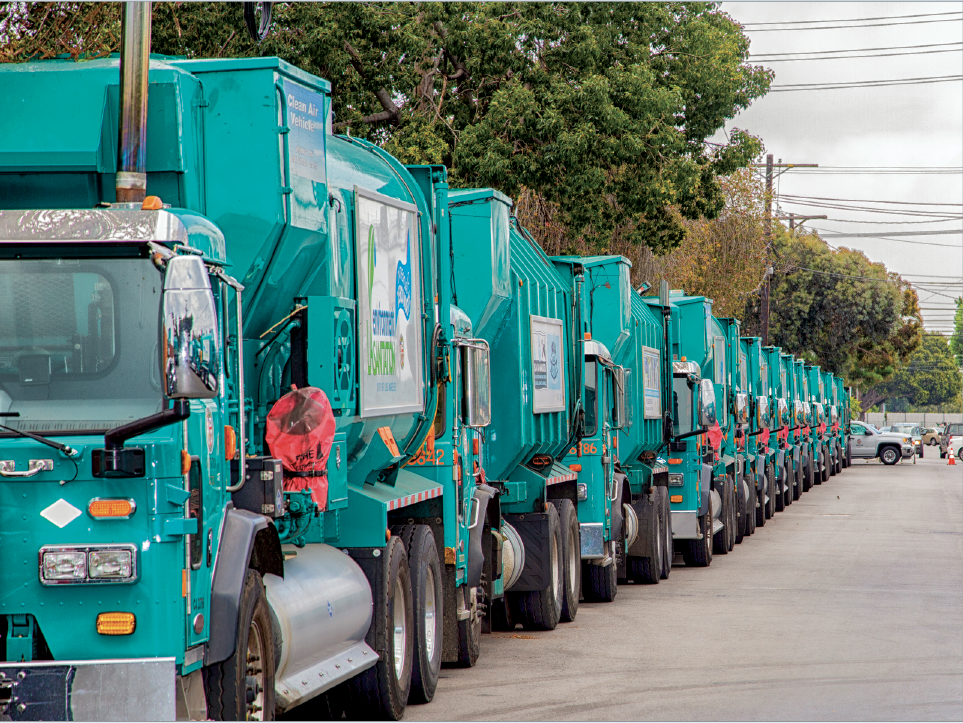
The city has six different “wastesheds,” each of which has 150 collection trucks.

Los Angeles operates the largest clean-fuel fleet of collection trucks of any municipality in the country, Potter said. And the city is currently working to move toward electric collection vehicle use.

Meanwhile, the city is planning for the future through a Solid Waste Integration Resource Plan (SWIRP), which Potter said “targets all the elements of municipal waste, ensuring we can divert the highest percentage possible.”

It was the SWIRP that set the 90% diversion goal. And through the plan, the city also formed a public-private partnership called recycLA, which was launched in 2017 and made changes to commercial and multi-family collection services. Among other components, the program introduced commercial franchise zones.

Think your local program should be featured in this space? Send a note to [email protected].


This article originally appeared in the June 2019 issue of Resource Recycling. Subscribe today for access to all print content.

Tags: Community SpotlightLocal Programs
TweetShare
Colin Staub

Colin Staub

Colin Staub was a reporter and associate editor at Resource Recycling until August 2025.

Related Posts

Bill to update New Jersey e-scrap program heads to governor

New Jersey recyclers talk EPR

byBrian Clark Howard
April 9, 2026

At the Association of New Jersey Recyclers’ spring meeting industry representatives discussed the state and future of the sector.

Wineries help create model for film recycling

Wineries help create model for film recycling

byAntoinette Smith
April 7, 2026

A collaboration between California wineries and the recycling value chain has provided a closed-loop model the partners aim to see...

Waste Connection recycling cart in The Dalles, Oregon

First Oregon community expands curbside recycling with EPR funding

byBrian Clark Howard
April 1, 2026

The City of The Dalles in northern Oregon is now rolling out nearly 5,000 new 90-gallon recycling carts to customers...

Rural effort targets vapes as battery fire risk grows

byScott Snowden
March 24, 2026

A Wisconsin firefighter is building a rural vape collection service as discarded devices with lithium-ion batteries continue to raise fire...

New Providence carts underpin recycling campaign

New Providence carts underpin recycling campaign

byBrian Clark Howard
March 23, 2026

With grant assistance, the Rhode Island capital is providing about 55,000 new collection carts to help boost its recycling rate,...

Recycling education needs consistency, simplicity 

byBrian Clark Howard
February 25, 2026

Several members of Circular Action Alliance team shared insights during a workshop at the 2026 Resource Recycling Conference in San...

Load More
Next Post

Mixed plastics need a home – here's one domestic possibility

Leading the Charge in Safe Battery Recycling
Sponsored

Leading the Charge in Safe Battery Recycling

byThe Battery Network
April 13, 2026

We’re connecting people, brands, and communities through one nationwide network built to make battery recycling safer, simpler, and more accessible...

Read moreDetails

More Posts

EPR fees are a market signal. Here’s what they’re telling you.

EPR fees are a market signal. Here’s what they’re telling you.

April 10, 2026
Wolframite ore, the primary ore of tungsten from Altai, Russia

Tungsten scrap export controls draw industry attention

April 9, 2026

WM opens new $60m MRF in Indy

April 10, 2026

Trafigura signs $1.1b deal for recycled battery metals

April 8, 2026
Battery recycler Ascend Elements files for bankruptcy

Battery recycler Ascend Elements files for bankruptcy

April 13, 2026
Solarcycle starts up Georgia recycling plant

S3399 signals a shift in how states are tackling solar panel waste

April 6, 2026

Recycling Partnership CEO stepping down

April 15, 2026

GFL acquires SECURE Waste for $6.4bn

April 13, 2026
Colorado regulators suggest mid-range EPR scenario

Why collaboration on plastic waste still matters

April 13, 2026
End markets, policy key to RPET viability

End markets, policy key to RPET viability

April 8, 2026
Load More

About & Publications

About Us

Staff

Archive

Magazine

Work With Us

Advertise
Jobs
Contact
Terms and Privacy

Newsletter

Get the latest recycling news and analysis delivered to your inbox every week. Stay ahead on industry trends, policy updates, and insights from programs, processors, and innovators.

Subscribe

Welcome Back!

Login to your account below

Forgotten Password?

Retrieve your password

Please enter your username or email address to reset your password.

Log In

Add New Playlist

No Result
View All Result
  • The Latest
  • Analysis
  • Recycling
  • E-Scrap
  • Plastics
  • Policy Now
  • Conferences
    • E-Scrap Conference
    • Plastics Recycling Conference
    • Resource Recycling Conference
    • Textiles Recovery Summit
  • Magazine
  • About Us
  • Advertise
  • Archive
  • Jobs
  • Staff
Subscribe
This website uses cookies. By continuing to use this website you are giving consent to cookies being used. Visit our Privacy and Cookie Policy.