





A new company formed through the merger of Solarcycle and Korea Zinc’s US recycling arm is expected to help meet the nation’s critical mineral needs amid a pending surge of AI-related e-scrap.
Solarcycle and PedalPoint Recycling announced the formation of Jupiter this week. That company, in which Korea Zinc holds a majority stake, combines PedalPoint’s recycling, ITAD and supply chain entities with Solarcycle’s advanced solar panel recycling assets.
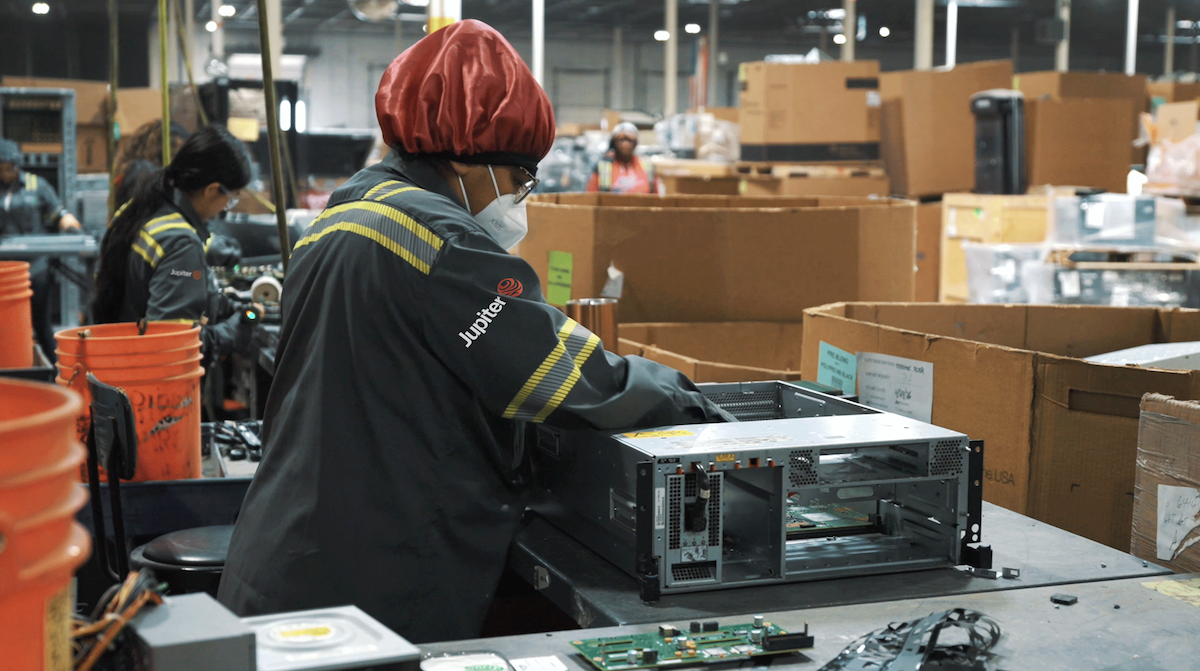
The companies merged to give hyperscalers and clean energy providers a place to recycle servers, solar panels, wind turbines and related equipment. Jupiter will process those items and recover minerals for reintroduction into manufacturing.
The increased capacity is important, company leaders said, given the wave of both decommissioned solar panels and data center hardware that’s expected to hit the market in the coming years. Most of these items aren’t recycled, a company spokesperson said, so creating more capacity for e-scrap gives companies in that space a natural partner for retiring IT assets.
“Retired IT and energy assets are some of the fastest-growing sources of e-waste and extremely rich in critical metals. Jupiter will play an important role in strengthening the supply chain by preparing this feedstock for final refinement by Korea Zinc,” said Mark Pope, CEO of PedalPoint. “For the customer, our uniquely integrated relationship with a leading global metals company means having a single partner who can take retired assets from the field all the way through final refinement and return the critical materials to the supply chain.”
The spokesperson said the deal helps Jupiter stand out because, while other companies may handle ITAD or recycling, “we ensure that every asset realizes its highest-value outcome by handling everything from decommissioning and triage, to reuse and resale, to recycling, refining with Korea Zinc, and returning renewable metals to customer supply chains.”
The move gives Jupiter priority access to Korea Zinc’s global metals refining operations. Those include its Onsan refinery in South Korea, which produces about 650,000 tons of zinc and 420,000 tons of lead a year along with other critical minerals, the spokesperson said.
The Seoul-based metal refiner posted 2025 revenue of $12.4 billion and partnered with the US government last year to begin work on a $7.4 billion smelter in Clarksville, Tennessee, that will be one of the first of its kind on US soil.
That facility will produce 13 metals, including many, such as gold, silver and antimony, that the US government has designated as critical minerals. When completed in 2029, it will process about 1.1 million tons of raw materials and produce 540,000 tons of finished product. Interested customers can include a contract clause ensuring the return of all the minerals extracted from the items they send for recycling, the spokesperson said.
New York City-based Jupiter inherits the clients of both businesses, among them Brookfield and Microsoft. The latter is also a minority investor.
“Responsibly building AI requires innovation not only in technology, but across the energy, infrastructure and materials systems that support it,” said Brandon Middaugh, Microsoft’s general manager of market development. “Recovering and reusing critical materials will become increasingly important to building resilient domestic supply chains and advancing a more circular economy.”
Jupiter also inherits the recycling facilities that were operated by both companies, which will remain operational. Those eight US sites have a combined processing footprint exceeding 1 million square feet and employ more than 250 people.
Solarcycle’s Suvi Sharma will serve as Jupiter’s CEO, while PedalPoint’s Kevin Hahm was named CFO. Other members of the leadership team and board will come from both companies.
Leadership said the move best equips the new company to handle coming feedstock supplies while aligning with federal initiatives to secure US mineral independence.
“We are facing critical material shortages just as demand for electrification and digital infrastructure is surging,” Sharma said. “Jupiter closes that gap, turning retired IT and energy assets into a domestic material supply at an unmatched scale.”