

Resource Recycling
  • The Latest
  • Podcast
  • Analysis
    • All
    • Certification Scorecard
    • Industry Announcements
    • Opinion
    IT asset disposition and electronics recycling: Now and then

    Data center moratoriums cast development shadow

    Recycling tracking data is already on your truck

    Recycling tracking data is already on your truck

    A five star ranking with one under a microscope

    Certification scorecard — week of Nov. 9

    Data centers and AI combine to create ITAD ‘growth engine’

    Component shortages drive demand for data center hardware

    Ingram Micro again files to take company public

    Ingram Micro sees lifecycle services rise 35%

    Inside the Circle: Will we lose our shirts over CA textile EPR?

    Inside the Circle: Will we lose our shirts over CA textile EPR?

  • Conferences
    • Resource Recycling Conference
    • Plastics Recycling Conference
    • E-Scrap: The Longevity Conference
    • Textiles Recovery Summit
  • Publications
    • E-Scrap News
    • Plastics Recycling Update
    • Policy Now
    • Resource Recycling
    • Other Topics
      • All Topics
      • Brand Owners
      • Critical Minerals
      • Glass
      • Grant Watch / RFPs
      • Markets
      • Organics
      • Packaging
      • Research
      • Technology
      • Textiles
Subscribe
No Result
View All Result
Resource Recycling
No Result
View All Result
Home Recycling

Alphabet’s Materra wants recyclers to see molecules, not bottles

Stefanie ValenticbyStefanie Valentic
November 13, 2026
in Recycling

Peter Chauvel is strategy and operations lead for Materra. | Stefanie Valentic

Alphabet’s moonshot factory has spent years building a molecular map of what Americans throw away. Its strategy lead says the data, not more equipment, is what recycling has been missing.

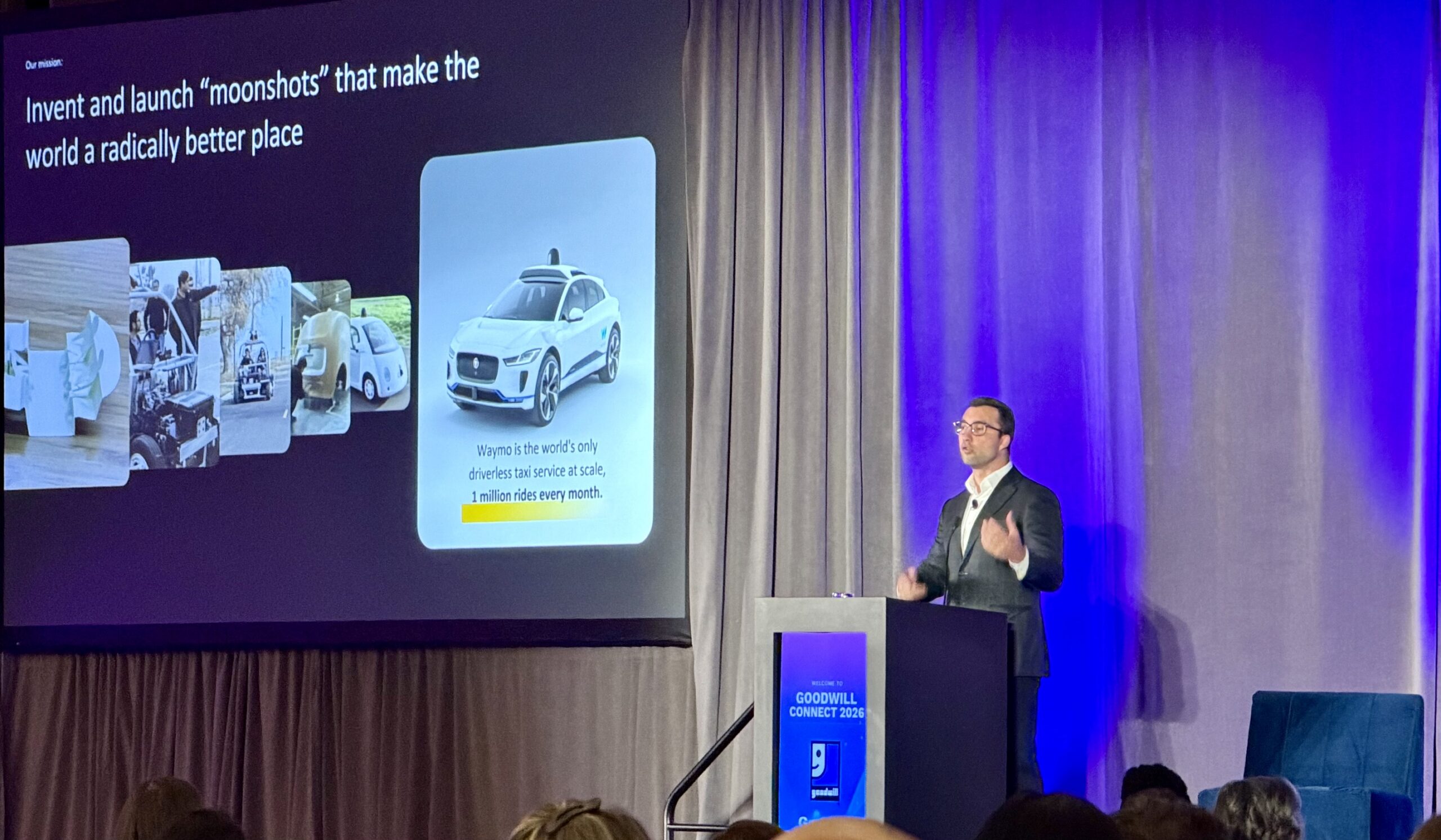
Peter Chauvel is strategy and operations lead for Materra, the circularity project inside X, Alphabet’s innovation lab. He spoke about the project’s approach Nov. 10 at the Goodwill Sustainability Summit in Houston.

“We’re looking at how we might radically reimagine waste so nothing is ever thrown away again,” Chauvel said.

X, formerly Google X, has launched more than 30 technologies and companies in 16 years, including Waymo. Every project starts from the same blueprint, Chauvel said. The team finds a problem affecting millions or billions of people, proposes a solution that sounds like science fiction, then builds the technology to make it work.

Chauvel pointed to Waymo as the clearest example. Traffic crashes kill 1.16 million people a year, according to the World Health Organization. Ninety-three percent of those deaths trace to human error, he said. Other companies were working on better seatbelts and airbags, he said. In 2007, X decided to take the driver out.

Materra applied that same blueprint to materials. Chauvel said humanity spends trillions of dollars a year extracting raw materials and throws away roughly 75% of them. He said the mineral value alone will reach $8.6 trillion a year by 2040.

“Right now, we’re throwing that all back into the ground,” he said.

Seeing is believing

Recycling has existed for decades but “the process is operating blind,” Chauvel said. Processors have little visibility into where their feedstock comes from or what is in it.

They often pay for the very materials that contaminate their output. Without traceability, they have no way to know which supplier is responsible for contaminated loads.

Recyclers also compete against oil, gas and mining — industries that have had a century to refine their operations, he said.

Chauvel compared recycling to baking.

“If you put the wrong thing in at the beginning, if you, for example, switch up your sugar for salt, … you end up with a bad product at the end,” he said.

The system’s incentives make the problem worse, Chauvel said. Collectors are paid to gather as much material as possible and keep it out of landfills.

The bales they sell carry contamination, so reclaimers have to buy what amounts to mini sorting facilities at the front of their lines. Even after that capital spending, the resin often doesn’t meet the quality or price brands require.

From objects to molecules

Materra’s answer is to replace what Chauvel called an object-based view with a molecular one. Instead of seeing a bottle, a T-shirt or a laptop, the system identifies the molecules each item is made of.

Analytical chemistry labs could already do that, he said, but never quickly, cheaply or at scale.

The technology stack has four parts:

  • A molecular knowledge base. When Chauvel joined Materra, his job was to pick material off MRF lines. The team did that for years, reverse-engineering discarded items to learn what they contained and using the results to train its AI.
  • Inline sensors. These run on conveyor belts and identify the molecular makeup, shape and color of thousands of items per minute.
  • Molecular sortation. Sorting decisions go to robotics, air jets or human sorters through what Materra called a “human assist.”
  • A recycling optimizer. This feedback loop learns from recyclers’ results.

“We are not a recycler,” Chauvel said. “There’s people in the world who are very good at this, and we are not one of them.”

Film and flex

Film and flexible packaging is Materra’s most public test case. Chauvel said the US produces 7 million tons of it a year and recycles less than 5%. Most of what is recycled is post-industrial scrap.

Working with Dow, Materra showed it could detect the individual layers in multilayer film and each layer’s share of the item’s weight. That tells a recycler whether it can accept the material and which process it fits, Chauvel said.

“Today, film and flexible has basically zero value to the world. It’s actually a cost,” he said. Turning it into feedstock means taking something “you might even get paid to take” and producing a valuable product.

A systems challenge

Chauvel said technology alone won’t close the loop. “Circularity is a systems challenge,” he said.

Materra’s long-term vision is the circularity hub. A single facility would take in textiles, packaging and electronics and sell reuse, resale and recycling outputs. Combining streams would cut transport costs and help recovered materials compete with virgin ones, he said.

“It might sound a lot like a Goodwill,” Chauvel said. “When I was thinking about it, it really looks like a Goodwill.”

He added that Materra is “not there today.”

Chauvel said the technology won’t replace human sorters. He cited a summit exercise in which Goodwill staff sorted shoes he couldn’t classify. He also said bad product labels often send material to the wrong recycler, and Materra hopes to fix that upstream.

Chauvel urged attendees to try things quickly and inexpensively. X builds a deliberately bad first prototype of every project, Waymo included.

“There’s no such thing as failure. There’s only learning,” he said. “Don’t measure twice, cut once when you’re trying something innovative.”

He predicted that within 10 years, material data will be “a currency” for organizations that handle physical goods at scale.

“We don’t need to go back to the ground to get the materials for the products of tomorrow,” Chauvel said. “We have them in the products of today and yesterday.”

Tags: Film & FlexiblesTechnology
TweetShare
Stefanie Valentic

Stefanie Valentic

Stefanie Valentic is an award-winning journalist who has covered the waste and recycling industry for more than five years. Throughout her career, she has led editorial teams and served as a keynote speaker, moderator and panelist at numerous trade shows and conferences.

Related Stories

Vessel gives excess inventory a second life

Vessel gives excess inventory a second life

byPaul Lane
November 13, 2026

The recently rebranded company helps manufacturers redistribute product more cheaply than destroying it.

Goodwill eyes EPR revenue, starting with waste audit

byStefanie Valentic
November 12, 2026

Goodwill sustainability leaders say the nonprofit’s donation network could serve packaging and textile EPR programs, but they first need hard...

Produce packers face narrow exits under SB 54

byStefanie Valentic
November 11, 2026

Fiber, compostables, PCR and monomaterial films all come with tradeoffs for fresh produce, and no single swap will work across...

Groups publish national recycling acceptance data

PC shipments slump as data center investment surges

byDavid Daoud
November 4, 2026

Global infrastructure industry presents a mixed outlook for ITAD, recycling companies.

Artificial intelligence is altering the marketplace for ITAD providers in numerous ways. | Shutterstock

AI alters ITAD economics

byDavid Daoud
November 3, 2026

Companies are using the technology for sorting, logistics and other functions to enhance their operations.

Stoa hopes to establish AI hardware marketplace

Stoa hopes to establish AI hardware marketplace

byPaul Lane
November 3, 2026

Startup looks to give buyers, sellers and lenders a central place to compare prices and complete deals.

Load More

2026 Buyers’ Guide

Equipment, services and technology suppliers serving the recycling industry.

Browse the Guide

More Posts

NexPoint Materials to shutter Alabama plastics plant

NexPoint Materials to shutter Alabama plastics plant

November 4, 2026
PureCycle sees easing headwinds to R-PP adoption

PureCycle shifts focus, secures feedstock

November 5, 2026
Inside the Circle: Will we lose our shirts over CA textile EPR?

Inside the Circle: Will we lose our shirts over CA textile EPR?

November 9, 2026
Artificial intelligence is altering the marketplace for ITAD providers in numerous ways. | Shutterstock

AI alters ITAD economics

November 3, 2026
PET bottles for recycling

PET imports reshape US markets as demand grows

November 11, 2026
Textile EPR needs end markets, not just collection

Textile EPR needs end markets, not just collection

November 10, 2026
The missing link in e-plastic recycling

The missing link in e-plastic recycling

October 28, 2026
UC Riverside expands reusable takeout program

UC Riverside expands reusable takeout program

November 6, 2026
New CAA chief talks markets, industry support

New CAA chief talks markets, industry support

November 4, 2026
Partnership targets mixed nylon waste

Partnership targets mixed nylon waste

November 4, 2026
Load More

About & Publications

About Us

Staff
Job Listings

Archive

Magazines

Work With Us

Advertise
Contact
Terms and Privacy

Newsletters

Get the latest recycling news and analysis delivered to your inbox every week. Stay ahead on industry trends, policy updates, and insights from programs, processors, and innovators.

Subscribe

Welcome Back!

Login to your account below

Forgotten Password?

Retrieve your password

Please enter your username or email address to reset your password.

Log In

Add New Playlist

No Result
View All Result
  • The Latest
  • Podcast
  • Analysis
  • Recycling
  • E-Scrap
  • Plastics
  • Policy Now
  • Conferences
    • E-Scrap Conference
    • Plastics Recycling Conference
    • Resource Recycling Conference
    • Textiles Recovery Summit
  • Magazines – Old
  • About Us
  • Advertise
  • Archive
  • Job Listings
  • Staff
Subscribe
This website uses cookies. By continuing to use this website you are giving consent to cookies being used. Visit our Privacy and Cookie Policy.