




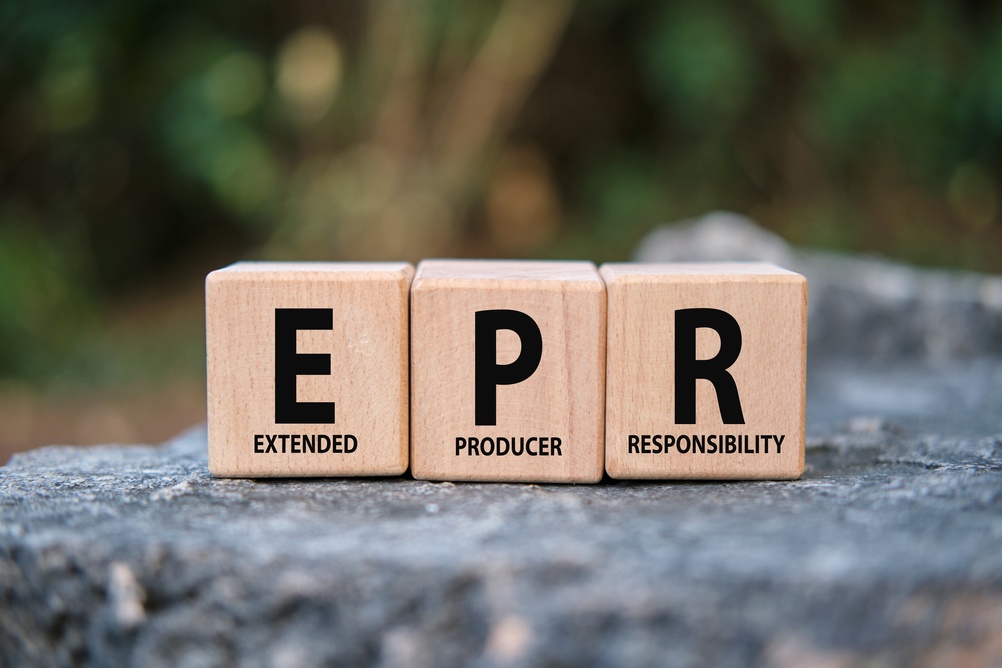
The US is on the verge of having three active extended producer responsibility (EPR) laws for packaging, representing a paradigm shift, said policy expert Kate Bailey during a recent industry meeting.
Bailey, who is chief policy officer for the Association of Plastic Recyclers (APR), described packaging EPR as an active, large-scale transition, with the early years expected to be uneven as programs, contracts and regulations take shape. (APR owns Resource Recycling, Inc., publisher of Plastics Recycling Update.)
“When we look back in 10 years, we will say ‘those were wild times when we were starting up these programs,'” she said during APR’s Oct. 27-29 fall membership meeting in New Orleans, Louisiana. “So when it feels a little bumpy, a little chaotic, it’s because we are in the middle of a really, really big transition that’s about to affect 20% of the US population by 2030.”
That significant transition is “because it delivers results, because it increases the amount of material that’s collected and processed for recycling,” Bailey said.
But because the US is a very litigious country, “every major piece of environmental legislation in this country has gone to court, so it’s not a surprise about EPR, and it’s probably not over.”
Still, EPR is here to stay, Bailey said: “I get a lot of questions about the lawsuits with EPR, and if EPR is going away. And I want you to hear loud and clear: The answer is no. EPR has taken hold around the globe in the past 10 to 15 years, so this is not just something the US is grappling with.”
However, she acknowledged that the various state laws are imperfect. “They all have their little quirks, thanks to state politics.” And so a more cohesive approach is called for, she said.
A ‘whole of North America’ approach
In Canada, EPR programs are generally more advanced than in the US, with British Columbia’s program becoming the first of its kind in North America in 2014. In the 12 years since then, 98% of the population has gained packaging EPR coverage, she said.
And now Canadian provinces are working toward harmonizing design guides among the various programs. Despite having 12 years of packaging EPR in practice, British Columbia is just now aligning design for recycling guidance – using the APR Design Guide – and reporting, she said.
In addition, Mexico has a “sweeping new circular economy law that actually could surpass us,” Bailey said. As such, Bailey encouraged members to work toward a “whole of North America approach” to circularity.
“What we don’t want is 12 Canadian provinces, 50 US states and 31 Mexican states all doing different things. We want them all doing the same thing.”
One key difference in Canada is that the EPR programs are fully funded and managed by producers, Bailey said. Another is that the programs have strong targets for flexible plastic and rigid plastics, and five large PROs rather than just one.
In Canada, the PRO not only collects the fees from producers but also contracts for household collection and markets bales to reclaimers, Bailey said. In contrast, the US has basically set up a reimbursement model, in which CAA takes in money, and then gives it back to haulers, MRFs and reclaimers – reimbursing the existing system.
But because even most Canadian programs are in early stages, it’s yet unclear how the different models will play out, Bailey said.
“So the takeaway is we’re going to get there,” she said of the nascent US packaging EPR system. “It’s just not going to happen tomorrow. It’s going to be a bit of a process.”
Bailey also acknowledged that stakeholders would like to see quicker alignment on reporting categories in the US.
In addition, APR and Canada’s five biggest PROs are appealing to the Canadian government to encourage federal support, including investments in clean energy and technology, tax credits for recycled content and recycled content mandates, she said.
This partnership draws into focus two important points, Bailey said: EPR programs alone will not build a better system, and Canada is not perfect either. “They’ve got their own set of challenges. They don’t know how to recycle more film and flex, not much more than we do. So they’re trying to figure it out,” she said.
“And they’re also dealing with rising costs, particularly in Ontario, where they have multiple bureaus and they have some infrastructure that was really neglected for a while. So it’s not all rainbows and unicorns up there.”
As for Mexico, Bailey said the recent legislation is far bigger than any US EPR law. “It is a whole-of-government approach to a circular economy.” And although the Mexican law is still in early days, packaging EPR will be among the early target areas, she said.