

This article originally appeared in the January 2018 issue of Resource Recycling. Subscribe today for access to all print content.
While not a new concept, community composting is growing in popularity. And as more attention is focused on the strategy, it could help push ahead diversion in some jurisdictions that struggle to cost-effectively implement other options.
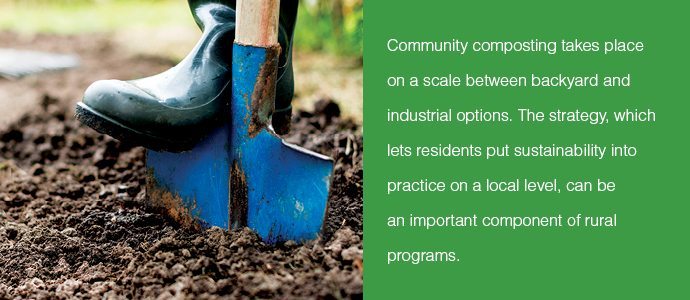
Community composting generally takes place on a scale that is larger than home composting but smaller than what is typically considered commercial or industrial composting. Community sites vary in size, structure, scope, staff and financing. They may be established at community gardens, farms, schools, transfer stations, businesses, institutions and other locations. These sites can be managed by volunteers, community groups, social enterprises or local governments.
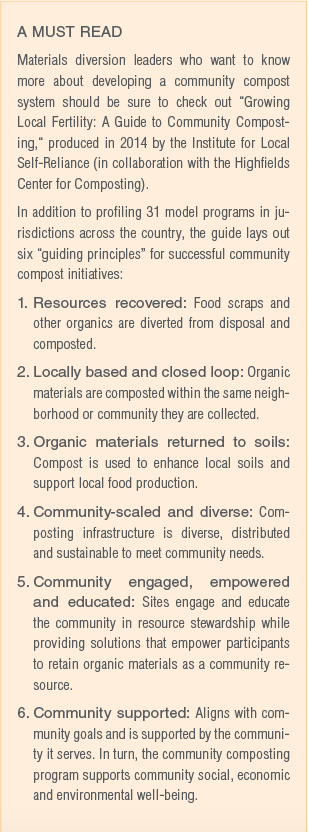
Perhaps the most inclusive definition of community composting comes courtesy of the New York City Community Compost Roundtable: “The first goal for community composting is that organic material flows the shortest possible distance in a cycle internal to a community, from the sources to a compost site and then, in a new form as mature compost, to greening projects in that same community. The second goal is to maximize participation of community members, both to help sustain the operation but also to foster individuals’ education about and commitment to sustainable practices.”
Recently, several organizations in Vermont came together to develop a statewide project to streamline community composting in small towns and rural areas of the Green Mountain State. As the effort develops, it could serve as a model for other less-populated areas where the community-focused arrangement can add energy to local programs.
A rural diversion opportunity
In many rural towns, public and private composting operations are either not available or very limited. Low population densities impact efficiencies in collection, transportation and material volumes for processing food waste, typically making these ventures uneconomical. While many residents in rural and small town communities may compost yard trimmings at home, concerns with odors and vermin often preclude home composting of food scraps.
 In addition, rural communities often face fiscal shortages which constrain efforts for managing organics. Limited economic resources, staffing and professional support and training in rural areas exacerbates the struggle, limiting communities’ abilities to develop creative, low cost ways to manage organics.
Community composting presents the opportunity to cost-effectively decrease solid waste generation, mitigate environmental impacts and resource use, improve soils, increase food security, and strengthen communities.
This past fall a project called Food Scrap Composting at Community Gardens was launched in Vermont. It was initiated by the Composting Association of Vermont (CAV) and Vermont Community Garden Network (VCGN), in partnership with select solid waste management districts and the New England Grassroots Environment Fund. The Northeast Recycling Council (NERC) also joined in the initial phase of the project through a U.S. Department of Agriculture grant that supported implementation of the food recovery hierarchy in rural Vermont communities.
The project was specifically designed to provide participants with funding, training, and technical assistance for community composting at, or in association with, community gardens. The pilot focused on establishing sites that would accept less than 100 cubic yards of organic material a year and thus be exempt from permit requirements under Vermont law.
The community gardens participating in the pilot project are located in Ludlow (population 1,963), Montpelier (population 7,535) and St. Albans (population 6,918). A community garden in Colchester (population 17,067) was also provided technical assistance and training for its new community composting system. All sites are managed by volunteer compost teams.
Site inspections were conducted at all of the gardens prior to the start of food scrap collection. Inspection reports and recommendations were provided to the site compost teams. On the scheduled food scrap collection kickoff day at each site, project partners (CAV, VCGN and NERC) provided on-site technical assistance for food scrap collection. Further observations, advice and recommendations were made to each compost team. Compost site participation ranged from five to 15 people at the kickoff events.
Project resources developed for the initial stages of the pilot included a basic community composting recipe to help participants find the right blend of organic feedstocks as well as a community compost site inspection form, poster and flier templates, and “good neighbor tips” to help ensure activities at the site would not upset residents living nearby.
 A training webinar was also hosted by the project partners, and it drew 33 viewers from around Vermont; the webinar recording was posted on YouTube so others could view later on. The webinar provided an overview of the pilot project, offered information on how to get started in food scrap collection, and gave a brief overview of composting, including recipes, compost management, recordkeeping and troubleshooting.
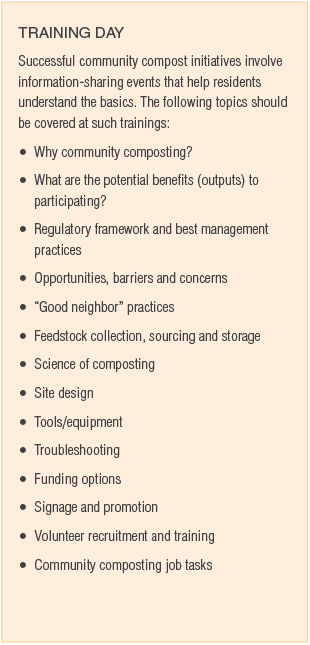
Finally, a best management practices training was held on a Saturday in mid-October at the Central Vermont Solid Waste Management District offices in Barre. Organized and presented by project partners, the training included a range of topics from “good neighbor” policies and volunteer recruitment and training to the science of composting and site design. PowerPoint presentations, group discussion, exercises and an on-site component at the Montpelier community compost site were included in the training. Participants were provided with a flash drive of community composting resources, including materials developed specifically for the project.
Participant survey responses revealed a preference for multimedia training materials, such as videos, that would allow for remote learning opportunities. However, participants also felt that local, on-site trainings are most valuable.
Community composting site best management practices
While community composting site characteristics vary widely, common best management practices can help ensure success.
First, successful community compost sites are designed to meet community needs effectively and consistently. Starting small, with a manageable number of food scrap generators, ensures that the site remains viable. Planning capacity for future expansion while developing the site, however, allows for the project to grow and better meet the needs of the community.
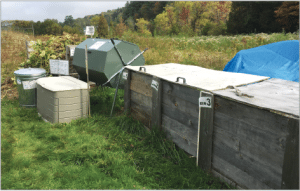
The site design needs to account for collecting, storing and processing food scraps and organics. Compost tumblers/bins, bays or windrow composting systems are typically used. In Vermont, as in many other rural areas, bears are a particular concern, so more rapid composting and reduced odor potential is a priority. Long, cold winters are also a factor in northern states: Pilot sites in Vermont were provided with a Jora tumbler (an insulated, dual-chamber tumbler) for use during the initial composting of food scraps. Once substantially decomposed, the food scraps can then be moved to a three-bin compost system or windrow to finish the cycle.
In addition, monitored collection or “receiving” of food scraps is encouraged to limit contamination. Community compost sites typically exclude the acceptance of meat in order to avoid odor, vermin concerns and the associated slower decomposition. Having wood shavings on hand to lightly sprinkle over food scraps during the intake reduces odor and provides carbon for incorporation into the tumblers.
And speaking of carbon, having on-site sources of carbon (leaves, livestock bedding, straw) is essential. Proper storage of carbon materials, in enclosed bins, is encouraged in order to keep materials dry and to reduce the chance that vermin will nest in the materials.
 Near the end of the process, compost curing (in a strategically designated place) is an important step.
As initiated in the pilot project, technical assistance and training in the compost process and the science of composting is critical. Keeping material size small, ensuring proper carbon-to-nitrogen ratios and appropriate moisture levels, is a strategy that should be emphasized at the community level just as it is at commercial organics operations. The science of composting is essentially the same no matter the size of the site. When managed correctly, hot composting (“process to further reduce pathogens”) is achievable at community compost sites.
Recordkeeping is another important component. Maintaining data on the volumes and sources of incoming food scraps and carbon sources is recommended. It’s also helpful to keep logs on process management (temperature recordings, turning details and so on) and to note any issues encountered during the process as well as solutions used to resolve them. You’ll also want to record the volume of compost produced and use of finished compost.
Finally, don’t forget about the ever-critical human component. Ongoing recruitment of volunteers and nurturing the community compost team are critical for the success of composting and integral to community composting.
The Vermont pilot project partners found that while there are training resources available, these were insufficient to meet the needs of the diverse nature of rural and small town communities.
The master composter programs available provide excellent initial training for food scrap composting for home composting. However, another level of training is required to impart more in-depth knowledge, particularly in areas such as finding an appropriate community compost site, creating a compost recipe using food scraps, containing runoff, managing for pests, selecting proper equipment and obtaining usable end product. Hands-on training in site development, food scrap collection, and food scrap compost site management for community-scale operations is also required.
Beyond food waste diversion
According to the most recent statistics from the U.S. EPA, across the country, just over 5 percent of food scraps are recovered for beneficial reuse.
Recovering organic materials locally provides an opportunity for communities to focus attention on the economic and environmental impact of food waste. As a result of outreach and involvement, individuals and organizations learn about food scrap diversion, the benefits of composting, and the value of using locally produced compost in their community.
What’s more, community composting serves to build awareness around the importance of soil building and can help spark more interest in how food is grown and where it comes from. A rising interest in community gardening, rain gardens, use of compost for erosion control and storm water management can also result.
Small-scale composting can benefit all communities by providing a catalyst for neighborhood and community development, stimulating social interaction, and encouraging self-reliance by addressing solid waste management locally.
For rural areas, community food scrap composting can serve an essential role in the evolution of food scrap diversion and allows these valuable resources to stay local.
Athena Lee Bradley is the projects manager for the Northeast Recycling Council (nerc.org) and can be contacted at athena@nerc.org. Natasha Duarte is the director of the Composting Association of Vermont (compostingvermont.org) and can be contacted at director@compostingvermont.org. Libby Weiland is the statewide network coordinator for the Vermont Community Garden Network (vcgn.org) and can be contacted at libby@vcgn.org. Links to the pilot project resources, webinar, and training presentations can be found on the NERC website.