






Handing me a screwdriver and a soldering gun has about the same effect as draping Superman in a kryptonite cloak.
Any semblance of strength seeps away as I stand there, unable to make one productive motion. The hopes of those around me — dashed.
OK, it’s not quite THAT bad. But there’s a reason the toolbox I work with contains digital development tools and not literal ones.
Some people have a disposition for knowing how things are made and repaired. Some don’t.
After seeing how much easier the repair process has become for some electronics at the E-Scrap Conference during a repairability session, I think I could become more of the former than the latter.
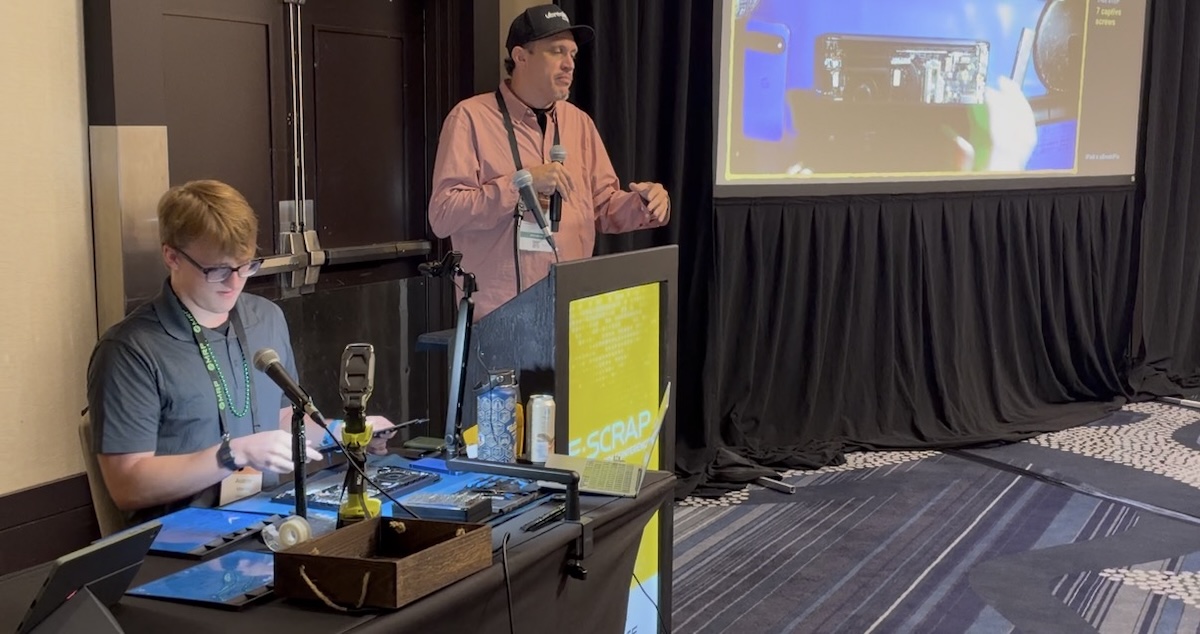
Leading the presentation were Tripp Grant, senior client director for uBreakiFix by Asurion, and Austin Martin, pro sales support specialist for iFixit. They ran attendees through the teardown process of a Lenovo laptop and a Google cell phone, highlighting how manufacturers can make their devices easier to repair.
That’s becoming an increasingly common theme across the e-scrap industry. Several states have debated right-to-repair laws this year, and New York is poised to become the first state in the nation with an electronic device repairability labeling requirement law.
That’s central to the ethos of both presenting companies. They work with companies like Google to help those manufacturers make their devices more easily repairable.
“Repairability is really important to consumers,” Grant said. “It matters for customer satisfaction.”
Both presenting companies work toward that end in different ways. Where uBreakiFix performs repairs on behalf of customers, iFixit provides guides, tools and parts for do-it-yourselfers. The community-based wiki, as Martin described it, brings together a broad network of around 145,000 contributors who share their expertise.
Martin put his knowledge to work on the showroom stage, going through multistep processes to disassemble the devices to the point where someone could swap out anything they needed to.
His company rates devices on their repairability using a system that’s occasionally revisited when there are meaningful changes. The highest-scoring devices use screws with the same head type, easily removable backs and other features that improve the user’s ability to fix what’s needed.
The expertise Martin displayed in navigating through a field of boards, chips and other components comes from years of experience. But as he describes it, anyone can work with adequately engineered products.
“I feel like my grandma could do it,” he said.
Manufacturers have many factors to consider when designing repairability, of course. Device displays often need adhesives for secure placement, soldered-in ports ensure proper function and an even remotely loose battery presents a serious safety hazard.
“The words ‘prying’ and ‘battery’ should not go together,” Grant said.
That doesn’t mean there’s no way to make these parts easier to remove. That’s important both from a customer satisfaction and a policy standpoint. The European Union, for one, will require as of February 2027 that new smartphones and tablets be made with easily removable batteries, if they meet durability and IP67 standards.
“The less tools you need to take out the battery, the better,” Martin said.
Better engineering around repairability will come as more consumers call for it, Grant said, similar to how devices have become more durable as users experienced damaged displays and other wear.
Just as users don’t have to worry so much about cracked screens after drops anymore, a time could come when repairability removes any concerns about devices becoming unusable due to minor issues.
“I don’t even feel stressed anymore,” he said of dropping his phone. “Durability has improved. Manufacturers will really key in on what matters to consumers.”
Certainly, at least one thing that matters is keeping devices in use longer, for both financial and sustainability reasons. As the market shifts in that direction, empowering mechanically disinclined individuals such as myself can only benefit manufacturers that want to improve their user experiences.
Just as with Metropolis when Superman gets his cape, everyone benefits when electronics users are empowered to keep their devices stronger for longer.