


For many municipalities, advancing beyond curbside recycling can seem out of reach. Limited budgets, inexpensive landfill disposal and the high cost of new infrastructure often make ambitious waste diversion goals difficult to achieve.
Those challenges were once true for Fort Collins, Colorado and its population of approximately 172,000 residents. But over the past three decades, the city has steadily built a comprehensive materials management strategy that extends well beyond recycling, integrating waste reduction, reuse, composting, climate action and regional collaboration into a long-term vision for achieving zero waste.
The solution was rather than relying on a single flagship project, Fort Collins has taken an incremental approach, layering policies, ordinances and partnerships over time while adapting to changing markets and community priorities.
“We’ve been building toward this for decades,” said Megan DeMasters, lead specialist in the Environmental Services Department for the City of Fort Collins. “The key has been creating policies that reinforce one another while keeping the community engaged in the process.”
That foundation of the plan harkens back to 1995 when the Fort Collins City Council adopted a Pay-As-You-Throw ordinance that charged residents based on the size of their trash cart while providing every household with a large recycling cart regardless of trash service level.
The program encouraged residents to think differently about waste generation by creating a financial incentive to reduce disposal while making recycling more convenient.
Over the years, the city continued adding policies that expanded its waste reduction efforts.
Those milestones included a cardboard recycling ordinance in 2013, a Community Recycling Ordinance in 2016 requiring multifamily and commercial properties to provide recycling service, and a Disposable Bag Ordinance in 2021 that banned plastic checkout bags and imposed a fee on paper bags at larger retailers.
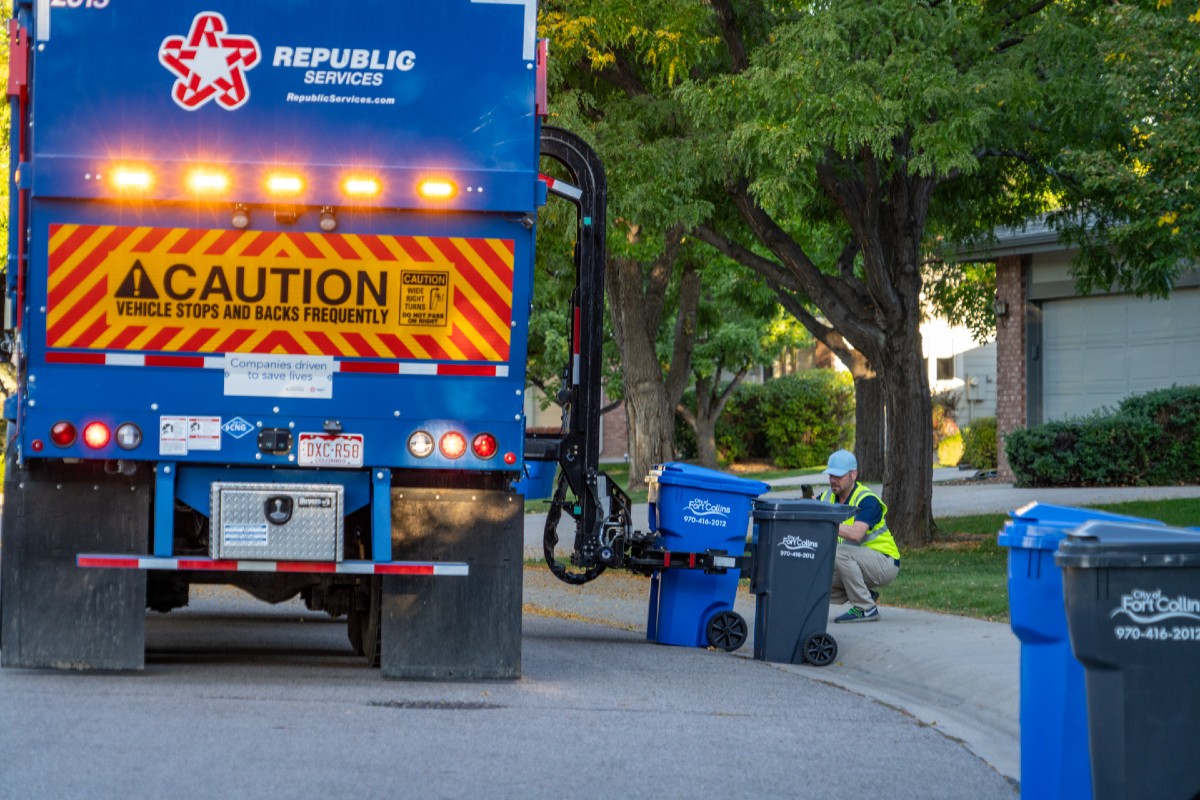
More recently, the city expanded those requirements to additional businesses while launching a single-hauler residential collection system designed to improve service consistency and reduce truck traffic.
Just as important, city leaders intentionally linked waste management with broader environmental goals.
“Our Climate Future established aligned targets across waste, energy and transportation,” DeMasters said. “We treat materials management as a core emissions reduction strategy because landfill diversion directly reduces methane emissions while supporting our broader greenhouse gas reduction commitments.”
Beyond the blue bin
While recycling remains a critical component of the city’s strategy, officials increasingly view it as only one part of a much broader materials management philosophy.
In fact, the city’s emphasis begins with waste prevention. For instance, programs like the Save Your Food campaign encourage residents to reduce household food waste before it ever reaches the curb. More recently, Fort Collins has incorporated circular economy principles into its Economic Health Strategic Plan, recognizing that businesses also play a significant role in reducing material consumption.
One example is a partnership with local company Compost Queen, which is piloting residential and commercial composting services at reduced rates.
“The pilot gives us real-world information about participation and operational challenges before expanding composting citywide,” DeMasters said. “Those results will help determine what the next phase looks like.”
Reuse also has become a growing priority. This summer, the city’s Neighborhood Services team coordinated communitywide yard sales designed to extend the life of household goods and reduce unnecessary disposal.
While such efforts may appear modest compared with large infrastructure projects, city officials believe they reinforce an important cultural shift.
“Our approach follows the hierarchy of sustainable materials management,” DeMasters said. “Reduce, reuse and recycle remain the guiding principles behind how we develop programs.”
Education plays an equally important role in all of this as well. Instead of relying solely on regulations, Fort Collins has focused heavily on community outreach, pairing new ordinances with education campaigns that explain why changes are being made and how residents can participate successfully.
“Many of our programs were driven by community members who identified needs and pushed for change,” DeMasters said. “Buy-in is often built into the foundation of the programs themselves.”
Today, outreach efforts continue through partnerships such as NoCo Biz Connect, which works directly with businesses to identify barriers to recycling and reducing single-use plastics.
Meanwhile, the city’s recently launched Back-to-Basics recycling campaign aims to reduce contamination by reinforcing simple recycling practices that many residents may have forgotten as messaging evolved over the years.
Rather than assuming people already know how to recycle correctly, the campaign returns to fundamentals while preparing residents for future changes under Colorado’s Extended Producer Responsibility program.
Tackling difficult material streams
Like many communities pursuing higher diversion rates, Fort Collins eventually found that the easiest materials had already been captured. Therefore, achieving additional gains meant focusing on sectors traditionally considered more difficult, including construction and demolition debris.
Construction and demolition materials represent a significant portion of the municipal waste stream, making them an essential target for communities working toward ambitious diversion goals.
Fort Collins has required construction and demolition projects to recycle wood, metal, cardboard and aggregate materials since 2012, with compliance verified through documentation and on-site inspections.
Those local requirements are now being strengthened through a broader regional partnership with Larimer County.
Rather than attempting to build duplicate infrastructure, the two governments are collaborating on a construction and demolition processing facility that will serve communities throughout the region.
Located adjacent to the county’s new Diversion Transfer Station, the proposed facility is expected to process as much as 130,000 tons of material annually once fully operational, targeting wood, metals, cardboard and other recoverable materials while expanding recycling opportunities for asphalt, concrete and green waste.
“Construction and demolition debris typically accounts for 30% to 40% of total landfill volume,” said Lesli Ellis, director of Community Planning, Infrastructure and Resources for Larimer County. “Creating a regional hub gives neighboring communities access to infrastructure they simply couldn’t build on their own.”
Regional thinking drives infrastructure
The planned facility reflects a philosophy that has become central to Fort Collins’ long-term strategy: midsize communities often cannot afford to build sophisticated diversion infrastructure independently. Instead, success depends on sharing costs, expertise and facilities across jurisdictional boundaries.
Ellis noted that concept has guided the relationship between Larimer County, Fort Collins and neighboring municipalities since the adoption of the region’s Solid Waste Infrastructure Master Plan in 2018.
“The initial planning phase was widely praised as a model for regional waste planning,” she said. “As we moved into implementation, each community had different priorities and timelines, but the shared vision remained intact.”
While Larimer County concentrated on developing a new landfill and diversion transfer station, Fort Collins continued expanding municipal programs and policies. Those parallel efforts are now converging into a regional system that includes construction and demolition diversion, composting initiatives and expanded household hazardous waste services.
“Major diversion infrastructure is capital intensive and often requires financial subsidies to launch,” Ellis said. “Midsize communities cannot go at it alone. Regional cost- and resource-sharing is the only viable path forward.”
That regional approach also creates economies of scale that individual cities struggle to achieve.
By centralizing specialized processing at one location, surrounding communities can access services that otherwise would be financially unrealistic while creating enough material volume to support stable end markets.
Improving quality
Capturing more material is only part of the equation. Maintaining high-quality recyclables remains equally important as processors contend with contamination and increasingly complex packaging.
For instance, at Fort Collins’ Timberline Recycling Center, residents can recycle a wide variety of materials beyond those accepted through curbside collection, including electronics, batteries, used motor oil, paint and plastic film.
“I’ve been told directly how much of a success the single-use plastic bag ban has been for our downstream material recovery facility,” said Ben Sumanis, environment, health and safety manager of the recycling center. “Plastic bags used to clog equipment because people often placed recyclables inside them before putting them in curbside carts.”
Although plastic bags remain recyclable through designated drop-off programs, keeping them separate from traditional recyclables has helped improve processing efficiency.
The city’s Back-to-Basics campaign reinforces that message by reminding residents to place recyclables loose in collection carts and take plastic film to appropriate collection locations.
Sumanis believes Colorado’s Extended Producer Responsibility program will further strengthen those efforts.
“One of the biggest benefits will be consistent education and labeling across the state,” he said. “Whether you’re recycling at home or using a drop-off center, people should see similar messaging, which reduces confusion and ultimately contamination.”
He also expects producer responsibility funding to help sustain public recycling facilities that have struggled with declining commodity prices.
“Drop-off centers provide an important public service, but they’re expensive to operate,” Sumanis said. “Additional funding will help maintain those programs while encouraging manufacturers to design products and packaging that are easier to recycle.”
Overcoming economic realities
Despite Fort Collins’ progress, city leaders acknowledge that achieving zero waste remains an ongoing challenge. One of the biggest obstacles has little to do with technology.
“Low tipping fees in northern Colorado make landfilling inexpensive compared to recycling and composting,” DeMasters said. “That weakens the financial case for diversion and often requires policy intervention or incentives to make alternative programs competitive.”
Infrastructure presents another hurdle. With approximately 75,000 households, Fort Collins occupies an awkward middle ground—too large to depend entirely on county services, yet too small to justify building every major processing facility on its own.
That reality reinforces the importance of regional collaboration.
The city also continues to confront evolving packaging materials that are difficult to recycle economically.
Although contamination rates remain lower than many peer communities, nonrecyclable plastics and low-value packaging continue to create operational challenges.
“This is largely a producer-side problem that cities can’t solve alone,” DeMasters said. “Municipalities bear the operational costs of managing those materials after they’re discarded.”
Building for the next decade
Looking to the future, organics diversion remains Fort Collins’ top priority. In 2025, voters approved $7 million toward development of a future composting facility, while city staff continue evaluating expanded food-scrap collection through an ongoing pilot program. At the same time, the city is working to improve recycling quality, implement Colorado’s Extended Producer Responsibility law and strengthen regional partnerships that can support future infrastructure.
Through all its efforts, DeMasters noted the biggest lesson Fort Collins has learned isn’t tied to a specific facility or ordinance.
“Invest in community trust before infrastructure, because voters and residents have to understand and believe in the system before they will fund it,” DeMasters said. “Don’t wait for perfect conditions on tipping fees or markets before building program capacity. Find the regional partners who share your constraints, because the infrastructure math almost always requires collaboration.”