
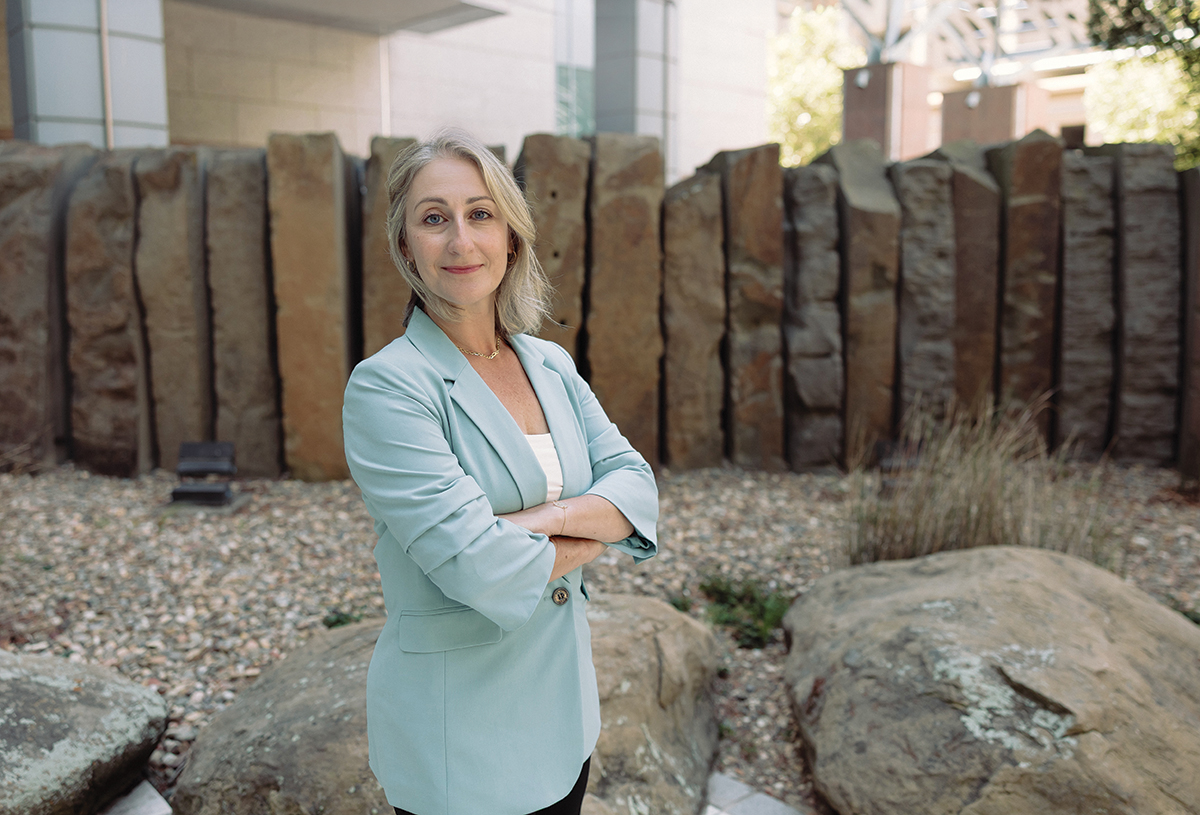
Throughout her career, Zoe Heller, director of CalRecycle, has been focused on the human connection to environmental effects. That focus continues today through her work leading an agency with a 2026/2027 annual budget of $2.2 billion and an ambitious agenda of sustainability and circularity in the world’s fourth-biggest economy.
CalRecycle, formally the California Department of Resources Recycling and Recovery, is a branch of the state’s Environmental Protection Agency that oversees waste management and recycling programs.
Heller, 46, was appointed by Gov. Gavin Newsom and unanimously confirmed more than two years ago. Before her directorship, she served in various roles in CalRecycle, including deputy director of three units: the division of circular economy, materials management and local assistance, and policy development.
Now is a crucial time for recycling and circularity and for the state, and many advocates and Sacramento insiders say Heller is the right person for the job, challenging as it is.
“Director Heller leads with expertise and vision and is deeply dedicated to protecting the environment, supporting communities in the aftermath of wildfires and catalyzing a truly circular economy,” California Secretary for Environmental Protection Yana Garcia told Resource Recycling.
‘We need a lot more Zoes’
Scott Smithline, who served as director of CalRecycle from July 2015 to December 2019, remembers hiring Heller at the agency and says he isn’t surprised by her rise to its top job. “Zoe is a fiercely competent and extremely gracious human being,” he said.
“She has been managing the hardest, most controversial set of issues that any director has had to manage, and I think she is doing a fantastic job at it,” said Smithline, who now works as a consultant to the recycling industry. Those issues include a bottle bill program marked by controversies, wildfire debris removal and landmark new laws including the sweeping Plastic Pollution Prevention and Packaging Producer Responsibility Act (SB 54).
Nick Lapis, director of advocacy for Californians Against Waste (CAW), said, “She is constantly being put between a rock and a hard place and is in the public spotlight more than any other CalRecycle director has ever been.”
Lapis, whose group sued CalRecycle in early June along with the Natural Resources Defense Council (NRDC) and Oceana for what the environmental groups called illegally weakening the implementation of SB 54, said he doesn’t always agree with Heller’s decisions but that he always appreciates what a great listener she is and how thoughtful she is in dealing with a broad range of stakeholders.
“It’s a no-win situation for her on a lot of these issues,” said Lapis. “No matter what decision she makes, people are going to be mad at her, and there is going to be a lot of investment that is at stake. It is rare to have someone who has as much respect as she does from every side of the issues.”
Heidi Sanborn of the National Stewardship Action Council has known Heller for 15 years. Sanborn praised Heller’s intellect, openness, caring and thoughtful deliberation – and sense of humor.
“We need a lot more Zoes in government,” she said. “I don’t think there is a position in state government that is harder than hers and she’s handling it beautifully.”
Smithline added, “We talk a lot about the director but it’s really all about the team you put together. And Heller has a “solid team in place, competent and accountable, that understands what she needs.”
Heller herself is quick to praise her team, which includes more than 900 mission-driven staff. “It’s an incredible group to work with,” she said.
Anja Brandon, director of plastics policy for the Ocean Conservancy, said, “She is the kind of leader I aspire to be one day, and I think she’s done a fantastic job at the state agency, which is coming from someone who doesn’t agree with everything the state agency does.”
In particular, CalRecycle has been good at recognizing what it doesn’t know and reaching out to stakeholders to fill in the gaps, said Brandon.
This theme was echoed by Timothy Burroughs, executive director of StopWaste, a public agency serving the 1.7 million residents of California’s Alameda County. CalRecycle’s work “requires a lot of coordination between the local and state level, and it feels that under Zoe’s leadership she is very welcoming of feedback from the local level,” he said.
A background in environmental justice
Prior to her work at CalRecycle, Heller spent almost 11 years at the US Environmental Protection Agency in San Francisco. There, she managed the zero-waste section and worked in the environmental justice program. Before that she worked as a research and policy analyst for the Chicago-based nonprofit Center for Neighborhood Technology. Heller grew up in Chicago.
Heller studied environmental policy at Eckerd, a small college in west-central Florida. While earning a master’s in public administration from Roosevelt University in Chicago, she focused her academic work on prioritizing brownfield project cleanup.
During her tenure at the EPA’s Region 9, Heller learned to understand that “environmental justice issues are not just urban issues, they can affect communities all throughout the region that have different situations that they’re dealing with.”
In working with Navajo communities impacted by uranium mining, for example, Heller learned the importance of deep community engagement and cultural sensitivity, lessons that she says still inform her efforts.
A landmark packaging law
This is an exciting and pivotal time for the agency, Heller said. Much of the public attention recently has been on the state’s EPR law for packaging. Signed in June 2022, SB 54 requires reductions in single-use plastic packaging and foodware, mandates producer investment in reuse and refill systems and requires all covered packaging to be recyclable or compostable.
The landmark law takes aim at the packaging that makes up more than 50% of what goes into California landfills by volume. Since the regulations for SB 54 were finalized on May 1, the rubber is starting to hit the road, said Brandon of the Ocean Conservancy. “Now will come tests of those regulations,” she said.
One big test was a lawsuit filed June 2 by Oceana, NRDC and CAW, arguing that the finalized rules create unlawful loopholes that gut the legislation’s core mandates. On June 22, a 17-state coalition of Republican attorneys general, led by Nebraska’s Mike Hilgers, joined the National Association of Wholesaler-Distributors (NAW) in a federal lawsuit seeking to block SB 54’s enforcement.
Heller declined to comment on the lawsuits but said SB 54 “has been an incredible challenge, but also a huge opportunity.”
“SB 54 is complex,” said Emily Coven, California executive director of Circular Action Alliance, the producer responsibility organization implementing the law. “It requires alignment not only between CAA and CalRecycle, but also across producers, local jurisdictions, recyclers, NGOs and many others.”
Coven added that Heller “has been thoughtful about creating space for dialogue, and clearly cares deeply about understanding the perspectives of all the involved parties, which is essential at this stage of implementation.”
Heller said she has been particularly encouraged by meetings with producers. The law “empowers these businesses to first off design waste out of their packaging,” she said.
Brandon said that, despite the lawsuits, “we are one step closer to SB 54 delivering on its promise to Californians. It is a massive law and massive program, and I think we have a really good first step.”
That promise is substantial, as SB 54 passed the state legislature by a wide margin. A January 2025 Harris Poll found 81% of California voters support the legislation. The law is considered the flagship US EPR program, and six other states have passed EPR laws for packaging so far.
Michael Caprio, director of California governmental affairs for hauler and recycler Republic Services, said SB 54 is likely to be the most challenging action for CalRecycle, because of its complexity and number of stakeholders. He said he appreciates how open the agency has been in talking with industry, while meeting deadlines and issuing “thoughtful policy.”
Julia Mangin, director of sustainability and government affairs for hauler and recycler Recology, praised Heller’s understanding of policy and operations, along with “balancing California’s climate goals with operational realities.” She noted a “strong foundation for partnership” between CalRecycle and industry but that “more regular, structured engagement would strengthen that collaboration even further.”
Mangin added, “More frequent touchpoints, clearer guidance, and opportunities to test ideas on the ground would go a long way. At the end of the day, clarity and consistency are just as important as ambition.”
As to how the state will achieve the law’s ambitious target of recycling 65% of covered single-use plastics, Heller said that EPR in general provides “a lot of opportunity for course correction, flexibility in understanding that there’s a lot we don’t know now, and as we know more, we may have to shift to be able to achieve once again those very aggressive but incredibly important goals.”
Global leadership
California has long been out front on recycling and other environmental issues, from clean air and water to plastic pollution.
And because California is such a big market, and so many goods flow through its busy ports, the state has a lot of power to drive economic decisions like packaging design. Heller noted that those decisions can then trickle up nationally and even globally.
Heller said she thought the biggest stories in circularity for 2027 would center on two themes:
- What happens to beleaguered plastics recycling markets—hammered by cheap virgin resins and overseas competition—as EPR ramps up.
- Development of regulations for California’s Responsible Textile Recovery Act (SB 707), passed in August 2024. That law established the first textile EPR program in the country and has big ambitions to reuse and recycle clothing and other fabrics in the state.
The designated PRO for textiles, Landbell USA, is working on a needs assessment, to identify gaps in collection and sorting capacity and opportunities for repair and reuse, plus defining a responsible end market.
SB 707 is also facing legal challenges, as the American Apparel & Footwear Association (AAFA) has sued to block the selection of Landbell USA as PRO. The AAFA did not respond to requests for comment on this story.
Joanne Brasch, assistant director of the California Product Stewardship Council, said her group was a sponsor of SB 707. Of the three CalRecycle directors she has experienced, “Zoe is the easiest to work with because of her extensive experience.”
Brasch noted that her own “holy moly” moment came when she realized the scope of developing textiles recycling in the state, which is bigger than many countries.
The sheer scale of these programs contributed to the Association of Plastic Recyclers (APR) awarding Heller and her staff a 2026 APR Recycling Leadership Award.
APR owns Resource Recycling, Inc., publisher of Resource Recycling magazine.
The organics revolution
Heller said she also is particularly proud of California’s progress on organics, spurred by SB 1383. Implemented in 2022, the law requires that 75% of organics are diverted from landfill and 20% of what would otherwise have been edible food is preserved and donated.
“Over a billion meals have been rescued to go to Californians in need, and we’re seeing incredible expansion of composting capacity and facilities to be able to create more of that incredibly valuable compost for California,” Heller said. In fact, 97% of required communities now have residential organics recycling collection programs, she noted.
Organic material like food scraps, yard trimmings and paper products makes up half of what Californians send to landfills. That material emits 20% of the state’s methane, a greenhouse gas that heats 84 times more than carbon dioxide, as well as air pollutants that can contribute to asthma, according to CalRecycle.
The biggest challenge CalRecycle sees with organics is contamination, said Heller. To address that, the agency is working on education through its Recycle Right campaign and continually investing in system infrastructure.
“I think 1383 is an incredible success story of communities, local governments and industry coming together and identifying how to get this done collectively,” Heller said.
A ‘critical moment’
Brandon noted that California will have a new administration in January, around the same time SB 54 launches. That dual transition will mark a critical moment for CalRecycle, she said.
Heller said the agency has been resilient amid political change and “we’ll continue to see progress,” regardless of who is elected governor. She added that her primary focus remains on the state’s big goals to reduce waste and environmental impact. “It’s easy to get caught up in some of the details, and it’s important that we get the details right, but at the end of the day, what is the goal that we’re all marching towards?”
A key personal goal for Heller is leaving California’s environment in a better place for her 7-year-old daughter, whom she is raising with Steven Anderson, her “wonderful musician” husband.
“My hope is that Californians want to participate in the system, to make sure their banana peels and apple cores are going into the right bin and utilizing the blue bin for those materials that can be recycled into new products,” said Heller.
This story first appeared in the August 2026 issue of Resource Recycling Magazine.