
Resource Recycling
  • The Latest
  • Analysis
    • All
    • Certification Scorecard
    • Industry Announcements
    • Opinion

    Who should pay for lithium-ion battery fire damage?

    America’s critical-materials buildout has a feedstock problem

    Certification scorecard – week of Sept. 14

    Canada Plastics Pact reports 2024 progress

    Trade tensions shift global mineral partnerships 

    Spin-off lets Linca focus on battery mineral recovery

    Critical mineral policy shift creates opportunity

    CommanderAI launches searchable hauler database

    Inside the Circle: Put AI to work for the people who do the work

  • Conferences
    • Resource Recycling Conference
    • Plastics Recycling Conference
    • E-Scrap: The Longevity Conference
    • Textiles Recovery Summit
  • Publications
    • E-Scrap News
    • Plastics Recycling Update
    • Policy Now
    • Resource Recycling
    • Other Topics
      • All Topics
      • Brand Owners
      • Critical Minerals
      • Glass
      • Grant Watch / RFPs
      • Markets
      • Organics
      • Packaging
      • Research
      • Technology
      • Textiles
Subscribe
No Result
View All Result
Resource Recycling
  • The Latest
  • Analysis
    • All
    • Certification Scorecard
    • Industry Announcements
    • Opinion

    Who should pay for lithium-ion battery fire damage?

    America’s critical-materials buildout has a feedstock problem

    Certification scorecard – week of Sept. 14

    Canada Plastics Pact reports 2024 progress

    Trade tensions shift global mineral partnerships 

    Spin-off lets Linca focus on battery mineral recovery

    Critical mineral policy shift creates opportunity

    CommanderAI launches searchable hauler database

    Inside the Circle: Put AI to work for the people who do the work

  • Conferences
    • Resource Recycling Conference
    • Plastics Recycling Conference
    • E-Scrap: The Longevity Conference
    • Textiles Recovery Summit
  • Publications
    • E-Scrap News
    • Plastics Recycling Update
    • Policy Now
    • Resource Recycling
    • Other Topics
      • All Topics
      • Brand Owners
      • Critical Minerals
      • Glass
      • Grant Watch / RFPs
      • Markets
      • Organics
      • Packaging
      • Research
      • Technology
      • Textiles
Subscribe
No Result
View All Result
Resource Recycling
No Result
View All Result
Home E-Scrap

Vape fires cost waste, recycling sector $2.5B yearly

byScott Snowden
December 9, 2025
in E-Scrap, Recycling
electronic vapes

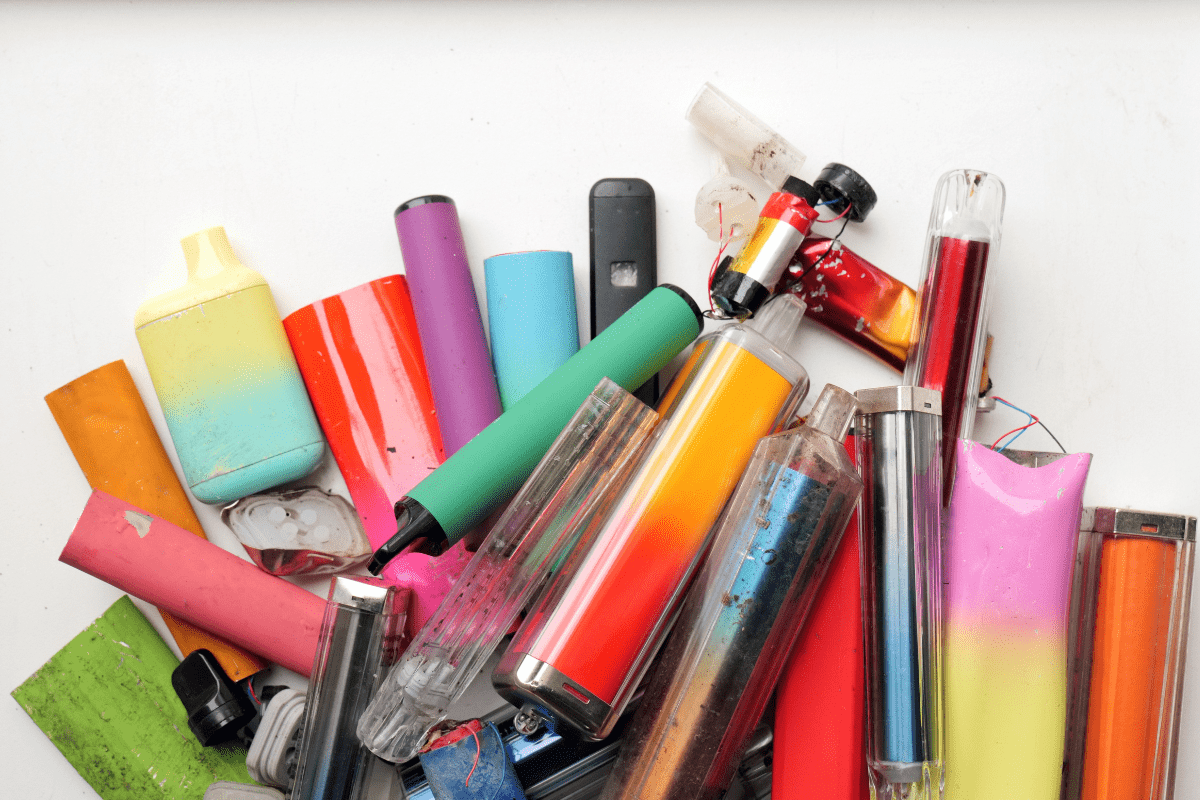
Discarded vapes illustrate how multiple hazards can converge in a single device with no clear end-of-life path. | B Robinson/Shutterstock

Waste and recycling operators are heading into another year of elevated fire risk as lithium-ion batteries from electronics and disposable vapes continue to slip into waste streams, according to fire-tracking consultant Ryan Fogelman.

He said the sector is still dealing with what he calls the vape effect and argued that the next phase of the response has to involve tobacco and vaping companies directly. Fogelman, vice president of fire protection at Fire Rover, has been compiling and publishing data on publicly reported waste and recycling facility fires in the US and Canada since 2016.

His reports show that incident counts have climbed sharply in recent years as battery-powered devices proliferate and as disposable vapes move from ashtrays and pockets into bins, trucks and tipping floors. In a recent fire report, he wrote that the average number of facility fires in the current four-year span is noticeably higher than in the previous six years and that vapes are a major contributor to that increase.

The problem with bans

Speaking with E-Scrap News, Fogelman said he does not believe bans on single-use vapes will reverse the trend.

“I do not believe bans work,” he said. “We look at the UK and know the bans do not work.” He pointed to data from British recycling companies that continue to find very large numbers of outlawed vapes in their systems months after national restrictions took effect.

Instead of relying on bans, Fogelman is publicly urging tobacco and vaping companies to help pay for the battery side of the problem. In a December column structured as an open letter to US tobacco executives, he argued that the industry should step into extended producer responsibility programs for lithium-ion cells and help fund new collection options rather than focus solely on health liabilities.

“Everybody who is causing any part of the problem needs to be part of the solution,” he said. He framed the request as a fire safety issue rather than a referendum on nicotine or addiction. “I do not even care about that,” he said during the interview. “Take that away. We are not coming at you for that.”

A three-part hazard

Fogelman said vapes illustrate how multiple hazards can converge in a single device with no clear end-of-life path. “If you look at a vape, there are three pieces of it,” he said. “One is your biohazard, because it has been in your mouth. Then it is a hazardous material issue, whether it is THC or the Nic juice, and then it is a battery issue because it is electronic.” He said those overlapping risks make it difficult for retailers and community programs to accept used vapes even when they want to expand battery collection.

His proposed starting point is a design rule requiring removable batteries in vapes and similar devices. He said that a simple change would separate the battery from the cartridge, allowing consumers to treat the cell like any other household battery. 

“This would all be pretty much a lot more clear if you take the vape problem and you take the batteries out,” he said. “Now you are not trying to educate to skip the bin. You are saying skip the bin with the battery out.”

Even with design changes, he said, there is no way to educate consumers out of the problem without far more convenient drop-off options. “We need more uber-local drop-off locations for all batteries,” he said. He argued that cost should not fall on municipal taxpayers or waste companies and said it belongs with manufacturers through extended producer responsibility programs and related funding tools.

A long road ahead

Fogelman has estimated that fires linked to discarded batteries are costing the US and Canadian waste and recycling sector about $2.5 billion a year, a figure he describes as intentionally conservative.

“We are talking about two and a half billion dollars a year and just to the waste and recycling industry,” he said. “That is not global.” He said the financial toll comes on top of risks to workers, nearby residents and responding fire departments.

Alongside his policy push, Fogelman is investing time and money in education. He is collaborating with educator and Scrap University Kids leader Jessica “Scuba Jess” Alexanderson on a children’s book called Supercharged that focuses on lithium-ion battery safety, with support from the National Waste and Recycling Association (NWRA), the Solid Waste Association of North America (SWANA) and other partners.

The book is written so that children follow a story, while parents and teachers receive additional guidance and links to battery drop-off locations.

“You have a storyline for the child and then a storyline that is focused on the adult and the teacher,” Fogelman said. He said the team hopes to place copies in classrooms across the US and Canada through donations from foundations and industry.

Fogelman said he remains realistic about how long behavior change will take, particularly for current adult vape users. He believes education, better product design and new collection infrastructure will have to move together. For now, he said, the underlying risk is not easing and the vape effect has not peaked.

“I am optimistic that 10 years ago people knew nothing,” he said, but Fogelman added that “the numbers are not going down. They are only going up, unless you get 20 million people to stop smoking tomorrow.”

Tags: BatteriesCollectionEPR
TweetShare
Scott Snowden

Scott Snowden

Scott has been a reporter for over 25 years, covering a diverse range of subjects from sub-atomic cold fusion physics to scuba diving off the Great Barrier Reef. He's now deeply invested in the world of recycling, green tech and environmental preservation.

Related Posts

Bridge Green, Hartree partner on mineral processing deal

Bridge Green, Hartree partner on mineral processing deal

byPaul Lane
September 21, 2026

The agreement will see Bridge Green’s lithium carbonate sold to and marketed by Hartree.

Who should pay for lithium-ion battery fire damage?

byDavid Daoud
September 21, 2026

Fires continue to be a major threat to the recycling industry, even as states explore new policy solutions.

America’s critical-materials buildout has a feedstock problem

byDavid Daoud
September 18, 2026

As the US invests in critical-minerals capacity will facilities have enough material to process?

Colorado’s EPR programs move from planning to practice

Colorado’s EPR programs move from planning to practice

byStefanie Valentic
September 17, 2026

Colorado's producer responsibility organizations move to implement the state's extended producer responsibility law.

Van filled with rolled carpeting for recycling or disposal.

California carpet recycling rate reaches 37%

byBrian Clark Howard
September 17, 2026

The state’s recycling rate rose for the sixth year in a row, despite challenging market conditions.

SB 54 plan for cartons, film draws warning

byStefanie Valentic
September 15, 2026

The new law's cartons and film targets could add 100,000 tons of plastic contamination to California's paper exports annually, a...

Load More
Next Post
Colorado approves final EPR plan for packaging

Colorado approves final EPR plan for packaging

2026 Buyers’ Guide

Equipment, services and technology suppliers serving the recycling industry.

Browse the Guide

More Posts

SB 54 plan for cartons, film draws warning

September 15, 2026
Colorado’s EPR programs move from planning to practice

Colorado’s EPR programs move from planning to practice

September 17, 2026
Canada tariffs latest in new normal for RPET

Canada tariffs latest in new normal for RPET

September 11, 2026
Alpek closing Pennsylvania RPET plant

Alpek seizing on war-related opportunity 

July 27, 2026
New Jersey pushes back PCR mandate to 2030

New Jersey pushes back PCR mandate to 2030

September 10, 2026
Study assesses environmental cost of excess data storage

BAN paper says AI e-scrap estimates are low

September 17, 2026
Additive cuts acetaldehyde migration in RPET bottles

PET roadmap pairs demand, CO2 footprint

September 15, 2026
US packaging is evolving. The recycling system isn’t ready

US packaging is evolving. The recycling system isn’t ready

September 16, 2026
California Governor Gavin Newsom speaking at podium.

What’s on Newsom’s desk after the CA session end

September 14, 2026
Spin-off lets Linca focus on battery mineral recovery

Critical mineral policy shift creates opportunity

September 14, 2026
Load More

About & Publications

About Us

Staff

Archive

Magazines

Work With Us

Advertise
Jobs
Contact
Terms and Privacy

Newsletters

Get the latest recycling news and analysis delivered to your inbox every week. Stay ahead on industry trends, policy updates, and insights from programs, processors, and innovators.

Subscribe

Welcome Back!

Login to your account below

Forgotten Password?

Retrieve your password

Please enter your username or email address to reset your password.

Log In

Add New Playlist

No Result
View All Result
  • The Latest
  • Analysis
  • Recycling
  • E-Scrap
  • Plastics
  • Policy Now
  • Conferences
    • E-Scrap Conference
    • Plastics Recycling Conference
    • Resource Recycling Conference
    • Textiles Recovery Summit
  • Magazines
  • About Us
  • Advertise
  • Archive
  • Jobs
  • Staff
Subscribe
This website uses cookies. By continuing to use this website you are giving consent to cookies being used. Visit our Privacy and Cookie Policy.