






Resource Recycling
  • The Latest
  • Analysis
    • All
    • Certification Scorecard
    • Industry Announcements
    • Opinion
    Unlocking the power of source reduction in US EPR

    Unlocking the power of source reduction in US EPR

    Following petition, Microsoft extends Windows 10 support

    Windows AI Recall is pushing data destruction upstream

    Certification Scorecard — Week of April 27, 2026

    Five trends shaping PCR packaging to 2031

    Intel sign on company building with blue sky and trees.

    Intel boosts margins by selling what it used to scrap

    Our top stories from April 2022

    Peters-Michaud named CEO, Houghton chair of Sage Sustainable Electronics

  • Conferences
    • Resource Recycling Conference
    • Plastics Recycling Conference
    • E-Scrap: The Longevity Conference
    • Textiles Recovery Summit
  • Publications
    • E-Scrap News
    • Plastics Recycling Update
    • Policy Now
    • Resource Recycling
    • Other Topics
      • Brand Owners
      • Critical Minerals
      • Glass
      • Grant Watch
      • Markets
      • Organics
      • Packaging
      • Research
      • Technology
      • Textiles
      • All Topics
Subscribe
No Result
View All Result
Resource Recycling
  • The Latest
  • Analysis
    • All
    • Certification Scorecard
    • Industry Announcements
    • Opinion
    Unlocking the power of source reduction in US EPR

    Unlocking the power of source reduction in US EPR

    Following petition, Microsoft extends Windows 10 support

    Windows AI Recall is pushing data destruction upstream

    Certification Scorecard — Week of April 27, 2026

    Five trends shaping PCR packaging to 2031

    Intel sign on company building with blue sky and trees.

    Intel boosts margins by selling what it used to scrap

    Our top stories from April 2022

    Peters-Michaud named CEO, Houghton chair of Sage Sustainable Electronics

  • Conferences
    • Resource Recycling Conference
    • Plastics Recycling Conference
    • E-Scrap: The Longevity Conference
    • Textiles Recovery Summit
  • Publications
    • E-Scrap News
    • Plastics Recycling Update
    • Policy Now
    • Resource Recycling
    • Other Topics
      • Brand Owners
      • Critical Minerals
      • Glass
      • Grant Watch
      • Markets
      • Organics
      • Packaging
      • Research
      • Technology
      • Textiles
      • All Topics
Subscribe
No Result
View All Result
Resource Recycling
No Result
View All Result
Home Plastics

Oregon is first to approve EPR plan

Marissa HeffernanbyMarissa Heffernan
February 26, 2025
in Plastics
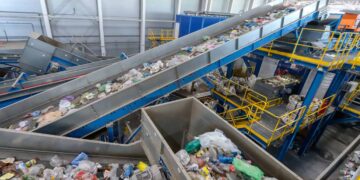
The Oregon Department of Environmental Quality announced it approved a program plan on Feb. 21. | Yanqiang Dai/Shutterstock

After several years of work, Oregon has approved an extended producer responsibility plan, laying out how packaging producers are expected to fulfill the requirements of the law.  

Of the five states with packaging EPR laws, Oregon is the first to reach this milestone following the 2021 passage of its policy. The Department of Environmental Quality has been working with national producer responsibility organization Circular Action Alliance on implementation. 

On Feb. 21, Oregon DEQ announced it approved CAA’s program plan with six ordered changes. Nicole Portley, the EPR program plan lead at Oregon DEQ, called the approval a significant milestone. 

“DEQ and CAA are, in effect, on the same relay team,” she said. “We’ve been doing a lot of the execution up until now, and now we hand off the baton in many ways, and they’ll be doing much of the execution with us settling more into our oversight role.” 

The producer plan is a vital part of Oregon’s shared EPR model, Portley said. 

“We think we have a really strong plan, one of the most detailed and transparent that we’re aware of,” she said. “We’re very confident in CAAs ability to implement a robust program based on the work that we’ve seen in this runup. They’ve been steady and sophisticated in developing a plan and we feel really good about the result.” 

Jeff Fielkow, CAA CEO, said in a statement that the approval “demonstrates the value of partnership with DEQ and input from organizations across the state.”

“By working together, we have developed a balanced framework that ensures producer compliance while delivering tangible improvements to Oregon’s recycling system,” he said. “We look forward to launching this transformative program in July.”

Changes come after three drafts, close engagement

The changes concern more clarity around the process that will fund all local governments’ eligible infrastructure, including trucks, containers, depots and reload facilities. In addition, there are amendments to the dispute resolution process. 

“We want to be sure if there would be any statutory interpretations or rule interpretations that those would be handled effectively,” Portley said. 

DEQ asked for some changes to convenience standards for the list of covered materials, though the PRO has until the end of 2027 to fully meet the standards. 

“We didn’t expect a fully fleshed out plan in the program plan but wanted a commitment and process to get there,” she said. “There were some tweaks on that front.” 

The fourth requested change was authorizing CAA to let DEQ take the lead on remote bale tracking for responsible end market obligations, which is a jointly assigned task under the law. 

 DEQ also asked for more detail on how CAA plans to evaluate whether material hierarchy goals, which specify that materials have to be managed to their “highest and best use,” are being met, Portley said.  

Finally, DEQ requested minor technical tweaks in the financial section, mostly around the flat fee schedule and how the state adjustment factor could be temporarily applied to a single material that is being transitioned onto the statewide collection list. The change is meant to account for the fact that onramping a material could make the price temporarily higher than other, “environmentally unfavorable” methods.

Portley said over the course of three drafts, there have been substantive improvements and important lessons learned. Engaging with the PRO early is vital, she said, and the biggest takeaway for her was that the process showed how to effectively carry out a needs assessment. 

“What are the questions you need to ask in order to have enough information to identify what the eligible costs are? Our first pass at that was insufficient,” she said. So CAA performed a second one – the Oregon Recycling System Optimization Project – to get the information it needed. 

“We’re glad that everything was able to stay on track timing-wise, but when we roll around to the next needs assessment, it’s going to be more robust and informed by our experience,” she said.  

What comes next?

With the plan approved, next comes rollout. The program officially starts on July 1, but Portley said it’s not a switch but rather a dial that will slowly turn up. 

“Depending on where folks live in Oregon and the baseline they’re starting from, they’ll see changes sooner or later, more dramatic or less dramatic,” she said. 

Communities have been sorted by priority level, and priority A communities – those who need investments in order to comply with the law – will see funding first. 

There’s $3 million “slated to go out the door” in the third quarter of 2025, Portley said, and those are mainly for priority A communities. In addition, MRFs will start to see processor commodity risk fees and contamination management fees starting July 1. 

“While we have a complete plan and it’s something to celebrate and sit upon a bit, it is also a living document,” Portley said. “It can be amended, and there are several amendments that CAA has foreshadowed in the plan.” 

That includes moving several materials to the uniform statewide collection list that needed a little more time and investment to get to a responsible end market, she said. One example is PET thermoforms. 

“We’ve drawn a bit of a line, where we want to see some investment in markets before we would give a green light to that material,” Portley said. 

Any plan amendments would undergo both recycling council review and public comment.

A version of this story appeared in Resource Recycling on Feb. 25.

Tags: EPRMRFsPolicy Now
TweetShare
Marissa Heffernan

Marissa Heffernan

Marissa Heffernan worked at Resource Recycling from January 2022 through June 2025, first as staff reporter and then as associate editor. Marissa Heffernan started working for Resource Recycling in January 2022 after spending several years as a reporter at a daily newspaper in Southwest Washington. After developing a special focus on recycling policy, they were also the editor of the monthly newsletter Policy Now.

Related Posts

Unlocking the power of source reduction in US EPR

Unlocking the power of source reduction in US EPR

byMichael Wassermanand1 others
May 1, 2026

EPR is evolving to include mechanisms to encourage reuse and promote design changes to enable recycling and reduce the amount...

What is EPR and why it matters

What is EPR and why it matters

byScott Snowden
April 22, 2026

Extended producer responsibility is reshaping recycling by shifting costs to manufacturers and driving changes in product design, repairability and end-of-life...

EPR fees are a market signal. Here’s what they’re telling you.

Oregon DEQ flags 250 producers for RMA noncompliance

byStefanie Valentic
April 21, 2026

Oregon DEQ released its first quarterly producer status list under the Recycling Modernization Act on April 9, flagging 250 companies...

WM opens new $60m MRF in Indy

byAntoinette Smith
April 10, 2026

The newest recycling facility has annual capacity of 200,000 tons and will send all mixed paper to Pratt Industries for...

Oregon’s battery EPR bill officially charged for implementation

byStefanie Valentic
April 10, 2026

Oregon Governor Tina Kotek signed HB 4144 into law on April 7, setting into motion the mechanics for an extended...

EPR fees are a market signal. Here’s what they’re telling you.

EPR fees are a market signal. Here’s what they’re telling you.

byChristine Yeager
April 10, 2026

EPR is not asking companies to be perfect, but rather to be honest about what their packaging costs the system,...

Load More
Next Post

Women in Circularity: Katie Drews

More Posts

What Netflix’s ‘Plastic Detox’ gets wrong – and right

April 23, 2026
EPR fees are a market signal. Here’s what they’re telling you.

Oregon DEQ flags 250 producers for RMA noncompliance

April 21, 2026
Birch Plastics gets FDA green-light for post-industrial PP

LyondellBasell upgrade to PreZero assets on hold

April 23, 2026
Intel sign on company building with blue sky and trees.

Intel boosts margins by selling what it used to scrap

April 29, 2026

PCA keeping focus on virgin fiber products

April 27, 2026
Intel sign outside of company building.

What Intel’s blockbuster quarter means for ITAD

April 27, 2026
Float-sink technology at the Quantum Lifecycle Partners facility in Toronto, Canada enables the processing of e-plastics.

E-plastics recovery line opens in Canada

April 28, 2026
Our top stories from April 2022

Peters-Michaud named CEO, Houghton chair of Sage Sustainable Electronics

April 28, 2026
Dow touts US PE advantage amid Iran war

Dow touts US PE advantage amid Iran war

April 24, 2026
Plastic Ingenuity to use PureCycle PP for coffee lids

Plastic Ingenuity to use PureCycle PP for coffee lids

April 30, 2026
Load More

About & Publications

About Us

Staff

Archive

Magazine

Work With Us

Advertise
Jobs
Contact
Terms and Privacy

Newsletter

Get the latest recycling news and analysis delivered to your inbox every week. Stay ahead on industry trends, policy updates, and insights from programs, processors, and innovators.

Subscribe

Welcome Back!

Login to your account below

Forgotten Password?

Retrieve your password

Please enter your username or email address to reset your password.

Log In

Add New Playlist

No Result
View All Result
  • The Latest
  • Analysis
  • Recycling
  • E-Scrap
  • Plastics
  • Policy Now
  • Conferences
    • E-Scrap Conference
    • Plastics Recycling Conference
    • Resource Recycling Conference
    • Textiles Recovery Summit
  • Magazine
  • About Us
  • Advertise
  • Archive
  • Jobs
  • Staff
Subscribe
This website uses cookies. By continuing to use this website you are giving consent to cookies being used. Visit our Privacy and Cookie Policy.