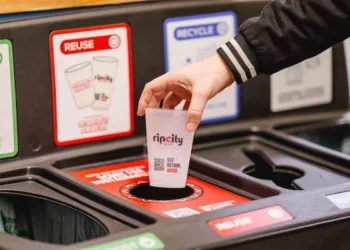





Imagine a customer at a neighborhood cafe ordering an iced coffee to go. The barista hands her the drink in a 100% recycled plastic cup. The customer sees the recycled content label and feels good about the purchase as well as the wider plastics supply chain.
Five years ago, three companies shared a vision that such a scenario would one day be possible – and common. We came together to help advance technologies that could convert used plastics into new materials and products. These companies saw great promise in the inherent value of plastics that weren’t being traditionally recycled, beyond simply sending them to landfills.
We were and are innovators in using pyrolysis – the thermal treatment of plastics in the absence of oxygen – to create a range of valuable products out of plastics that were not being recycled using traditional methods. Products such as naphtha, lubricants, jet fuel and even the raw material monomers to create new polymers/plastics in a never-ending circular loop.
Companies engaged in this type of business model formed a group at the American Chemistry Council (ACC) for practical reasons: The technology provides a solution for post-consumer plastics. Today there are eight companies in what is now called The Chemical Recycling Alliance, and those businesses represent the growing value chain engaged in the business of creating new products from used plastics.
The Chemical Recycling Alliance’s members are essential enablers in society’s push for a more circular economy and in the ACC’s goal of 100 percent of used plastic packaging in the United States being repurposed into new, valuable products by 2040. In addition, many brand companies and retailers have announced equally ambitious recycling goals.
To reach these objectives, all sorts of post-use plastic packaging will need to be recovered and repurposed into new products. The emerging technologies being developed and scaled by The Chemical Recycling Alliance member companies will significantly expand the paths to success.
From pollution to profitability
The opportunity in the chemical recycling sector is enormous, both environmentally and economically.
Every day we see new evidence of how improperly managed, post-use plastics lead to tragic results. Recovering and repurposing these plastics will keep them out of the environment. This is especially important and relevant in developing nations, which have been shown to be the source of most ocean plastics and whose economic growth has outpaced their ability to manage waste.
Strategies to recover and repurpose plastics – when implemented alongside other necessary steps, such as reducing plastic waste through reduction, reuse and innovative designs – can lessen negative impacts on the environment broadly. For example, compared to conventional diesel, making fuel from used plastics could decrease the use of traditional energy sources by 96 percent, according to a 2017 study from Argonne National Laboratory.
On the economic front, a recent report by Closed Loop Partners (CLP), an organization that invests in the development of the circular economy, found there is tremendous demand for the products of the emerging technologies that fall under the chemical recycling umbrella.
The opportunity in the chemical recycling sector is enormous, both environmentally and economically.
“Our analysis indicates that these technologies could meet an addressable market with potential revenue opportunities of $120 billion in the United States and Canada alone,” the report notes. CLP identified 60 technology providers with significant potential for growth, along with 250 investors and strategic partners engaged with them.
The CLP report in many ways heralds a tipping point: A critical mass of companies has developed multiple technologies (pyrolysis and beyond) to create valuable materials that can be repurposed into new products; a broad group of stakeholders is engaged and committed; the public and policymakers are eager for solutions.
So now it’s time for these technologies to make a presence, ramp up the scale, and create a more circular economy for plastics.
Examples of encouraging action
The holy grail in materials usage and management would be a completely circular business model – once a plastic molecule is in play, it would remain in play. We would perpetually “reincarnate” plastics. Below are some real-world examples of movement in this direction:
- The Agilyx facility in Tigard, Ore. chemically recycles used polystyrene packaging into its raw material: styrene. Americas Styrenics has publicly announced that it will use that styrene to make recycled polystyrene in multiple new products, including foodservice, creating a circular loop.
- Eastman can break down used polyester into its building blocks to make new polyester for food packaging and other products. The petrochemical company is also moving forward on a technology in which mixed plastics are deconstructed into hydrogen and carbon monoxide molecules that can then be used to create new products..
- Sabic declared that it will sell plastics derived from chemically recycled mixed plastics to Unilever and other companies to make packaging for food, beverage, personal care and home care products. This packaging in turn could be recovered and repurposed again and again.
And while these examples are noteworthy, there’s room for all sorts of products made from repurposed plastics. Both United and Delta airlines have announced ventures to produce fuels from used plastics. My company, Renewlogy, collects used plastics from multiple cities and creates beneficial products such as naphtha that can be used to make brand new plastic, diesel, and petrochemical products.
That’s one reason the previous names of The Chemical Recycling Alliance referenced plastics-to-oils or fuels or petrochemicals. That’s all still here.
“Chemical recycling” includes the creation of all sorts of “chemical” products with multiple end uses, including crude oil, diesel fuel, industrial products such as waxes and lubricants, petrochemicals and monomers. These are all valuable products and the technologies creating them help keep plastics out of the environment.
As Rick Wagner of Chevron Phillips Chemical Company wrote a year-and-a-half ago in this publication: “The choice of which products to make from chemically recycled plastics should be made by the ‘whole host of forces’ – with an eye toward the circular vision.”
So what’s needed to go from tipping point to a circular economy for plastics? Frankly, we need everybody on board to accomplish three things.
First, we need more states to join Florida, Georgia, Iowa, Tennessee, Texas and Wisconsin in updating old laws to attract investments in these emerging technologies. Second, we need brand owners and retailers to integrate the products of repurposed plastics into their new products and packages. Third, we need all parts of the value chain to invest in our shared vision of repurposing more plastics and join The Chemical Recycling Alliance.
It’s here where we will meet the Closed Loop Partners’ recent call to action: Recognize the opportunities to scale these innovative technologies and educate all stakeholders to create a more circular economy for plastics.
We can only do this together.
Priyanka Bakaya is CEO and founder of Renewlogy and chair of the American Chemistry Council’s Chemical Recycling Alliance.
The views and opinions expressed are those of the author and do not imply endorsement by Resource Recycling, Inc. If you have a subject you wish to cover in an op-ed, please send a short proposal to news@resource-recycling.com for consideration.