






A recent consumer survey from packaging producer ALPLA suggests that clearly worded recycling claims can have benefits beyond providing information, such as influencing buying decisions, increasing credibility and coloring brand perception.
In contrast, vague claims can lead consumers to make erroneous assumptions about packaging, hesitate on purchases or guess how to dispose of packaging – behavior closely tied to the phenomenon known as “wishcycling.”
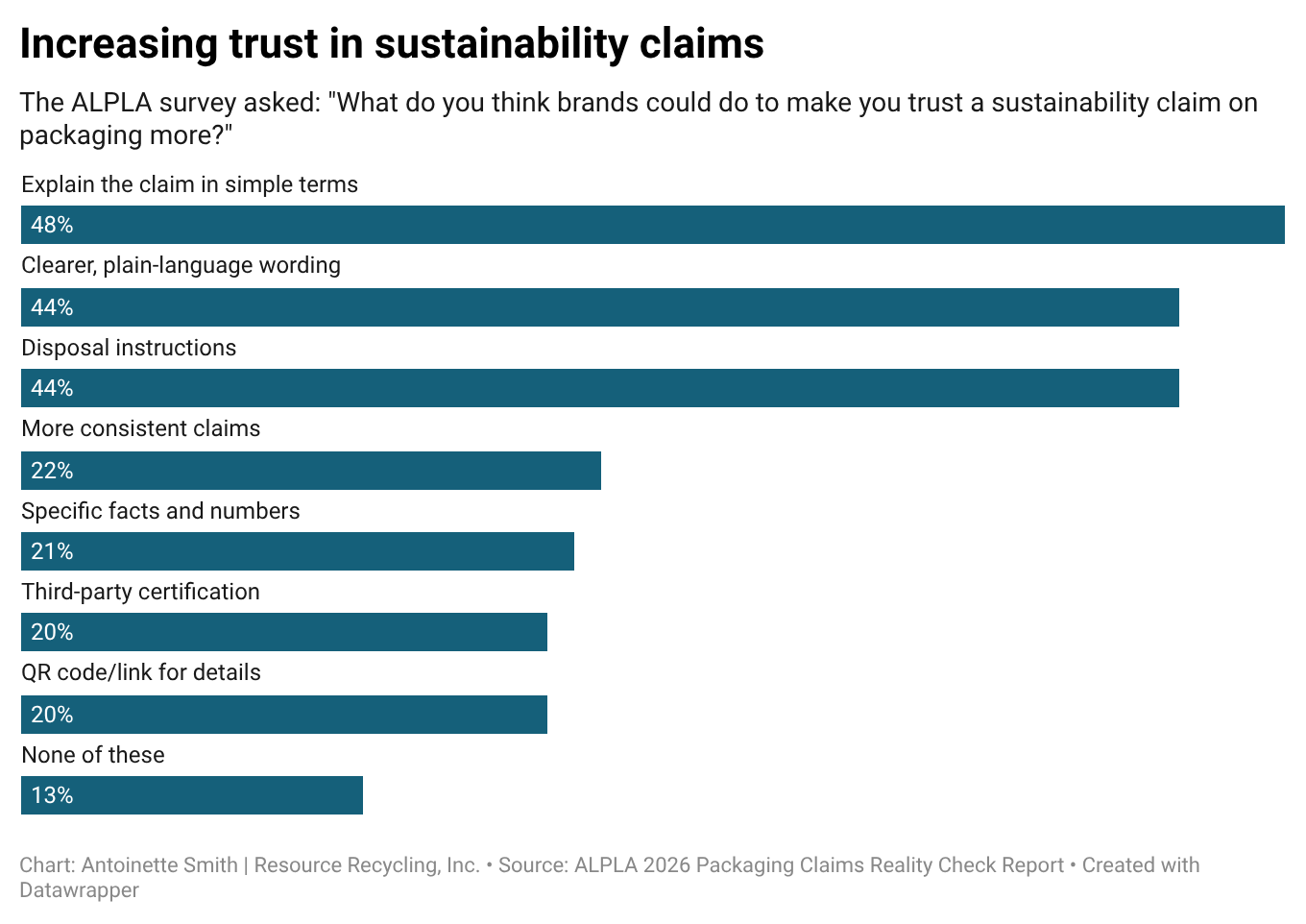
Of 1,000 Americans surveyed in April, nearly half (48%) said explaining claims in simple terms would increase their trust of sustainability claims, and respondents indicated a desire for clearer wording and specific disposal instructions (44% each). ALPLA partnered with the third-party survey platform Pollfish for the survey.
Specific to plastic packaging, this perception deficit means that even legitimate, accurate sustainability claims start at a disadvantage, the study authors said, adding that packaging type becomes a credibility cue when shoppers are deciding what to believe.
When the same sustainability message appears across different package types, 40% of respondents would trust the message most on a cardboard package, while another 40% would trust all package types equally. Hard plastic (6%) and soft plastic (8%) attracted far less default trust, the survey indicated.
Closing the perception gap requires consumer education that helps shoppers understand what may make a specific packaging format a more appropriate choice than alternative materials, over the full product lifecycle. To this end, ALPLA created the site Plastic Reimagined to provide consumer education.
Unclear terminology
The term “recyclable” is a common trouble spot for consumer understanding. Most respondents (64%) attach a meaning to “recyclable” that extends beyond “local acceptance.”
The survey also showed that shoppers don’t all read a label the same way. Under US guidelines, an unqualified “recyclable” claim is generally tied to whether recycling programs that accept the item are available to a substantial majority of consumers or communities where it’s sold. “In that context, it makes sense that about 36% interpret ‘recyclable’ to mean their local recycling program accepts the package,” the study said.
A recent example of the tension between definition and consumer assumption came from a study released by anti-plastics group Beyond Plastics that purported to disprove Starbucks’ use of the term “recyclable” for its polypropylene cold-drink cups. And although the group’s report left many questions unanswered, it also provided an opportunity for meaningful dialogue to improve processes and influence consumer behavior.
Emerging extended producer responsibility (EPR) programs for packaging, along with independent third-party certifications, aim to add transparency and accountability, and by extension could help improve understanding of labels. Examples include the new PCR content verification from the Association of Plastic Recyclers (APR), a new standard for responsible chemical recycling from SCS, ISCC Plus and traceability technology including digital product passports launching in Europe. (APR owns Resource Recycling, Inc., publisher of Plastics Recycling Update.)
But the extent that such transparency will resolve consumer confusion will take years to quantify. In addition, in the ALPLA survey 32% said there are too many labels and certifications to track and 30% said they don’t have time to research claims while shopping.
Likewise, “recycled content” can be misconstrued. More than a quarter of respondents (28%) assume “made with recycled content” means the package is made entirely from recycled materials.
As to what would rebuild trust in sustainability claims, respondents emphasized plain language and practical direction.
Takeaways for brand owners
The ALPLA study urges consumer brands to understand that packaging must explain both the claim and the next step. ALPLA emphasizes that packaging design, material choices and end-of-life guidance contribute to a consumer’s ease in understanding, and whether they find the claims credible and useful.
Clear and credible labeling can also bring benefits beyond sustainability. Almost 60% of respondents said an easy-to-understand sustainability claim makes them view a brand more positively.
In addition to finding labeling confusing, shoppers often read sustainability language primarily as marketing, more so than as an information source. “Unfortunately for brands, the most common response to that framing is ambivalence,” the report said.
Of the respondents, 44% said some claims were helpful and others were not, representing a middle band of consumers who could be convinced with accurate, clear labeling. “These shoppers haven’t written off sustainability claims and are still open to being persuaded. They’ve decided the quality is inconsistent rather than the labels being meaningless,” the study authors said.
Federal bills nod to consumer confusion
The survey results also suggest a need for harmonized rules around recycling labeling, possibly on a federal level.
In addition to emerging state legislation surrounding recycling claims, several bills introduced in Congress last winter seek to provide federal rules to pre-empt a potentially confusing “patchwork” of laws.
The Packaging and Claims Knowledge (PACK) Act aims “to establish the first voluntary federal standard for environmental claims on packaging and put an end to misleading ‘green’ labels that confuse consumers and undermine real recycling efforts,” according to Republican Texas Congressman Randy Weber, who introduced the act in December 2025.
Late July hearings on the PACK Act highlighted “the urgent need for a harmonized national approach to these packaging claims,” said Lynn Dyer, president of advocacy organization Ameripen. “Consumers deserve accurate and trustworthy information about recyclable, compostable, and reusable claims on packaging, verified by an independent third party. At the same time, manufacturers, retailers, and brand owners need a consistent framework that allows them to communicate accurately with consumers regardless of where their products are sold. The PACK Act provides a practical, commonsense solution that advances transparency, informs consumer decision-making, and supports efficient interstate commerce.”
The proposed Recycled Materials Attribution Act (RMAA) would establish national standards for marketing of recycled content, direct the Federal Trade Commission to update its Green Guides and authorize mass-balance accounting for chemical recycling.
The American Fuel & Petrochemical Manufacturers (AFPM), the American Chemistry Council, the Plastics Industry Association and the Vinyl Institute, along with other members of the Recycling Leadership Council, urged support of the RMAA amid recent testimony.
“There shouldn’t be 50 different definitions of what is or isn’t recyclable in this country,” AFPM said in a statement. “That type of patchwork confuses consumers and freezes investment in recycling and waste collection technologies, holds back innovative waste-reduction partnerships, and invites frivolous lawsuits.”