

This year has been a busy one for policy concerning e-scrap and electronics, with several dozen bills filed in states across the country.
Here’s a roundup of filed bills that touch on extended producer responsibility programs for electronics, batteries, solar panels and vapes, as well as right-to-repair legislation and studies on critical metals.
EPR for electronics
There are a dozen active bills on EPR programs for electronics. Some are updates and expansions to current programs, while others seek to establish entirely new programs.
Alaska (SB 61), Arizona (SB 1419) and Massachusetts (SB 653 and HB 1015) are all seeking to set up new programs. The bills are all in committee in their chambers of origin.
Hawai’i has several similar bills in play to expand its current program. SB 1298, SB 987 and companion bill HB 906 would add peripherals and legacy devices such as facsimile machines, videocassette recorders, portable digital music players, digital video disc players or recorders, and household routers or modems. They would also require manufacturers to pay for convenient recycling options for consumers and allow them to coordinate with each other to meet the requirements.
SB 1298 is the furthest along in the legislative process: It passed out of the Senate and into the House on March 4 with a vote of 23-2 and is now moving though House committees. The other two remain in committee in their chambers of origin.
A pair of bills in Illinois (SB 2414 and HB 3098) would add home audio components and peripherals to the existing program and require manufacturers to provide consumer education. Both are in committees in their chambers of origin.
SB 591 and HB 931 in Maryland would add laptops, tablets, cell phones, computer CPUs, printers, scanners, facsimile machines, copiers and computer accessories to the program. The bills would also separate out a covered electronic device recycling account in the larger State Recycling Trust Fund and simplify the manufacturer registration fee schedule.
Finally, an advanced recycling fee would be added on July 1, 2027, to help fund the program, and a 13-person advisory council would be established. Both bills are in committee in their chambers of origin.
Minnesota introduced a cross-filed set of bills, SF 1690 and HB 1426, that would require a stewardship program for circuit boards, batteries and electrical products. Both are in committee in their chambers of origin.
In New York, AB 4234 would require that municipalities set up pilot electronics recycling programs in Nassau and Suffolk counties for one year. It is in committee in its chamber of origin.
And in Utah, the governor signed SB 217 on March 26. It defines “community collection events” and requires manufacturers to develop public education programs.
EPR for batteries
Batteries continue to be a hot topic, and 12 states are looking to regulate them in some way, from adding them to existing electronics stewardship programs to setting up separate programs.
States looking to establish EPR programs specifically for batteries and battery-containing products are Colorado (SB 163), Connecticut (HB 5019), Iowa (SF 545 and HF 726), Maryland (SB 686), Massachusetts (S 556 and H 968) , Nebraska (LB 309 and LB 607) and Oregon (HB 2062). All of those bills are still in committee in their chamber of origin.
Missouri (SB 593 and HB 1508) and New York (S 2178 and A 1324) are looking at programs only for batteries, not battery-containing products. Those bills are also still in committee in their chamber of origin.
Hawai’i has a set of bills in play (HB 332 and SB 391) that would establish a lithium-ion battery recycling working group in the state Department of Health “to assess recycling methods for small and medium format lithium-ion batteries.”
SB 391 passed from the Senate to the House on Feb. 28 with a vote of 23-0, but the House Energy and Environmental Protection Committee recommended on March 18 that the bill be deferred.
HB 332 remains in committee in its chamber of origin.
Right to repair
Sixteen states have introduced bills concerning the right to repair electronic devices, a jump from even a few months ago.
Those states include Alaska (SB 61), Connecticut (HB 6053), Florida (S 1132), Illinois (SB 122 and HB 2549), Massachusetts (SB 189 and HB 433), New Mexico (SB 69), New York (S 4655, A 3058 and S 6438), Rhode Island, (SB 60 and HB 5246), Texas (HB 2963, SB 2428 and HB 3682), Vermont (HB 161), Virginia (HB 2483), Washington (HB 1483 and SB 5423) and West Virginia (HB 2155).
In addition, HB 582 in Missouri would provide an extremely broad right to repair “consumer products” but doesn’t specifically mention electronic devices.
Washington’s HB 1483 passed into the Senate on March 4 with a vote of 94-1 and is now in committee. Both of Rhode Island’s bills have been recommended to be held for further study, while Virginia’s HB 2483 was recommended to be left in committee on Feb. 4. The rest are still in committee in their chamber of origin.
Indirectly related to the right to repair are Senate Joint Memorial 8 in Oregon, which requests that the Federal Trade Commission and the National Institute of Standards and Technology create a repair score system for electronics to display at the point of sale, and HB 386 in Pennsylvania, which would create a diagnosis, maintenance and repair score that manufacturers would be required to display on product packaging.
Those bills are still in committee in their chambers of origin.
Solar panels
Turning to solar panels, HB 320 in Georgia would ban disposal of the panels “by any manner other than by delivery to a collection or recovered materials processing facility or other recycling center.”
There are two similar bills introduced in New York (S 1346 and S 1502) that would set up EPR for photovoltaic panels – S 1502 also covers wind turbines and batteries – while SB 157 in Illinois would ban the disposal of panels in landfills.
All four of those bills are still in committee in their chambers of origin.
Other bills
In California, SB 235 would require a study on in-state collection, recycling, reuse and stockpiling of domestic consumption of precious metals and critical minerals, which under the bill would be due by Jan. 1, 2028.
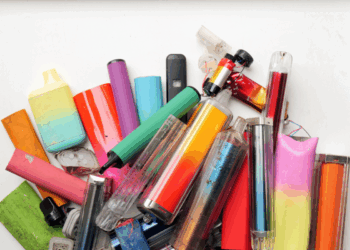
On the other coast, AB 3059 in New York would require vape manufacturers to create and submit “plans regarding the collection, transportation and recycling of electronic cigarettes.”
In the same state, S 6393 directs manufacturers of electronics and e-scrap collection sites to expand and improve their public education and outreach program, as well as provide updated convenience standards.
LD 754 in Maine would ban the sale of single-use electronic nicotine delivery devices and order a study on EPR options for vape-device batteries.
The bills are still in committee in their chambers of origin.