






North American waste and recycling facility operators, coming off their most dangerous year on record, aren’t getting any relief this year.
That’s according to Ryan Fogelman, who works as a fire prevention consultant at Fire Rover. His analysis of fire data found 56 publicly reported fire incidents took place in January and February across the United States and Canada. Thirty-one of those happened in February, the most Fogelman’s seen in that month since he started gathering data in 2016.
Incidents that Fogelman records are publicly reported incidents; as such, they’re generally assumed to be two-alarm fires or greater, he said, because otherwise they wouldn’t warrant the media’s attention.
The two nations saw 448 fires in 2025, he found in his 2025 annual report, causing more than $2.5 billion in damage. Fogelman said that number surpassed the previous record of 430 in 2024 and is nearly 25% above the annual average of 360.
A continued surge of disposable vaping devices – about 1.2 billion per year – is putting more volatile lithium ion batteries into the waste stream, he said. The market for pressurized nitrous oxide containers is also growing. The nitrous market now exceeds $400 million per year, with the U.S. Food and Drug Administration estimating more than 13 million people misuse them; designed as whipped cream chargers, their contents can be inhaled as an intoxicant.
“Those bottles are getting into the waste stream,” Fogelman said. “It’s getting worse.”
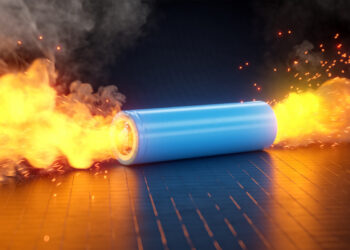
These devices act as grenades, igniting fires when put through waste-handling equipment.
“It’s not about safe batteries or unsafe batteries,” Fogelman said. “We are not gentle on our trash. If you beat them up, that’s what’s going to happen.”
Fogelman said players across many fronts can help mitigate the risk. Facility operators can properly separate waste piles and not overstuff their systems. Haulers can more safely handle these materials. Consumers can return devices for proper disposal to designated retailers instead of throwing them out.
Agencies such as the National Waste and Recycling Association can continue their pushes to educate the public. And manufacturers can make vapes with removable batteries to allow for safe disposal of the rest of the device.
“If manufacturers would make removable batteries, it would solve the entire thing,” he said. “You could remove the battery and return it. They don’t even understand what’s going on. We’ve got to get everybody to the table.”
The early numbers, he said, confirm his 2025 findings that a one-time “summertime spike” of fire-related incidents has flatlined into an elevated year-round risk.
“The reality is that the risks are increasing,” he said. “Yet the work must continue, as there’s no alternative when it comes to doing what’s right for society.”