
Canada-based Quantum Lifecycle Partners has launched an advanced plastics separation system designed to recover higher-quality polymers from end-of-life electronics, a move that reflects downstream processing investment alongside a wider shift in the company’s operating model.
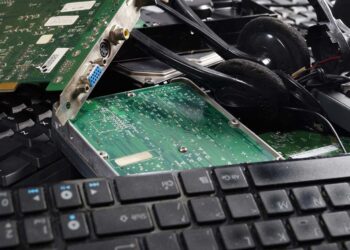
The new Advanced Plastics Recovery Line, which opened at Quantum’s Toronto facility on April 28, 2026, represents a $4 million investment integrated into the company’s existing $10 million electronics processing infrastructure. Described by the company as Canada’s most advanced plastics separation system for electronics recovery, it uses sink-float (wet density) separation technology to sort mixed polymer streams recovered from end-of-life IT equipment such as computers and printers. The output is clean, sorted e-plastic flake that meets Basel Convention standards for international trade, improving material purity and increasing the share of recovered plastics that can re-enter manufacturing supply chains.
The announcement aligns with ongoing pressure across the electronics recycling sector to extract more value from non-metal fractions, which have historically been more difficult to process economically. Heterogeneous polymer mixes, flame retardants, and contamination have long made electronics plastics one of the most challenging streams in the industry.
While metals recovery continues to anchor e-scrap economics, plastics recovery is receiving greater attention as OEMs pursue recycled-content targets and regulators increase scrutiny of mixed-plastic exports. For Quantum specifically, the investment is also linked to Ontario’s competitive Extended Producer Responsibility (EPR) framework, currently the only fully competitive EPR system for electronics in Canada, and to updates to the Basel Convention that have pushed greater emphasis on domestic processing over export of mixed plastic streams.
Beyond downstream processing
The plastics initiative sits within a broader corporate expansion strategy. Over the past several years, Quantum has completed a series of acquisitions and service expansions that extend beyond traditional IT asset disposition and recycling. These include additions in refurbishment, configuration, deployment, and reverse logistics capabilities, as well as facilities that support device processing and redistribution.
The January 2026 acquisition of 2NDGEAR, a U.S. technology lifecycle solutions provider, brought Quantum a key configuration and fulfillment hub in Albuquerque, New Mexico, focused on certified refurbished devices and education and commercial end-user programs. More recently, the April 2026 acquisition of the Device Lifecycle Management business and Jacksonville, Florida facility from Red8 added a 35,000-square-foot East Coast technology center with capabilities in device intake, inventory management, imaging, configuration, kitting, and reverse logistics. Earlier, the acquisition of Ontario-based DCR Systems Group expanded Quantum’s Canadian footprint with managed IT deployment, technology rental, repair, and asset disposition services.
Together, these capabilities are distinct from conventional ITAD operations, which are typically centered on collection, data sanitization, and resale. The integration of these businesses points to a shift toward lifecycle management services that begin earlier in the device lifecycle and extend further downstream into reuse and redistribution.
US footprint signals geographic expansion
The addition of facilities in Albuquerque and Jacksonville provides Quantum with operational nodes in the United States that support configuration and fulfillment activities alongside material processing. Combined with its Canadian operations and a facility in Costa Rica that serves Latin America, the company now operates an integrated North American and Latin American network.
The expansion positions Quantum to participate more directly in US enterprise and institutional device programs, including education-sector deployments and commercial fleet management. These segments often require integrated services such as imaging, staging, and logistics coordination, capabilities that go beyond traditional recycling infrastructure. The company has specifically highlighted BPO and distributed workforce environments as target use cases for pre-configured, fully kitted device deployment.
The presence in both Canada and the US positions the company to operate across cross-border reverse supply chains, which are increasingly relevant as organizations centralize device procurement and retirement strategies.
Convergence of ITAD, reuse and materials recovery
Taken together, the plastics recovery investment and the company’s acquisition activity point toward a model that combines multiple layers of the electronics lifecycle. At the upstream end, device collection and data destruction remain core functions. In the middle of the chain, refurbishment, remarketing and redeployment services are expanding. At the downstream end, investments in material recovery, including plastics separation, aim to extract additional value from residual streams. The model reduces dependence on any single revenue stream, particularly commodity recovery or resale pricing.
This convergence reflects broader dynamics in the sector. ITAD providers are under pressure to improve recovery rates, increase transparency, and support customer sustainability goals, while also managing margin variability tied to commodity markets and resale values.
Sector impact
Quantum’s trajectory illustrates a potential direction for large operators seeking to differentiate in a competitive and fragmented market. A model that integrates refurbishment, deployment, and material recovery can provide more control over asset flows and revenue streams, while also aligning more closely with enterprise requirements for circularity and reporting.
The approach also introduces operational complexity, requiring investment in logistics, processing technology, and service delivery capabilities across multiple segments.
The plastics separation system, a technical upgrade in its own right, fits within the company’s wider lifecycle strategy. It reflects a focus on extracting incremental value from materials while the company expands its role across the full electronics lifecycle.
As ITAD and electronics recycling continue to evolve, the degree to which operators can combine service breadth with processing depth is likely to shape competitive positioning across North America.