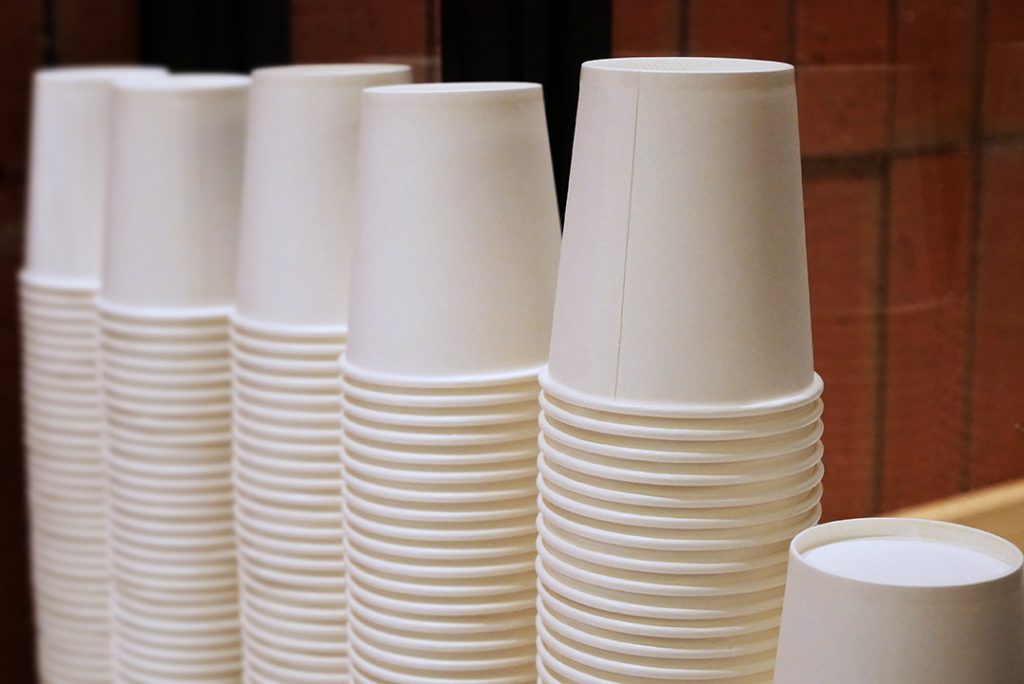
Paper cup recycling capabilities have quadrupled in the past decade, according to industry experts, with work ongoing to expand recycling services nationwide.
A report from the Foodservice Packaging Institute (FPI) trade association found that 20% of Americans live in communities in which single-sided (used for hot drinks) and double-sided (used for cold drinks) paper cups are accepted for recycling. That’s up from 5% in 2017 and includes 13 of the 20 largest cities nationwide, among them Philadelphia, Denver and Seattle.
“More communities are looking for practical ways to keep valuable materials out of landfills and give residents more recycling options,” said FPI President Natha Dempsey. “Achieving 20% access to recycling for paper cups demonstrates that more communities are committed to waste diversion and expanding services for residents.”
The figure was compiled by Resource Recycling Systems (RRS), an agency that offers material management services and was commissioned by FPI and the Sustainable Packaging Coalition (SPC) to do the study. RRS calculated the number by analyzing community recycling program guidance and industry announcements.
Paper cups have traditionally presented a challenge in terms of recycling because of the wax or polyethylene used in their waterproof coatings. Closed Loop Partners estimates around 250 billion paper cups are used each year globally, and only around 1% of those get recycled.
Several companies have taken steps to accommodate paper cups in their recycling waste streams and increase that percentage:
- WM has invested $1.4 billion in recycling infrastructure in order to accommodate curbside paper cup recycling.
- First Star Recycling in Omaha, Neb., began accepting paper cups curbside and at drop-off sites last year. So did LRS in Chicago.
- Casella capped off a two-year effort in January to accept paper cups across its 40-state footprint.
Technological upgrades at sorting facilities have allowed for paper cup recycling. Pulping systems can separate coatings from the paper fiber, resulting in a 70%-90% fiber feedstock yield. That’s allowed the Recycled Materials Association to add paper cups to its inbound residential single- and dual-stream specifications.
That milestone carries significance across the industry, according to GPA leadership.
“The inclusion of paper cups in ReMA’s specifications is the result of years of education and collaboration across the recycling value chain,” said Ed Tucciarone, the company’s procurement director, when the news was announced in summer 2025. “This is a win not only for our industry, but also for the environment and for companies pursuing sustainable packaging goals.”
Manufacturers are also doing their part to bolster recycling capabilities, FPI said. Graphic Packaging International (GPI), which provides more than a quarter of North America’s paper cup supply, operates specialized recycling facilities in Texas that can recover more than 95% of a cup’s fiber from up to 15 million cups per day.
“Expanding paper cup recycling access in the United States is a direct response to growing consumer demand for circular packaging solutions,” said Robert Rietbroek, GPI president and CEO. “Investments across the recycling value chain, including Graphic Packaging’s advanced fiber recovery technology, are helping turn used paper cups into new packaging for many leading household brands.”
The FPI’s Community Partnership program has helped find a new use for old cups since it launched in 2017. The program has partnered with more than 30 communities to expand foodservice packaging recycling capabilities, giving access to nearly 9 million U.S. households.
The FPI also founded the Paper Cup Alliance (PCA) in 2018, with GPI among its founding members. That group works to align supply chain partners and develop end markets for recycled materials. Its efforts led to a group of paper mill groups agreeing to accept recycled cups, growing the number of North American end markets from four prior to the PCA’s formation to 35 today.
“We are proud of the progress that we’ve made and the many partnerships that made it possible,” Dempsey said. “There is still more work to be done so that even more of the population can recycle their paper cups. FPI will continue to support efforts to strengthen end markets, increase collection and sorting, and improve communications within communities.”