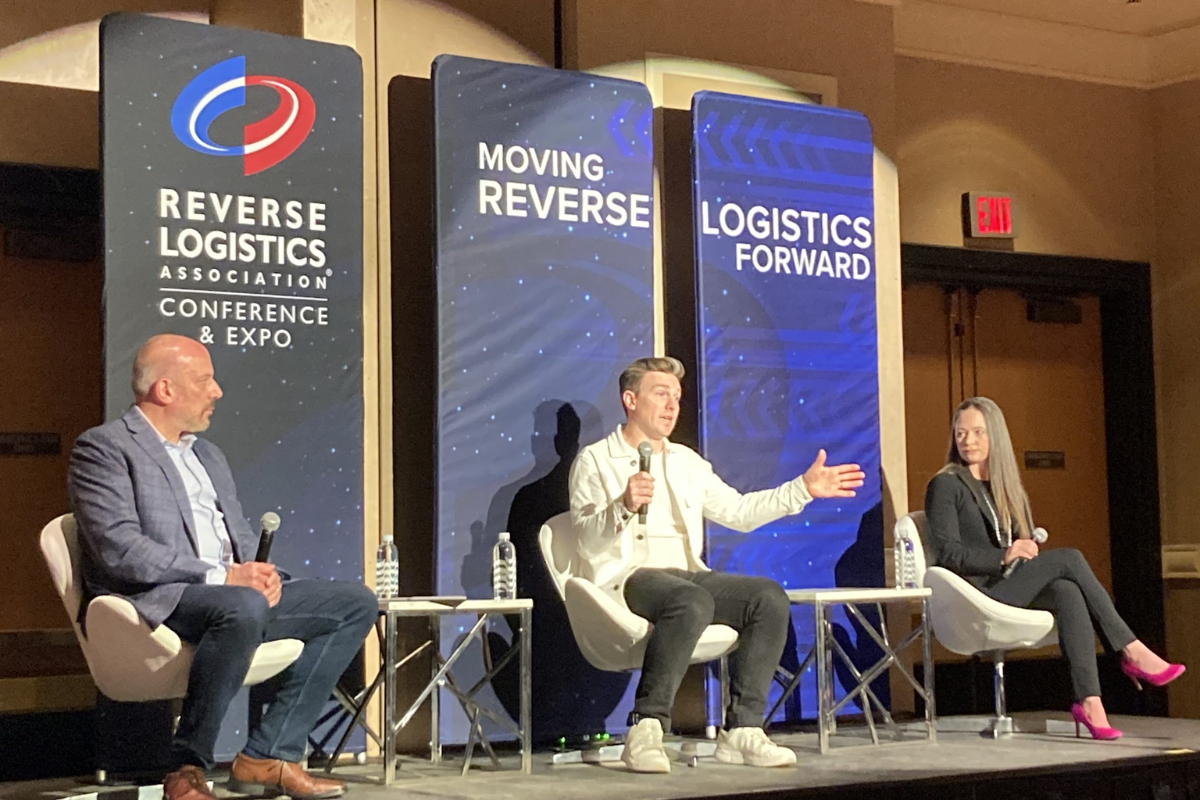
Data center decommissioning, right to repair, tariffs and the role of artificial intelligence in end-of-life product grading were hot topics during a meeting of reverse logistics professionals this week.
The Reverse Logistics Association Conference and Expo took place March 11-13 in Las Vegas, drawing IT asset disposition firms, electronics recycling certification groups, consultants and companies operating in other sectors.
The shared theme was an interest in efficiently and appropriately handling material after initial deployment, whether the asset is returned, retired or subject to a product refresh.
New outlets for reuse
The data center industry continues to see “exponentially huge” growth, said Sean Magann, chief commercial officer for Sims Lifecycle Services, driven by macro trends like migrating to cloud storage, ensuring redundancy of data storage, and adopting AI. Magann spoke during a Tuesday industry partners forum.
In response, data centers are experimenting with operational changes that can open the doors to new ITAD opportunities. Magann described previous norms in designing data centers to be able to handle peak loads all the time, which resulted in over-engineering the facilities and having large, mostly unused amounts of memory capacity.
More recently, data centers have begun shifting toward a design that allows lower permanent built-in memory capacity that still can handle those peak volumes. These facilities use a “memory pool,” a sort of shared extra memory capacity.
The opportunity for ITAD firms is that these memory pools can be outfitted with memory modules that are retired from their first use in other data center applications. For instance, Magann described how Sims is redeploying retired CPU servers from a data center customer.
“In the past, those (memory modules) either needed to be recycled or sold on the secondary market,” he said. “Now, those same (modules) are going back into the forward supply.”
Sims has redeployed 2.5 million memory modules in this way in the past two years, representing a potential value to the customer of hundreds of millions of dollars, Magann said. Additionally, data centers doing this aren’t competing with other companies to source equipment to outfit their memory pools – they’re simply reusing their own devices in a different way.
“This is not just a theory,” Magann said. “This is something that is happening right now.”
As a final bonus, Magann noted the failure rate of the redeployed memory modules is actually lower than when brand-new modules are installed. That’s because there is a “burn-in” process for new modules, a process Magann likened to breaking in a new pair of shoes.
Repair support lags
Device manufacturers have historically been less than favorable to the right-to-repair movement, which seeks to provide access to repair information, parts and tools to all consumers, not just OEM-approved repair providers.
But in recent years, there have been striking shifts by major OEMs like Apple and Google, both of whom have warmed – to some degree – to the repair sector. Apple designed the battery for its latest iPhone to be easier to remove, while Google has supported right-to-repair legislation at the specific state level.
“We’re hearing less and less in opposition from manufacturers,” said Gay Gordon-Byrne, executive director of The Repair Association, during the panel. “That’s been extremely helpful.”
Five right-to-repair consumer electronics bills have passed in U.S. states, providing repair guides and other resources for covered devices. During the industry partners forum, Gordon-Byrne noted her repair advocacy organization emphasizes bills that cover as many devices as possible.
“We don’t want bills that are just for cell phones,” she said. “That’s actually turned out to be low-hanging fruit: It’s pretty easy to get a bill done right now that just does cell phones,” and this has become even more true with the increasing OEM support, she said.
“That end of the spectrum is actually doing pretty well,” she said.
However, less progress is evident in the equipment that’s typically in data centers.
“There are some famous names I will not use, but they’re the big, old data center manufacturers, and they’re probably our strongest opponents right now,” Gordon-Byrne said.
Given those challenges, The Repair Association wants to work with ITAD firms in the data center decommissioning space, she said: “We’ve got multiple bills right now that include data center equipment that have been really hard to get through.”
Emerging tech can aid in grading
In the reverse logistics for electronics space, AI-equipped imaging equipment is increasingly useful for determining the condition of inbound devices.
“Being able to remove the subjectivity that humans bring to grading is good,” said David Watson, founding partner of consulting firm RL Equity, during a Wednesday session focused on automation.
One company that is actively using AI for device grading is Molg, a robotics firm that is working with Sims Lifecycle Services on data center decommissioning. Rob Lawson-Shanks, Molg CEO and cofounder, said image classification is a key AI ability that allows his company to determine the right track of disposition for a product.
“What someone grades at the beginning of their 6 a.m. shift might differ from what they do at the end of their 4 p.m. shift,” he said.
AI in device classification meshes with another industry goal: classification standards. Jennifer Foxworthy, director of certified refurbisher partner network and licensing at HP, noted standards can significantly differ from company to company. In her role as a buyer, she sees bulk loads of refurbished laptops that may contain devices in substantially different condition that all are marked Grade A.
“It really comes down to perception,” she said during a Wednesday session.
Beyond initial classification, AI also can help determine how to process a device. Magann noted that Sims used to think optical technology would provide everything the company could need. But the company realized that in working with some types of hard drives, the screws aren’t even visible; they’re embedded within the drive.
Dismantling the device involves getting a little deeper, and that’s where a technology like Molg’s comes into play: Its AI-equipped system can take note of when there are embedded screws, and it uses lasers to cut in and get to those fasteners.
There were two additional refurbishment and automation sessions in the first part of the conference: “Maximizing recovery value: Resale, refurbishment and liquidation strategies for retailers and manufacturers,” featuring HP, Logitech, The Home Depot and Liquidity Services, and “Automation meets reverse logistics: Driving innovation in supply chain management,” featuring PlanITROI, Amazon, the University of Nevada and DB Schenker. However, members of the press were not allowed to attend.
Tariffs draw focus during week of changes
President Donald Trump enacted, suspended or delayed several tariffs over the past two weeks, and the measures came up during several conference sessions.
Brian Comiskey, senior director of innovation and trends at the Consumer Technology Association, said the industry group has projected U.S. consumers will spend $537 billion in consumer technology purchases this year – but that figure does not take into account the recent tariffs.
“Our research shows that if tariffs continue to be enacted, you could see a reduction in that $537 billion figure by $90 (billion) to $143 billion in decline of U.S. consumer purchasing power,” he said.
As new consumer devices get more expensive, tariffs could drive demand for refurbished products, said HP’s Foxworthy. This could also drive the reverse logistics industry to become more regional than global. Watson of RL Equity said he’s already heard from companies that want to find domestic reverse logistics partners in the U.S. because of the tariffs.
But tariffs throw a major curveball at pricing projections, and that could be a problem for ITAD and other reverse logistics service providers.
“What you quote one day will be very, very different in two weeks’ time, three weeks’ time,” he said.
In the end, the only strategy may be to prepare for a great deal of uncertainty.
“Constant change is something we all need to get familiar with,” said Joyce Cruts, vice president of supply chain and operations at Acer.