





For a long time, the story of recycling has been purported to be simple – you just have to do X and it’ll all work out. X, of course, changes over the years.
If you just put some bins in the town square …
If you just installed a few optical sortation devices at some MRFs …
If you just teach the children how to recycle …
But there is no “if you just.”
“If you just” is magical thinking, plain and simple. And while the process of recycling might seem like magic on a YouTube video, we all know that it’s not. It takes a lot of interconnected parts to move the recyclables out of the trash can and into the recycling cart – and back into new goods – to enjoy the environmental and economic benefits that recycling can deliver in spades.
So, what does it take if you can’t just?
It takes a lot of work in a lot of sectors. But first you have to look at where the material is.
Mapping it out
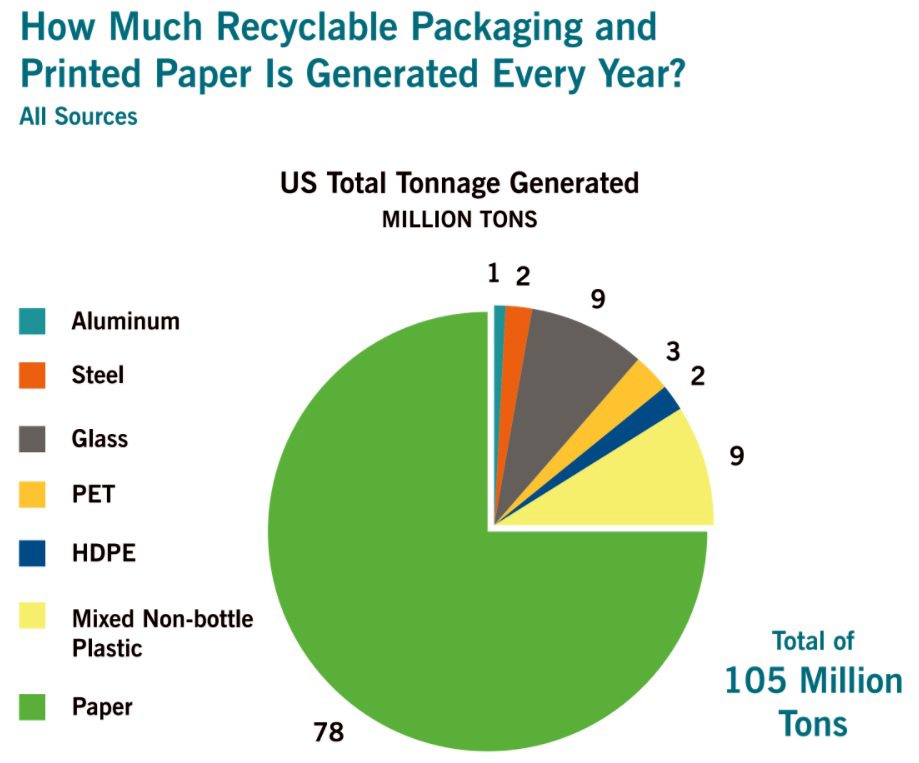
The Recycling Partnership looked for traditional recyclable materials most U.S. residents can put in their cart: cans, bottles, paper, cardboard, containers and cartons. Compiling different material-type generation sources, including our own and other studies of materials available at the curb, we calculated there are 105 million tons of recyclable packaging available to be captured in the U.S.
And we looked at where it was – 59 million tons are in the industrial, commercial and institutional (IC&I) sector, of which 70 percent (41 million tons) are estimated to be recovered. Looking to the multifamily sector, we see 9 million tons available in 30 million households. Our best estimates show a little less than 35 percent of that amount is being recovered. Then we look to the 95 million occupied single-family homes, where we see 36 million tons of recyclable packaging available to be recovered. Currently, we’re able to capture 14 million tons, which is just a little bit worse than a 40 percent clip.
We focus, for now, on the single-family home, because we can leverage existing multi-million-dollar infrastructure (think trucks and MRFs) and knowledge (the vast amount of intellectual capital has been banked in this segment of the recycling sector) to be able to get at that additional 22 million tons of recyclable packaging.
And there’s a lot of infrastructure to take advantage of. For example, research from Resource Recycling Executive Editor Jerry Powell presented at the Resource Recycling Conference showed there is ample capacity in existing single-stream MRFs in the U.S. to handle a third more material than they are currently managing. That’s a lot more material that doesn’t require huge investments.
How can we do it? Through partnering with communities to bring recycling collection where there is almost none, like we did in Columbia, S.C., or moving from tiny bins to 96-gallon carts that can more than quintuple the amount of recyclables collected, like we did for the Southeastern Oakland County Resource Recovery Authority (SOCRRA) in the Detroit area, Outagamie County, Wis., St. Paul, Minn., or Santa Fe, N.M.
Or working in big cities like Atlanta, Chicago and Denver to boost materials recovery via general (think billboards as well as social and traditional media pushes) and targeted (think cart tags) communications. Or using those communications channels to combat the biggest challenge in recycling today: contamination.
That’s contamination of the recycling stream with materials that should never be in the cart in the first place. Contamination including plastic film and bags that should head back to retail locations or dangerous goods such as lithium-ion batteries that should be taken to rechargeable battery take-back locations.
Measurement matters
So how did we measure this stuff? Over the last three years, we worked with partners such as DSM Environmental Services in Massachusetts and the Cascadia Consulting Group in those aforementioned big cities to measure impact at the curb via capture rate studies. Those capture rate studies allow us to look at what materials are available at the curb for those 95 million single-family homes across the U.S.
How do you measure a capture rate, you ask? You rent some box trucks and grab samples of paired recycling and trash carts in demographically diverse neighborhoods on collection days. Then you sort out what’s in ‘em, finding out what recyclables are in the trash and what trash is in the recycling to be able to measure what success looks like at the curb.
These capture rate studies allow us to both see which materials and behaviors need the most help and then help target those efforts. Does a community need to boost participation? We have tools for that. Does another need to get residents to put recyclables into the cart loose, instead of tied up in plastic bags that can give a MRF fits? Why, look at that – we have free tools and best management practices for that, too.
And we’re continuing to find partners and work on building this data set around the country – in different types of communities, as well. Because the industry needs new research and information, new tools and methods, new enthusiasm and assistance.
Capitalizing on human capital – together
Instead of “if you just” or “but, no,” we need a lot more of “yes, and.”
We know there needs to be more infrastructure, and we are working to place it throughout the U.S. (400,000 carts and counting).
We also know that there needs to be a lot more help. We can place those almost-half-million carts, but there still needs to be the human capital to back it up. That’s why our staff has worked with almost 600 cities providing technical assistance to improve programs.
That’s why we give out programmatic best management practices for free. And we work with cities and states around the country to give our expertise and support the 0.5 FTEs out there who need some easy wins to move recycling in their neck of the woods. And we’re champing at the bit to work with the thousands of other programs out there, to share and help and learn and – yes, and.
Which is why we have free six-point plans to help combat contamination and help shield local programs from China’s National Sword and scrap ban.
What do we have to do? We can’t just. We have to do more. And we’re here to do it with you. Because you’re all where it’s at, and we’re coming to you.
The views and opinions expressed are those of the author and do not imply endorsement by Resource Recycling, Inc. If you have a subject you wish to cover in an op-ed, please send a short proposal to news@resource-recycling.com for consideration.