




Resource Recycling
  • The Latest
  • Podcast
  • Analysis
    • All
    • Certification Scorecard
    • Industry Announcements
    • Opinion

    E-scrap feedstock competition mixed amid investments

    Open pit copper mine in Arizona.

    Trump touts aggressive US critical mineral goals

    From claims to custody: PCR procurement grows up

    Certification scorecard — week of Nov. 16

    Adam Gendell

    PET producers ride ‘local for local’ wave

    May pricing bullish for most bales

    HDPE resists seasonal, economic forces

    IT asset disposition and electronics recycling: Now and then

    Data center moratoriums cast development shadow

  • Conferences
    • Resource Recycling Conference
    • Plastics Recycling Conference
    • E-Scrap: The Longevity Conference
    • Textiles Recovery Summit
  • Publications
    • E-Scrap News
    • Plastics Recycling Update
    • Policy Now
    • Resource Recycling
    • Other Topics
      • All Topics
      • Brand Owners
      • Critical Minerals
      • Glass
      • Grant Watch / RFPs
      • Markets
      • Organics
      • Packaging
      • Research
      • Technology
      • Textiles
Subscribe
No Result
View All Result
Resource Recycling
No Result
View All Result
Home Plastics

How EPR and policy is reshaping WM’s facilities

Stefanie ValenticbyStefanie Valentic
October 5, 2026
in Plastics, Policy Now

Photo Courtesy of Circular Materials

When Ryan Nordt started in the recycling business in 2003, newspapers dominated what arrived at material recovery facilities.

Two decades later, the inbound stream at WM’s recycling facilities looks almost nothing like that, and Nordt, executive director of recycling operations at WM, says the pace of change is accelerating, with policy now among the forces driving it.

“Things are changing a lot quicker now than they did even 10 or 15 years ago,” Nordt told Resource Recycling. “The rate of change has increased, and policy could be an additional catalyst.”

Reshaped by e-commerce

Online shopping has pushed more plastics and cardboard into curbside carts, along with packaging formats that leave residents unsure what belongs in the bin. WM’s answer has been to simplify outreach around shapes rather than resin identification codes: empty, clean bottles, cans, cups, tubs, paper and cardboard.

Cardboard volumes in particular are “exploding,” Nordt said. Some retailers are adjusting, shipping in original product boxes, using smaller boxes and swapping plastic mailers for paper envelopes that fit easily into curbside programs.

Brands want their packaging on recyclable lists, and extended producer responsibility (EPR) laws rolling out in several states are adding pressure.

“One of our goals at WM is to ensure the materials coming through our recycling facilities go to responsible end markets. When we add new materials to our acceptable items lists, that is done in concert with strong demand from our customers,” Nordt said.

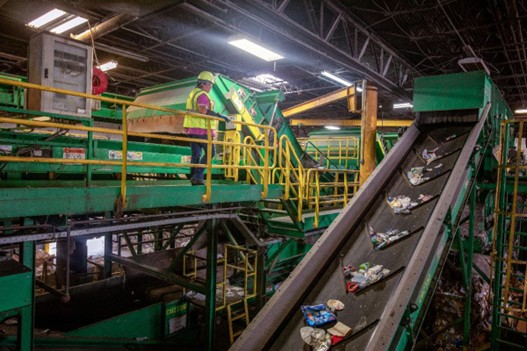
WM has invested ahead of that shift since 2022, bringing new facilities online and upgrading others, including its Germantown, Wisconsin recycling facility. From 2022 through 2027, WM plans to invest more than $1.4 billion to build new and update existing recycling facilities with state-of-the-art technology to increase the amount of materials that can be recycled and reused in other packaging and products. 

Optical sorters installed during that buildout have given the company more flexibility to accept additional material types, according to Nordt.

Proving polypropylene

WM has accepted polypropylene (PP) since 2010, but for the past 18 months it has concentrated on a single item: the PP cold cup used by coffee chains and quick-service restaurants.

The company now sorts more than 100 million of those cups a year, mostly with optical sorters, though a few facilities still pull them by hand. Demand has been strong from KW Plastics in Troy, Ala., and from PureCycle, whose Ironton, Ohio, plant converts PP into food-grade resin. Nordt said he has seen prototype clear beverage cups made with post-consumer resin.

Reports that placed tracking devices in cups and followed where they went have fueled claims that the cups aren’t recycled, yet the methodology to gather the data is disputed.

“Putting 50 or 100 trackers in cups and wondering where they’re going isn’t the way to figure out if things are recyclable,” he said.

After one such report, WM contacted KW Plastics, which photographed bales with cold cups in them and provided those photos to illustrate that cold cups are being recycled at their facility. Nordt also said he personally sorted 400 cups in 90 minutes at one of WM’s facilities.

Nordt said the tracker studies also misread how the cups are used. At Starbucks, he said, about 75% of beverages are served in cold cups, and most are consumed in transit after drive-through or mobile orders.

The relevant question for a “widely recyclable” designation is whether residents can recycle the cups at home, not whether stores do. The Widely Recyclable designation from How2Recycle is North America’s most recognizable on-pack disposal label, which means more than 60 percent of US residents have access to recycle plastic beverage cups curbside. 

Leading the charge

If the cup debate shows the industry’s messaging challenges, battery safety shows the opposite. Nordt called it an issue on which the industry is fully united.

WM has embraced the National Waste & Recycling Foundation’s “Skip the Bin! Turn Your Batteries In!” campaign, which launched in January with the US Forest Service’s Woodsy Owl. The initiative directs consumers to drop-off sites through BatterySafetyNow.org. In August, NWRA and NWRF announced a partnership with The Battery Network to expand the effort. WM has also deployed Fire Rover fire detection and suppression technology across its single-stream facilities to combat battery fires, Nordt said.

The company added a fourth rule to its Recycle Right program: no batteries in recycling or trash. It was the first new rule in “a long, long time,” Nordt said.

As Major League Baseball’s sustainability partner, WM also produced a battery safety video featuring MLB team mascots, slated to air during the postseason.

Beyond the potential for facility losses, Nordt pointed to employees, communities and first responders, and to public trust. If a fire takes a facility offline, residents lose the place their recyclables go every day.

Disposable vapes, which contain lithium-ion batteries, have become a particular flashpoint, as most of the country lacks collection systems for them.

End market outcomes

Looking ahead, Nordt expects legislation to shape the industry state by state, with EPR a patchwork everyone will have to navigate. “Every state’s a little different,” he said.

The goal of EPR is better quality and more volume over time, he added. But more volume only helps if the material has somewhere to go. Nordt pointed to PET, which he said had a difficult 2026, as evidence of why steady domestic end markets matter.

Recycled-content requirements is where he sees the biggest policy lever outside EPR.

“The piece of legislation that would help pull the supply through our facilities and into the hands of the brands prioritizing domestic recycled content could really be the accelerant to supercharge recycling,” he said.

Approximately 80% of what WM sells from its facilities, fiber and plastics alike, stays in North America, according to Nordt, and the company’s goal is to sell all of it in the US and Canada. Getting there depends on brands committing to ongoing purchases of recycled material.

“Recycling is more challenging today than it was 20 years ago, but the good news is there has been and will continue to be a lot of collaboration,” Nordt said. “It will take all of us working together, from collection and education to processing and strengthening end markets for recycled content. That collaboration is how we build trust in the system and continue moving recycling forward.”

Tags: CollectionEPRPETPolicy NowTechnology
TweetShare
Stefanie Valentic

Stefanie Valentic

Stefanie Valentic is an award-winning journalist who has covered the waste and recycling industry for more than five years. Throughout her career, she has led editorial teams and served as a keynote speaker, moderator and panelist at numerous trade shows and conferences.

Related Stories

Northeast recycled commodity values hit 5-year lows

Washington fines producers $246K for recycled content shortfalls

byStefanie Valentic
November 20, 2026

Washington regulators fined 38 plastic producers a combined $246,548 for missing the state’s minimum postconsumer recycled content (PCR) requirements on...

The AI tsunami

The AI tsunami

byJim Puckett
November 19, 2026

AI data centers and the devices they make obsolete could generate 8.6 to 13.1 million metric tons of e-waste a...

Thrift’s seat at the textile EPR table

byStefanie Valentic
November 19, 2026

Under California’s textile EPR law, every Goodwill in the state counts as a producer, even when new goods are under...

How to draw brand owners to recycled plastic

Connecticut redemption rate slips 8 points in Q2

byStefanie Valentic
November 19, 2026

Connecticut's beverage container redemption rate fell nearly 8 percentage points in the second quarter of 2026, from 86.6% to 79%...

A call to action: End markets and EPR

Recycling policy moves toward implementation

byAntoinette Smith
November 19, 2026

US EPR programs for packaging are starting up amid legal and operational uncertainty, said APR's Kate Bailey during a recent...

Electronics on a desk.

Blancco launches AI ITAD assessment tool

byDavid Daoud
November 18, 2026

Circulate combines diagnostic results with customer-defined grading rules and resale estimates to guide disposition decisions.

Load More
Next Post
In My Opinion: Producer fees in packaging EPR programs

Making the money work for EPR

2026 Buyers’ Guide

Equipment, services and technology suppliers serving the recycling industry.

Browse the Guide

More Posts

Closeup of PP with a chasing arrows recycling symbol.

PureCycle, WM sign rare 3-year bales contract

November 16, 2026

Goodwill eyes EPR revenue, starting with waste audit

November 12, 2026

Alphabet’s Materra wants recyclers to see molecules, not bottles

November 13, 2026
Solarcycle, Korea Zinc merge in critical mineral venture

Solarcycle, Korea Zinc merge in critical mineral venture

November 18, 2026

E-scrap feedstock competition mixed amid investments

November 19, 2026
RecyClass hits 500 EU recyclability evals

EU PET import codes set to begin

November 18, 2026
Open pit copper mine in Arizona.

Trump touts aggressive US critical mineral goals

November 19, 2026

Thrift’s seat at the textile EPR table

November 19, 2026
NexPoint Materials to shutter Alabama plastics plant

NexPoint Materials to shutter Alabama plastics plant

November 4, 2026
Adam Gendell

PET producers ride ‘local for local’ wave

November 16, 2026
Load More

About & Publications

About Us

Staff
Job Listings

Archive

Magazines

Work With Us

Advertise
Contact
Terms and Privacy

Newsletters

Get the latest recycling news and analysis delivered to your inbox every week. Stay ahead on industry trends, policy updates, and insights from programs, processors, and innovators.

Subscribe

Welcome Back!

Login to your account below

Forgotten Password?

Retrieve your password

Please enter your username or email address to reset your password.

Log In

Add New Playlist

No Result
View All Result
  • The Latest
  • Podcast
  • Analysis
  • Recycling
  • E-Scrap
  • Plastics
  • Policy Now
  • Conferences
    • E-Scrap Conference
    • Plastics Recycling Conference
    • Resource Recycling Conference
    • Textiles Recovery Summit
  • Magazines – Old
  • About Us
  • Advertise
  • Archive
  • Job Listings
  • Staff
Subscribe
This website uses cookies. By continuing to use this website you are giving consent to cookies being used. Visit our Privacy and Cookie Policy.