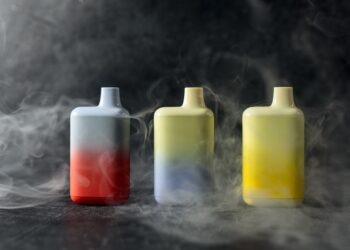
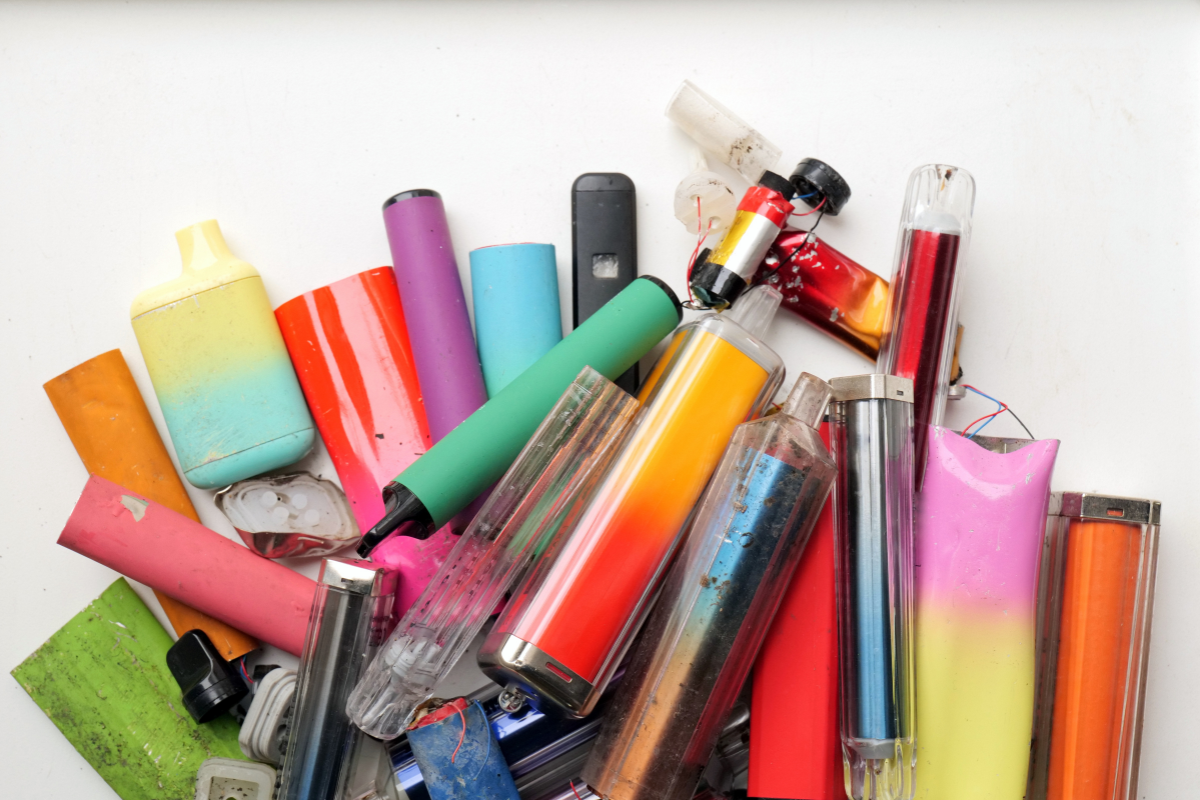
Disposable nicotine vapes will be off California store shelves by 2028 under a law Gov. Gavin Newsom signed Sept. 27.
AB 762, introduced by Assemblymember Jacqui Irwin (D-Thousand Oaks), bars the import and manufacture of new or refurbished disposable, battery-embedded vapor devices for sale in the state beginning Jan. 1, 2027.
Sales and distribution end Jan. 1, 2028. That gives retailers through the end of 2027 to clear their inventory.
Newsom also signed AB 2667. The companion measure gives schools a hazardous waste route for vapes confiscated from students. It also bans vapes designed to look like candy or school supplies.
“California has taken great strides to reduce waste and pollution in our communities, and I applaud Governor Newsom for signing AB 762 which is another step in the right direction,” Irwin said in a statement. “The convenience of these vapes cannot come at the detriment of our natural resources and the health and safety of our families and first-responders.”
She added that the state “is smart to redirect consumers to more sustainable options that are sold by many retailers around the state.”
AB 762 passed the Senate 30-9 on Aug. 25 and cleared an Assembly concurrence vote 47-16 the next day. Its co-sponsors were Californians Against Waste (CAW), CALPIRG, the California Product Stewardship Council and RethinkWaste.
Under the law, a device is disposable if it cannot be refilled or cannot be recharged. Meeting one standard is not enough to stay on shelves. The definition covers devices containing tobacco products, including nicotine. It excludes cannabis vapes and certain FDA-regulated medical devices.
That structure targets a workaround used in the UK. There, some manufacturers added USB-C charging ports to devices that still could not be refilled.
“If you’re not refillable or rechargeable, you’re disposable. So, you can’t get around that,” Nick Lapis, CAW’s director of advocacy, told Resource Recycling earlier this month. He said Altria was the bill’s biggest opponent.
Fines and license penalties
Cities, counties and the state can enforce the ban through escalating civil penalties. The fine is $500 for a first violation, $1,000 for a second and $2,000 for each violation after that. Every violation is also an infraction carrying a fine of up to $500, on top of any civil penalty.
Starting in 2028, disposable vapes also fall under the enforcement system California already uses for flavored tobacco. The California Department of Tax and Fee Administration or local police can seize the devices from licensed tobacco retailers.
The retailer then owes a $50 civil penalty for each device seized. A second seizure suspends the retailer’s tobacco license. A third revokes it.
Irwin’s office noted more than 12 million disposable vapes are sold nationwide each month. It also said more than 2,900 fires were reported at US and Canadian recycling and waste facilities in 2024, with vapes considered among the primary drivers.
The office tied those fires to higher insurance premiums and operating costs, which facilities pass on to ratepayers.
Tony Hackett, a policy associate at CAW, said the law puts the problem back on manufacturers. “The waste system shouldn’t have to clean up after an industry’s design choices,” he said.
Joe La Mariana, executive director of RethinkWaste, pointed to the 2016 fire at the agency’s Shoreway Environmental Center in San Carlos. “Ten years after the Shoreway fire, we know firsthand what a single lithium-ion battery can do,” he said.
A disposal route
AB 2667, by Assemblymembers Heather Hadwick (R-Alturas) and Buffy Wicks (D-Oakland), targets the vapes that pile up in school offices. Schools that qualify as very small quantity generators can now send confiscated devices to a local household hazardous waste facility. They need an agreement with that facility to do so.
Schools moving the vapes are exempt from the state’s hazardous waste transporter registration and manifest requirements. Public agencies, their contractors or registered haulers can also pick up the devices. Either way, the vapes must travel in closed containers marked with the school’s EPA identification number.
Collection facilities can accept only so much hazardous waste from small generators. To count vapes against those weight limits, schools and facilities may rely on US EPA guidance on e-cigarette disposal.
The Department of Toxic Substances Control must also study ways to make handling confiscated vapes safer and more convenient. That requirement expires Jan. 1, 2030.
The bill separately bans selling vapes built to imitate food, drinks, school supplies or clothing in order to hide them from parents and teachers. It also bans vapes with built-in video games. Penalties are $1,000 for a first violation, $2,500 for a second and $5,000 after that. Distributors face $50,000 per violation.