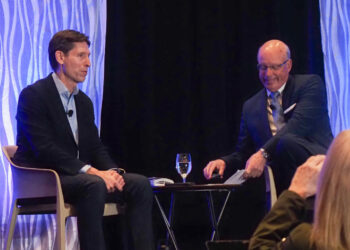







Producers will keep pushing end-of-life costs onto local governments until paying those costs is more expensive than redesigning their products, Heidi Sanborn told attendees at the National Recycling Coalition’s Circularity Forum in St. Louis, Missouri.
“We’ve got to make the money work for the right thing to happen,” said Sanborn, founder of the National Stewardship Action Council (NSAC). The 501(c)(4) advocates for extended producer responsibility (EPR) laws. Its sister 501(c)(3), the Stewardship Action Foundation, handles education.
Sanborn has worked on EPR since 2001, when she was in the chair’s office at California’s Integrated Waste Management Board.
Sanborn provided insight into two bills NSAC co-sponsored that Gov. Gavin Newsom signed this month. SB 501 adds medium-format batteries, including e-bike batteries, to California’s battery stewardship law. SB 936 bans sales of large nitrous oxide canisters. She said those canisters cost about $35 to buy and about $120 each to manage at end of life.
Battery fires are the more urgent problem, she said. Sanborn pointed to a lithium-ion battery fire at a San Mateo County facility. She said the fire shut the facility down for eight and a half months, led to 50 layoffs and cost more than $8 million to repair. The facility went from one insurer to seven, and now needs 16.
“I believe we’re getting really close to becoming an uninsurable industry,” Sanborn said.
Design follows cost
Sanborn’s core message was economic in nature. Source reduction sits at the top of every waste hierarchy, but no company makes money by making less, she said. Once producers have to pay for end-of-life management, design changes follow.
Her example was Hewlett-Packard. When HP began taking back its own laptops, it found that removing batteries held in with three different screw types drove up recycling labor costs. The company switched to a pop-out battery.
“Until they took them back, they didn’t know that,” she said.
She called California’s SB 54 the only US packaging law that addresses all three Ellen MacArthur Foundation circular economy principles. She cited its requirement that plastic producers pay $500 million a year for 10 years toward plastic pollution mitigation.
Sanborn also spoke on litigation. She described industry opposition as moving through stages of grief, now past anger and into what she called a “testing phase.”
The cases she referenced included:
- A 17-state coalition led by Nebraska’s attorney general, which Missouri joined, is suing to block SB 54.
- A federal court has enjoined SB 343, California’s truth-in-labeling law, on First and Fourteenth Amendment grounds.
- The National Association of Wholesaler-Distributors is appealing a ruling that upheld Oregon’s packaging EPR law, SB 582.
NSAC co-sponsored SB 343. Sanborn argued that misleading recyclability labels add sorting costs throughout the system.
She pointed to Alameda County’s drug take-back ordinance as precedent. The pharmaceutical industry challenged it on interstate commerce grounds. Lower courts upheld it, and the US Supreme Court declined to hear the case.
Sanborn said counties can impose EPR where there is a public health and safety connection, and she argued that some packaging now meets that test.
However, county-by-county EPR is not the goal.
“Industry didn’t come to the table, and they put themselves on the menu,” she said.
Hazardous packaging
Sanborn highlighted a concern still open under SB 54. Hazardous-product packaging is grouped with food-grade packaging. She said she has seen white LDPE pesticide containers labeled “triple rinse and throw in your bin.”
Colorado gave lubricant packaging its own alternative program, she said. She hopes California’s stewardship plan separates the two streams.
Her advice to local officials was practical. Take legislators on facility tours, frame EPR around cost savings rather than environmental benefits and support producers who comply.
“Just be like a bulldog,” she said. “Bite and shake.”