






This excerpt was published in the 2026 issue of E-Scrap News Magazine. Subscribe today for access to all print content.
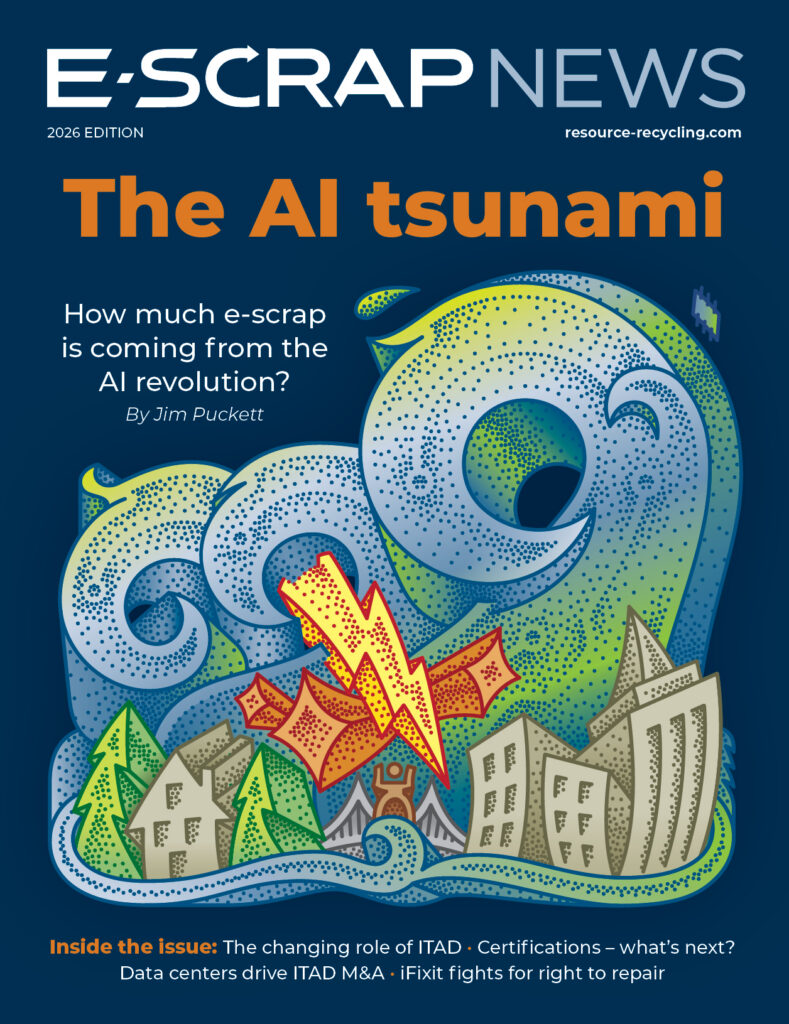
This is an excerpted, truncated version of Part 1 of a four-part white paper. The white paper is intended to be the first study to address the waste impacts of the coming AI buildout. In Part 1, we measure the full infrastructural footprint of AI data centers and the electronic waste they can be expected to generate or induce. In this version you will first find the key findings of the report, then a summation of our methodology, followed by a preview of the remaining story to come in Parts 2, 3 and 4.
Executive findings
Industry insiders project an expenditure of $7 trillion from 2025 to 2030 just to begin the build-out of the necessary infrastructure to power AI. $7 trillion is roughly the cost of ending world hunger for the next 75 years being spent in five. Or, the sum of money could instead fund a $10,000 higher-education trust for every child born on Earth (700 million children) during those five years.
That buildout to 2030 will equate, in energy terms, to roughly 219 gigawatts of total data center capacity — 80% more than what existed as recently as 2025. That is more than enough energy to power every home in the United States combined.
The AI buildout, now well underway, represents a paradigm shift in computing’s material footprint. The exhaustion of Moore’s Law, which delivered exponential performance gains by the steady improvement of individual chips (vertical scaling), has forced the industry to scale horizontally, deploying massive quantities of associated electronic infrastructure. This architectural shift across the planet will generate an unprecedented tsunami of rapidly obsolescent electronic equipment.
Why e-waste has been overlooked
Until now, environmental scrutiny of AI data centers has focused almost entirely on carbon footprint and freshwater consumption. The e-waste impacts, its likely toxicity, and its environmental justice implications have to date largely been ignored. This head-in-the-sand outlook exists even as we know that currently the world safely manages only one-fifth of the e-waste it produces, with much of it exported to developing countries to be mismanaged in substandard conditions in poorer communities.
The data center boom is well underway. 2030 is but four years away. The US alone has 4,871 facilities in the pipeline (821 under construction and 4,050 announced). Do the communities where these are being built realize that each of these centers will become point sources of hazardous waste, requiring disposal of massive amounts of this toxic waste every two–three years?
Previous quantitative AI e-waste estimates have underestimated the coming volumes as they focused overwhelmingly on servers and accelerators, which represent just 13% of a data center’s electro-mechanical infrastructure. This study identifies five equipment categories (including networking, power distribution, storage/backup and cooling), all of which total approximately 70,000 metric tons per GW of capacity. The previously uncounted 87%, the vast majority of which is also defined as e-waste, has never appeared in any AI e-waste projection of which we are aware.
The data center industry’s “cattle not pets” operational doctrine and rapid GPU generational turnover are already compressing AI equipment lifespans to 2.5–5 years, shorter than the normal lifespan of servers and related equipment, meaning the same infrastructure becomes waste far sooner than conventional replacement cycles would predict.
The paper introduces another overlooked AI e-waste category we call the AI waste contagion. This is electronic equipment retired outside data centers, induced when global AI adoption forces rapid replacement of PCs, phones, edge devices and telecommunications infrastructure at home and at work. In both our conservative and aggressive models of this phenomenon, this downstream contagion (16.2–30.7 Mt/yr) is expected to exceed the waste generated inside data centers themselves (15.5 Mt/yr).
By 2030, this study’s estimate of AI-driven electronic equipment being retired (8.6–13.1 Mt/yr) is roughly 40–60 times higher than the most widely cited academic projection (de Vries-Gao, 2026), primarily because prior work counted only servers and GPUs and did not consider the contagion effect.
Counting all sources (conventional and AI-driven), this study projects a total global e-waste generation of 196–211 Mt/yr by 2050 — more than tripling the roughly 67 million metric tons the world is producing today. Of the projected 2050 totals, 31–46 Mt/yr is attributable to AI waste alone. The cumulative AI-driven electronic equipment being retired between 2025 and 2050 (395–617 Mt) would fill 15–23 million 40-foot shipping containers. Placed end to end, they would circle the Earth about six times.
The pivot to hyperscaling
To understand a bit about why the numbers above are so large, it’s useful to understand what changed. While you won’t find it in any dictionary, “hyperscaling” is a term invented by the computing industry to describe the paradigm shift required today to achieve new frontiers of supercomputing. It means to scale horizontally without limit. Historically, the industry was able to scale vertically by improving each machine model, transistor or processor, at a constant rate of doubling power every two years (Moore’s Law). When that law finally hit the limit of physics around 2015, any desire to increase computing power demanded a different path — horizontal scaling, meaning thousands of chips running in parallel. One consequence of this paradigm shift is the proliferation of physical hardware. Rather than trending to miniaturization, more computing now means more stuff. And the stuff is more than just the computing devices.
What’s in a data center?
While most people expect AI data centers to be full of servers on racks, the hardware inside is far more than this. All of the specialized accelerators and servers need an even larger amount of infrastructure to allow them to operate. Based on a typical 100 megawatt AI data center, we estimate a total equipment mass of approximately 7,000 metric tons of hardware distributed across five categories: power supply and distribution (~34%, ~2,380 metric tons, including 2,700 metric tons of copper cabling and busbars); liquid cooling systems (most of which use water/glycol, though some use toxic fluorinated fluids) (~35%, ~2,450 metric tons); backup power — battery banks and diesel generators (~15%, ~1,050 metric tons); accelerators, servers, and racks (~13%, ~910 metric tons); and networking equipment (~3%, ~210 metric tons). And due to the integrated electronic controls on virtually all of it, this equipment is all likely to be considered as electronic waste under the international definition supplied by the Basel Convention.
Unprecedented volume x obsolescence
And that is one data center. Multiply that by the thousands of data centers projected in the global AI buildout and you have one major factor of the AI waste tsunami projection: volume, all largely driven by the global shift to horizontal scaling. The second factor driving the wave is rapid obsolescence rates. Each of the five equipment categories carries its own replacement cycle, but all of them we find are compressed well below traditional expectations. AI accelerators are on two–three year replacement cycles, down from the traditional five–seven years for general-purpose servers. Even cooling and power infrastructure, traditionally lasting 15–20 years, is expected to be replaced in five–eight years as facilities retrofit from air cooling to liquid cooling and upgrade power delivery for AI-density racks.
Due to the hyper competitive horse race now underway between the hyperscalers, we have a race of another kind: a race to rapidly replace fully functional, but less than state-of-the-art equipment as soon as possible, a race towards intentional hyper obsolescence.
Why previous studies projected far less
The previous efforts to quantify the AI electronic waste wave — Wang et al., de Vries-Gao, and Gröger et al. — counted only AI servers and, in Gröger’s case, power backup (see page 13). None included the power distribution infrastructure (34% of facility mass), cooling systems (35%), networking equipment, or (except Gröger) battery backup. Together, these non-server categories constitute 87 percent of the total equipment mass in a data center. The gap between BAN’s numbers and earlier studies is not a disagreement about methodology: it is a difference in scope. Counting servers alone is like estimating the scrap value of an automobile factory by weighing only the engines.
The AI waste contagion
And then there is another extremely important mountain of AI waste everyone forgot to count. Data center infrastructure is only part of the story, and, as it turns out, the smaller part. None of the published projections asks what happens outside data centers as a result of them. Everything the world will purchase and eventually discard in order to use what those data centers produce — the consumer devices, the telecommunications infrastructure, the edge computing hardware — constitutes a second, larger wave of AI-driven waste that no published study has attempted to quantify.
We call this the AI waste contagion. AI is already creating hard hardware thresholds that render existing devices functionally obsolete. Microsoft’s Copilot+ requires neural processing units capable of 40 trillion operations per second and 16 GB of RAM — specifications that exclude many PCs in current use. Gartner projects that 100 percent of enterprise PC purchases will be AI PCs by the end of 2026. We present this as conservative and aggressive models. The conservative model counts what consumers will have to buy to stay in the normal business of computing and communication. But then there is another measure, and that is forecasting what consumers will want to buy — to embrace the new thralls of gaming, immersive entertainment, and other untold forms of interactive engagement where AI creates a compelling choice if not an addictive one.
The “forever chemical” problem
Facilities that adopted two-phase immersion cooling face a particularly alarming situation. The fluorocarbon dielectric fluids used are PFAS “forever chemicals.” PFAS also find other uses in frontier data center hardware. The EPA has designated PFOA and PFOS as hazardous substances under Superfund law, and PFOS is listed under Annex B of the Stockholm Convention on Persistent Organic Pollutants. In the EU, a sweeping restriction on PFAS is under development. Early indications tell us that this new AI infrastructure increasingly will contain this class of persistent organic pollutants. We fear much of this new AI waste will in fact be hazardous waste. Do the communities where data centers are planned know this?
The rest of the story
So far in Part 1 of the BAN White Paper, we have sought to quantify the AI Waste Wave.
Part 2 will seek to quantify the potential for circularity strategies — reuse, refurbishment and repurposing — that might mitigate the AI waste crisis and the challenges to doing so. Will reusing the AI equipment save us?
Part 3 will examine just how dangerous this waste is likely to be — in particular, the growing role of PFAS “forever chemicals” in AI infrastructure, from semiconductor fabrication to cooling systems. Just how toxic will this new type of e-waste be?
Part 4 will address what we can do about it. To our knowledge, no hyperscaler — including AWS, Azure, Oracle, Google, Alibaba, or Meta — nor any government or international body has published a plan for managing AI-driven e-waste at the scale projected here. What can we do to mitigate the dangers ahead?