






Resource Recycling
  • The Latest
  • Analysis
    • All
    • Certification Scorecard
    • Industry Announcements
    • Opinion

    ITAD is moving past its adolescent phase: beyond end-of-life

    Rainforest

    Inside the Circle: What the rainforest can teach us about EPR

    Closeup of a printed circuitboard

    Hardware demand puts new focus on parts harvesting

    Rare look inside the world’s largest plastics recycler

    Mass balance matters: Why different rules can lead to different outcomes 

    Certification Scorecard — Week of June 1, 2026

    IT asset disposition and electronics recycling: Now and then

    $60 billion in AI servers will create an ITAD challenge

  • Conferences
    • Resource Recycling Conference
    • Plastics Recycling Conference
    • E-Scrap: The Longevity Conference
    • Textiles Recovery Summit
  • Publications
    • E-Scrap News
    • Plastics Recycling Update
    • Policy Now
    • Resource Recycling
    • Other Topics
      • All Topics
      • Brand Owners
      • Critical Minerals
      • Glass
      • Grant Watch / RFPs
      • Markets
      • Organics
      • Packaging
      • Research
      • Technology
      • Textiles
Subscribe
No Result
View All Result
Resource Recycling
  • The Latest
  • Analysis
    • All
    • Certification Scorecard
    • Industry Announcements
    • Opinion

    ITAD is moving past its adolescent phase: beyond end-of-life

    Rainforest

    Inside the Circle: What the rainforest can teach us about EPR

    Closeup of a printed circuitboard

    Hardware demand puts new focus on parts harvesting

    Rare look inside the world’s largest plastics recycler

    Mass balance matters: Why different rules can lead to different outcomes 

    Certification Scorecard — Week of June 1, 2026

    IT asset disposition and electronics recycling: Now and then

    $60 billion in AI servers will create an ITAD challenge

  • Conferences
    • Resource Recycling Conference
    • Plastics Recycling Conference
    • E-Scrap: The Longevity Conference
    • Textiles Recovery Summit
  • Publications
    • E-Scrap News
    • Plastics Recycling Update
    • Policy Now
    • Resource Recycling
    • Other Topics
      • All Topics
      • Brand Owners
      • Critical Minerals
      • Glass
      • Grant Watch / RFPs
      • Markets
      • Organics
      • Packaging
      • Research
      • Technology
      • Textiles
Subscribe
No Result
View All Result
Resource Recycling
No Result
View All Result
Home Plastics

Expert outlines rPET market evolution

Colin StaubbyColin Staub
February 1, 2017
in Plastics

Thermoforms are a growing factor in the PET recycling game, and the National Association for PET Container Resources wants to continue that trend.

Kate Eagles, NAPCOR program director, said the group’s goal is “to make recycling PET thermoforms as easy as recycling PET bottles, without disrupting bottle recycling infrastructure.”

In a webinar this week, Eagles touched on the state of the PET market, potential for growth and efforts to combat declining bale quality. She also delved into the opportunities and challenges associated with PET thermoforms. The webinar was organized by the Pennsylvania Recycling Markets Center and the National Recycling Coalition.

Room for growth

NAPCOR’s goal is to increase the overall supply of collected PET while reducing the contamination of PET bales. Eagles noted that 2016 was a challenging year for the recycling industry.

“So now, more than ever, we focus on market support, trying to remove obstacles to successful recycling,” she said.

PET recycling end markets are strong, Eagles said, with “quite significant” growth from 2004 through 2015. But there is plenty of room for more expansion, and the figures show it.

In their most recent report on PET recycling activity, NAPCOR and the Association of Plastic Recyclers (APR) noted that reclaimers processed roughly 1.5 billion pounds of PET bottles out of a collected 1.7 billion pounds in 2015 (thermoforms were not included in the study’s figures). That was out of a total of nearly 6 billion pounds of PET bottles sold into the U.S. market that year.

As of December 2015, the 28 PET reclamation plants operating nationwide had a combined capacity to process about 2.5 billion pounds of PET annually. That means “we have the capacity to process more material than we are typically collecting,” Eagles said, adding that the domestic PET processing infrastructure is “really quite robust.”

At the same time, while PET material collection is hovering right around 30 to 31 percent, the total amount of PET actually recycled has dropped. Out of all PET generated by consumers, the amount recovered and sold dropped from a 2013 high of 22.6 percent down to about 21.6 percent in 2015. There are a few reasons for that trend, but declining bale quality is a big one.

Quality control

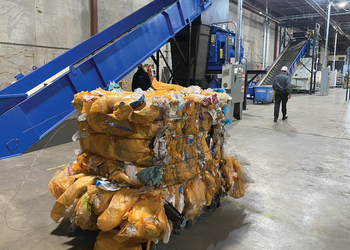
PET bale quality has declined due to increased single-stream collection, which increases overall volume but also increases contamination, Eagles said. Also contributing to the problem is an increase in packaging and labels that are not as recyclable as the PET bottle itself.

Lightweighting has also hurt the economics of PET recycling. Although it’s positive from a sustainability standpoint because less resin is used, it means the thinner containers can follow fibers during sorting. That reduces the volume of material available to make it into PET bales.

To begin addressing these issues, NAPCOR and APR came up with a grading system to rate bales based on the percentage of PET included. They also worked up an audit tool to rate a reclaimer’s output based on a representative sample.

“Let’s at least get a consistent way of talking about bale quality,” Eagles said.

Thermoform collection grows

Although NAPCOR is looking into several non-traditional PET recycling sources, including non-clear bottles, PET thermoforms will likely play a lead role in achieving supply growth in the future.

NAPCOR has been pushing measures to increase PET thermoform recovery since about 2007, when it opened up its membership to PET thermoform manufacturers. The percentage of PET thermoforms found in curbside and drop-off PET bales has risen from about 1.5 percent in 2009 to more than 6 percent in 2014. Figures for 2015 are not yet available, but Eagles predicted thermoforms could jump to more than 8 percent in bales.

PET bottles and thermoforms together can present problems. PET thermoforms can get caught up with other objects when they’re sorted into bales. And once recycling programs begin to accept PET thermoforms, they often see more thermoforms made of lookalike resins.

Although the percentage of PET thermoforms in bales continues to increase, Eagles said she doesn’t know of any reclaimers who are taking purely PET thermoform bales.

Last year, a study by the Sustainable Packaging Coalition found that PET thermoforms were accepted in recycling programs available to 60 percent of U.S. residents. That means PET thermoforms, which include common items such as clamshells, can carry unqualified “recyclable” label, per the Federal Trade Commission’s Green Guides.


 Van Dyk

Tags: Hard-to-Recycle MaterialsIndustry GroupsPET
TweetShare
Colin Staub

Colin Staub

Colin Staub was a reporter and associate editor at Resource Recycling until August 2025.

Related Posts

Various PET thermoform containers.

Thermoform recovery soars, PCR content falls

byAntoinette Smith
June 10, 2026

In its first standalone PET thermoform market analysis, NAPCOR examined production, recycling, PCR use and policy in North America.

House resolution aims to make recyclability central to product design

NY EPR bill fails to advance after third try

byStefanie Valentic
June 8, 2026

This marks the third session in which the bill cleared the Senate only to stall in the Assembly.

War, not demand driving polymer pricing

War, not demand driving polymer pricing

byAntoinette Smith
June 2, 2026

While prices for recycled commodities are tracking rises in virgin markets, few transactions are occurring, said an ICIS analyst.

PureCycle maintains price expectations for its R-PP resin

EPR clarity is driving brand demand, says PureCycle CEO

byStefanie Valentic
June 1, 2026

With SB 54 registered and lawsuits already filed, PureCycle CEO Dustin Olsen says the fight over what counts as recycling...

Film and flexibles recycling needs collaboration

byBrian Clark Howard
May 29, 2026

Experts from the Film & Flex Recycling Alliance, US Flexible Film Initiative (USFFI), Delterra, The Recycling Partnership and Circular Action...

California extends compostable labeling law

California bills crack down on false recycling, compostable claims

byStefanie Valentic
May 29, 2026

Three bills targeting recycling and compostables labeling have cleared key hurdles as California's session deadline nears.

Load More
Next Post
In other news: Sept. 8, 2016

In other news: Feb. 1, 2017

More Posts

Recycling industry addresses Beyond Plastics report

Recycling industry addresses Beyond Plastics report

May 26, 2026
House resolution aims to make recyclability central to product design

NY EPR bill fails to advance after third try

June 8, 2026
Fire at an EMR recycling facility in Camden, New Jersey May 29, 2026.

EMR faces shutdown calls after numerous fires

June 2, 2026
CalRecycle withdraws proposed regs for SB 54

Oceana, NRDC, CAW sue CalRecycle over SB 54 regs

June 5, 2026
IT asset disposition and electronics recycling: Now and then

$60 billion in AI servers will create an ITAD challenge

June 3, 2026
The independent ITAD at a crossroads

DMD acquires ITAD firm Lifespan, outlines acquisition strategy

June 2, 2026
Rare look inside the world’s largest plastics recycler

Mass balance matters: Why different rules can lead to different outcomes 

June 5, 2026
Circular Materials to supply PlasCred chem recycling plant

Circular Materials to supply PlasCred chem recycling plant

June 4, 2026
Our top stories from June 2021

Colorado advances EV battery EPR law

June 3, 2026
In My Opinion: Comparing the nation’s first packaging EPR laws

What Maine’s vape EPR law means for recyclers

June 4, 2026
Load More

About & Publications

About Us

Staff

Archive

Magazine

Work With Us

Advertise
Jobs
Contact
Terms and Privacy

Newsletter

Get the latest recycling news and analysis delivered to your inbox every week. Stay ahead on industry trends, policy updates, and insights from programs, processors, and innovators.

Subscribe

Welcome Back!

Login to your account below

Forgotten Password?

Retrieve your password

Please enter your username or email address to reset your password.

Log In

Add New Playlist

No Result
View All Result
  • The Latest
  • Analysis
  • Recycling
  • E-Scrap
  • Plastics
  • Policy Now
  • Conferences
    • E-Scrap Conference
    • Plastics Recycling Conference
    • Resource Recycling Conference
    • Textiles Recovery Summit
  • Magazine
  • About Us
  • Advertise
  • Archive
  • Jobs
  • Staff
Subscribe
This website uses cookies. By continuing to use this website you are giving consent to cookies being used. Visit our Privacy and Cookie Policy.