




Resource Recycling
  • The Latest
  • Analysis
    • All
    • Certification Scorecard
    • Industry Announcements
    • Opinion
    HP receives ocean plastics certification

    HP Inc. earnings point to memory inflation challenge

    Certification scorecard for the week of Feb. 23, 2026

    Umicore highlights strength in recycling, catalysis

    Apto, Tusaar partner on rare earths recovery

    Apto, Tusaar partner on rare earths recovery

    Certification scorecard for the week of Feb. 16, 2026

    Sims Lifecycle leverages hyperscale decommissioning

    Sims Lifecycle leverages hyperscale decommissioning

    The electronics recycling industry is undergoing a transformation from labor-intensive manual operations to highly automated, AI-driven facilities that use advanced robotics, cleaner chemistry and digital tracking systems to extract critical materials.

    The cyber-physical MRF: AI and robotics reshape e-waste recovery

    Certification scorecard for the week of Feb. 9, 2026

    Meta-Corning deal signals IT hardware retirement wave

    Meta-Corning deal signals IT hardware retirement wave

  • Conferences
  • Publications

    Other Topics

    Textiles
    Organics
    Packaging
    Glass
    Brand Owners

    Metals
    Technology
    Research
    Markets
    Grant Watch

    All Topics

Subscribe
No Result
View All Result
Resource Recycling
  • The Latest
  • Analysis
    • All
    • Certification Scorecard
    • Industry Announcements
    • Opinion
    HP receives ocean plastics certification

    HP Inc. earnings point to memory inflation challenge

    Certification scorecard for the week of Feb. 23, 2026

    Umicore highlights strength in recycling, catalysis

    Apto, Tusaar partner on rare earths recovery

    Apto, Tusaar partner on rare earths recovery

    Certification scorecard for the week of Feb. 16, 2026

    Sims Lifecycle leverages hyperscale decommissioning

    Sims Lifecycle leverages hyperscale decommissioning

    The electronics recycling industry is undergoing a transformation from labor-intensive manual operations to highly automated, AI-driven facilities that use advanced robotics, cleaner chemistry and digital tracking systems to extract critical materials.

    The cyber-physical MRF: AI and robotics reshape e-waste recovery

    Certification scorecard for the week of Feb. 9, 2026

    Meta-Corning deal signals IT hardware retirement wave

    Meta-Corning deal signals IT hardware retirement wave

  • Conferences
  • Publications

    Other Topics

    Textiles
    Organics
    Packaging
    Glass
    Brand Owners

    Metals
    Technology
    Research
    Markets
    Grant Watch

    All Topics

Subscribe
No Result
View All Result
Resource Recycling
No Result
View All Result
Home Recycling

Recycled pulp mill planned in Northeast US

Colin StaubbyColin Staub
June 30, 2020
in Recycling
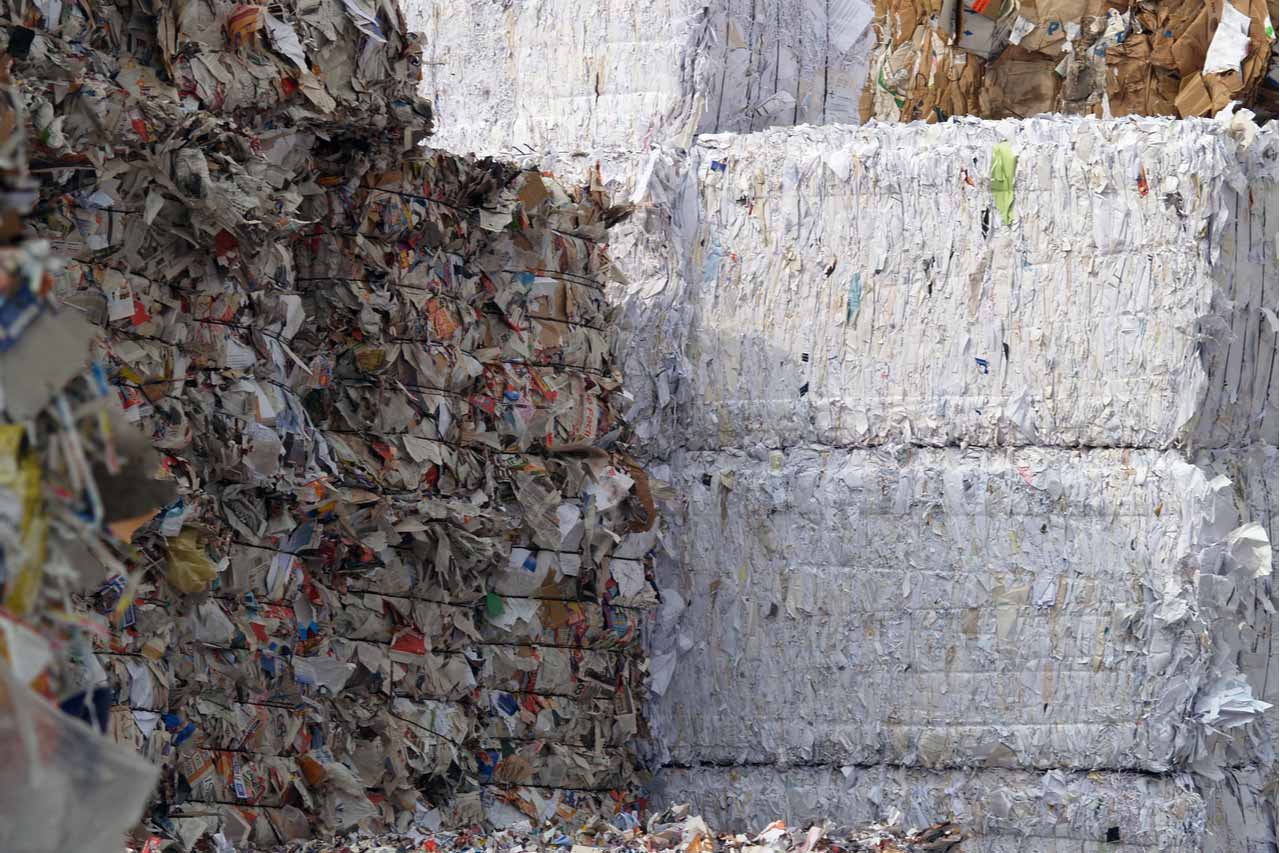
Once operational, the Empire Recycled Fiber mill will produce 440,000 tons per year of recycled paper pulp. | Luis M. Seco/Shutterstock

A $125 million recycled paper pulp mill in Pennsylvania will source more than 500,000 tons per year of mixed paper and OCC. The facility will ship its product to China.

The Empire Recycled Fiber mill is in development in Fairless Hills, Pa., on the site of a decommissioned steel mill complex. The facility will be looking to bring in 505,000 tons per year of recovered fiber from nearby regions, said Bill Moore of Moore & Associates. He presented on behalf of the project team during a recent virtual meeting of the Association of New Jersey Recyclers.

That feedstock will be 70% OCC and 30% mixed paper, Moore said.

The mill’s output will be 440,000 tons per year of recycled paper pulp, which paper manufacturers will use as a raw material. The mill will use “state-of-the-art” processing technology, Moore explained, to produce and dry the pulp to 10% moisture content. Then, the material will be wrapped, baled and exported to China.

The recycled pulp mill will fill a market void left in the wake of China’s National Sword import restrictions. Recovered fiber has become far more difficult to ship into China due to the policy actions, but pulp made from recovered fiber does not face the same import scrutiny.

Empire Recycled Fiber has a Chinese paper producer as an equity partner, and that same company signed a 20-year offtake agreement for the pulp. The project team has not publicly named the partner company, which holds a majority ownership in the Pennsylvania facility.

“You’ve always got to start out with a customer,” Moore said.

Empire will source scrap material primarily from eastern and central Pennsylvania, as well as New Jersey. The facility will also look to Maryland, Delaware and New York as secondary sourcing areas, Moore added.

The Pennsylvania mill is looking for long-term supply contracts, and it will begin buying recovered paper in late 2021 as the facility gears up for a 2022 startup.

Early work on the mill project began about a year ago, Moore said, and the team plans to close on financing during the third quarter of 2020. Full construction work is planned to start this fall and take a year to 14 months.

Once operating, the plant will employ roughly 110 full-time manufacturing employees.

Project leaders are already working with numerous recovered paper suppliers, including Waste Management, Canusa Corp. and more. The mill is looking for long-term supply contracts, Moore explained, and will begin buying recovered paper in late 2021 as the facility gears up for a 2022 startup.

Market shift drives opportunity

Substantial disruption in recovered paper markets contributed to the development of the Empire project.

Moore pointed to the ongoing decline in Chinese recovered fiber imports and the likelihood that the country completely closes the door to recovered fiber imports next year. These restrictions, Moore explained, have led to an unsustainable situation for the Chinese paper industry.

“They don’t have enough fiber to run their mills,” Moore said. As alternatives, the Chinese industry’s sourcing options are to increase domestic fiber collection, use more virgin pulp, use finished products such as linerboard, or import recycled paper pulp.

The first three options are taking place to some extent but are either not supplying enough material or are financially challenging. Domestic collection can only increase so much, Moore noted, because a substantial portion of containerboard boxes produced in China end up getting shipped abroad. And using virgin pulp and finished products carries significantly higher costs than raw recovered paper or recycled pulp.

The latter option is becoming more and more popular. China’s import restrictions do not extend to processed material made from recovered fiber, and in recent tariff talks the Chinese government lifted import duties on U.S. recycled pulp.

Chinese imports of this material from all countries quadrupled from 2016 to 2019, Moore noted, hitting nearly 1 million tons. Next year, he estimated, the country could import 3 million tons of the material.

Last year, a paper processing equipment supplier reported receiving numerous orders for recovered fiber processing plants outside China. Many of these operations have been located in Southeast Asia, where the proximity to China means fewer logistical hurdles. Pulp can be shipped in its wet form from Southeast Asian producers because the trip is short enough to avoid moisture-related damage to the material. Pulp originating further from China needs to be dried before transit.

Despite the greater distance, the U.S.-to-China model is taking off, as well. Pulp exports from the U.S. to China jumped from 16,000 short tons in 2018 to 239,000 short tons in 2019, according to U.S. export data. During the first four months of 2020, the U.S. shipped 94,000 short tons of recycled pulp to China.

U.S. mill operator Sonoco Products recently reported it shifted some of its recycled paperboard production capacity to instead produce recycled pulp, and the company has been shipping that material to China. Nine Dragons, the largest paper company in China, has purchased multiple U.S. recycled fiber mills in part to ship recycled pulp to the company’s manufacturing operations in China. Earlier this year, a separate recycled pulp facility project was announced in Chesapeake, Va.
 

Tags: AsiaPaper FiberTrade & Tariffs
TweetShare
Colin Staub

Colin Staub

Colin Staub was a reporter and associate editor at Resource Recycling until August 2025.

Related Posts

Borealis, Borouge aim to bolster PE, PP recycling in Indonesia

byPaul Lane
February 27, 2026

Plastics recycling in the Southeast Asian nation focuses on PET and on industrial and commercial waste, while post‑consumer polyolefin packaging...

Sony heads renewable plastic supply chain

Sony heads renewable plastic supply chain

byScott Snowden
February 19, 2026

Sony and 13 partners formed a unique global supply chain to make circular plastics for Sony high-performance audiovisual products using...

Carton recycling reaches 63% of US households

byScott Snowden
February 17, 2026

Carton recycling access rose to 63% of US households in 2025 after 2.5M homes gained service, with 86% of recycling...

UN trade data, tools aim to shape plastics treaty talks

UN trade data, tools aim to shape plastics treaty talks

byAntoinette Smith
February 17, 2026

UN agencies aim to use the harmonized trade data and a statistical framework to improve outcomes for the global negotiations,...

NERC: Blended average prices fell 40% in third quarter

HDPE, PP bales rise as paper fiber and cans stabilize

byRecyclingMarkets.net Staff
February 12, 2026

National average prices of post-consumer material bales were flat to higher on the month.

Alpek talks PET overcapacity, soft demand

byAntoinette Smith
February 11, 2026

Executives from the Mexico-headquartered polyester giant said the Chinese government has acknowledged issues and convened PET producers, but Alpek is...

Load More
Next Post
E-scrap processor dives deeper into plastics sortation

Study explores southeast state's contamination rate

More Posts

WM opens new $90m MRF in south Florida 

WM opens new $90m MRF in south Florida 

February 23, 2026
PET bales stacked for recycling.

Evergreen closing RPET plants in Ohio, New York

February 24, 2026
Battery fire risk isn’t going away. Insurance is responding

Battery fire risk isn’t going away. Insurance is responding

February 24, 2026
Chinese processing group details goals for US visit

AMP lays out vision of next-generation, AI-driven MRFs

July 24, 2024
Study links tagging tactics to lower contamination rates

Arizona, Reynolds reach settlement on Hefty bag lawsuit

February 23, 2026
Minnesota publishes prelim EPR assessment

Minnesota publishes prelim EPR assessment

February 20, 2026
How will 2026 unfold for plastics recycling?

How will 2026 unfold for plastics recycling?

February 19, 2026
Recycled plastic lumber firms report diverging results

Trex CEO to retire after 23-year run

February 25, 2026
Polyolefins producer provides PCR updates

Economic downturn forces LyondellBasell to trim sustainability goals

February 23, 2026
Where textile MRFs fit in a global recovery system

Where textile MRFs fit in a global recovery system

February 19, 2026
Load More

About & Publications

About Us

Staff

Archive

Magazine

Work With Us

Advertise
Jobs
Contact
Terms and Privacy

Newsletter

Get the latest recycling news and analysis delivered to your inbox every week. Stay ahead on industry trends, policy updates, and insights from programs, processors, and innovators.

Subscribe

Welcome Back!

Login to your account below

Forgotten Password?

Retrieve your password

Please enter your username or email address to reset your password.

Log In

Add New Playlist

No Result
View All Result
  • The Latest
  • Analysis
  • Recycling
  • E-Scrap
  • Plastics
  • Policy Now
  • Conferences
    • E-Scrap Conference
    • Plastics Recycling Conference
    • Resource Recycling Conference
    • Textiles Recovery Summit
  • Magazine
  • About Us
  • Advertise
  • Archive
  • Jobs
  • Staff
Subscribe
This website uses cookies. By continuing to use this website you are giving consent to cookies being used. Visit our Privacy and Cookie Policy.