




This article appeared in the November 2024 issue of Resource Recycling. Subscribe today for access to all print content.
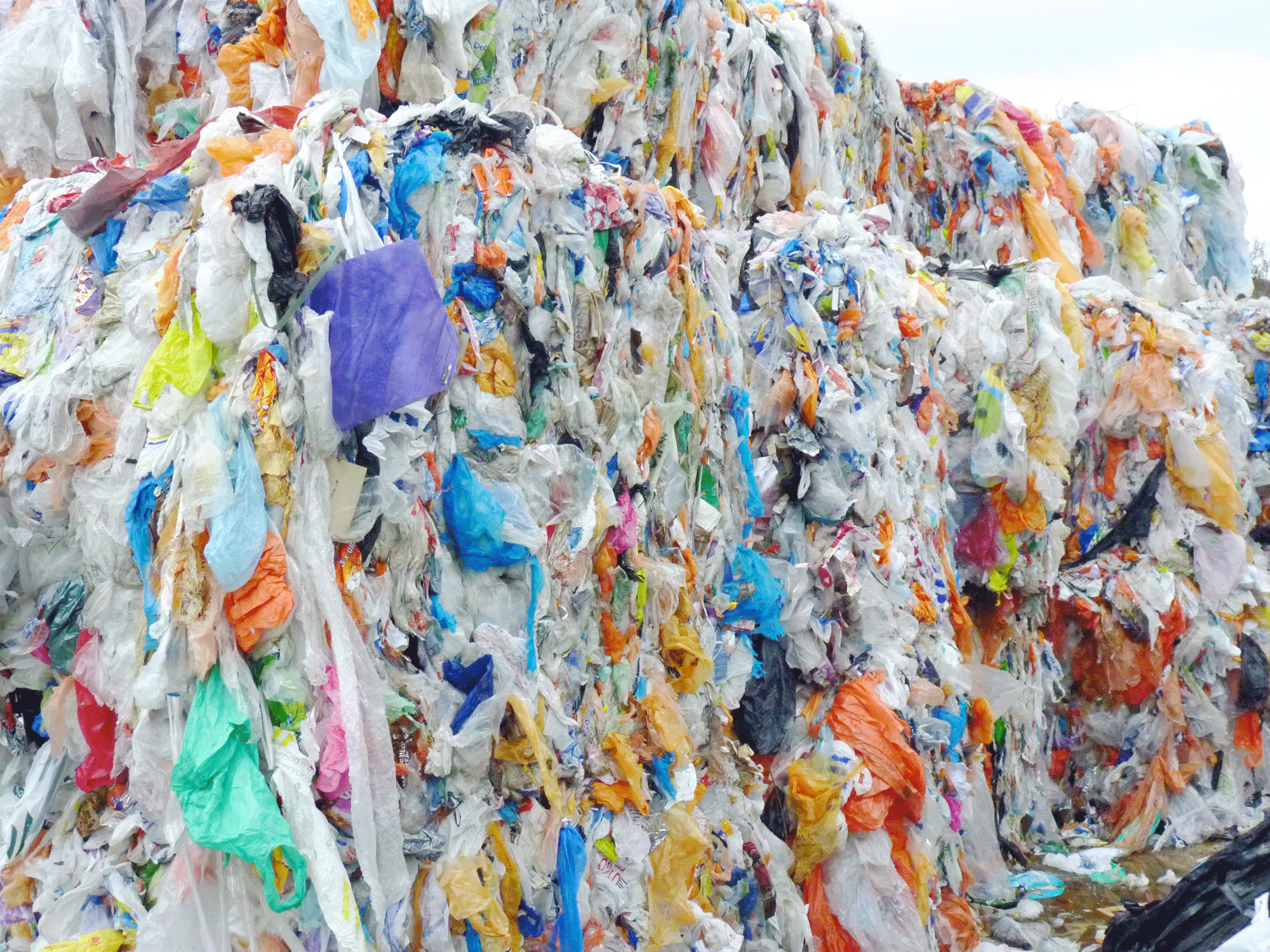
With slight differences across regions, some 30-40% of global plastics demand comes from packaging production. Low cost and functional properties make plastics an intriguing packaging solution. Yet it comes at a price from a climate perspective: With 90% of global plastics being made from fossil resources, our appetite for wrapping things in plastics takes a toll on the environment. In theory, plastics are well-suited for recycling, but there are various hurdles to turn this theory into practice at global scale, including the need to collect and sort, the limits of existing recycling technologies when it comes to impure, multi-material or layered materials, and demanding and sensitive plastic applications.
Considering the highly valued properties plastics offer and the limited availability in many cases of alternatives at scale, there is a wish to continue using them. Yet the question will be how can we make plastics production, use and waste management more sustainable. In parallel to recycling, do we have options to move from fossil-based to non-fossil based solutions?
I am convinced that there is reason for hope.
If it can be recycled, it should be recycled
Our priority should be to recycle whatever can be recycled. On the one hand, existing mechanical recycling has to be expanded. Whenever mechanical recycling can be done, it should be done. However, the aforementioned limitations of mechanical recycling lead to the need for new recycling technologies such as chemical recycling. Thus, whenever mechanical recycling is not feasible, for example due to waste streams being too mixed or impure — or the final products being too demanding quality-wise — chemical recycling can close the gap. A lot is happening in this regard.
At Neste, we are ourselves currently investing in chemical recycling capabilities at our refinery in Finland, focusing on turning liquefied waste plastic into high-quality raw material for new plastics, but other companies are also pushing new recycling technologies. Chances are good that this will enable us to increase recycling of plastics including plastic packaging in the future. But a question will remain: Will recycling be enough? Unfortunately not.
Demand for plastics and packaging is increasing at global scale. Aside from that, collection, sorting and recycling aren’t perfect processes. They come with material losses. Thus, even at a recycling rate of 100% (and we are currently only at some 10% globally!), we wouldn’t be able to meet the demand for new plastics just through recycling. Meeting the demand will require us to tap into other (renewable) material pools — and one of these is biomass.
Biogenic carbon is available in large quantities as a more sustainable feedstock
Plastics made from bio-based materials aren’t new, and there is a broad range of different approaches and technologies to turn biomass into polymers. They all share one basic concept and a common advantage, though: using biogenic carbon instead of fossil carbon, and as a result reducing greenhouse gas emissions over the lifecycle of plastics.
So let’s focus on the route of using bio-based waste and residues to achieve that goal, as this is also what we at Neste are experts on. Initially, we used these materials — for example, used cooking oil or residues from vegetable oil production — to produce fuels like renewable diesel or sustainable aviation fuel. We still do so, but the renewable hydrocarbon products our refineries produce can also be used to replace fossil naphtha or propane in the production of plastics. In fact, bio-based waste and residue oils and fats can be used to produce a one-to-one replacement for fossil plastics feedstock that can also be used in a blend with fossil feedstock. The plastics and chemicals produced that way are just the same as those made from conventional fossil raw materials, be it common polypropylene or polyethylene, PET or similar.
This is why we call it a drop-in solution: same performance, same characteristics, different raw material, different carbon footprint. The difference in the carbon footprint can be quite significant. Replacing fossil feedstock with bio-based feedstock may see GHG emissions plummet by more than 85% over the plastics’ lifecycle.
The question of scalability and availability
Plastics made with bio-based materials are not a vision but a reality already today. Neste alone — and we are not the only ones active in this field — has a production capacity for renewable products of 6 million tons, set to grow to 7.5 million tons within the next three years. Other providers are increasing their capacities as well, so there are good chances that bio-based materials can contribute to the defossilization of plastics, and thus plastic packaging, at industrial scale.
While production capacities are one thing, the required raw materials are another. The amount of commonly used waste and residue oils and fats is finite. Experts predict that the global availability of such resources could exceed 44 million tons annually from 2030 onwards. Considering the current global plastics production is somewhere around 440 million tons, this limited supply highlights a significant gap. Furthermore, it’s important to acknowledge that these oils and fats are not solely designated for plastics production; they are also utilized in manufacturing fuels and other products, emphasizing the need to explore alternative solutions. This means that further renewable carbon pools will be required. Research and development efforts are looking at various options for that, including algae, lignocellulosics or so-called novel vegetable oils, which are vegetable oils that do not compete with food and animal feed production and feature regenerative agricultural concepts. Aside from these bio-based options, a long-term alternative is Power-to-X, which converts CO2 and green hydrogen into hydrocarbons.
The time is now to pave the way for defossilization
The next years will be decisive to enable a future for fossil-free plastics and plastics packaging. New recycling solutions like chemical recycling are in a commercialization phase, and now is the time to ramp them up. While already available in large volumes, bio-based materials need to be incorporated at a broader scale throughout plastics production. These will be decisive factors to ensure that alternative solutions, on top of mechanical recycling, can play their role in defossilizing the industry in the long-term. I am confident it can be done.
Maiju Helin is head of market development for polymers and chemicals at Neste. Previously, she was head of sustainability and regulatory transformation and of stakeholder management for Neste’s Renewable Polymers and Chemicals business. Prior to Neste, Maiju worked at UPM Biofuels in various roles.
The views and opinions expressed are those of the author and do not imply endorsement by Resource Recycling, Inc. If you have a subject you wish to cover in an op-ed, please send a short proposal to news@resource-recycling.com for consideration.